
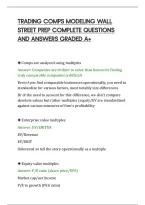
TRADING COMPS MODELING WALL
STREET PREP COMPLETE QUESTIONS
AND ANSWERS GRADED A+
◉ Comps are analyzed using multiples
Answer: Companies are trickier to value than houses bc finding
truly comparable companies is difficult
Even if you find comparable businesses operationally, you need to
standardize for various factors, most notably size differences
Bc of the need to account for this difference, we don't compare
absolute values but rather multiples (equity/EV are standardized
against various measures of firm's profitability
◉ Enterprise value multiples
Answer: EV/EBITDA
EV/Revenue
EV/EBIT
Unlevered so tell the story operationally as a multiple
◉ Equity value multiples
Answer: P/E ratio (share price/EPS)
Market cap/net income
P/E to growth (PEG ratio)
,Levered so tell the story operationally and leverage (before
interest, principal)
◉ Financial leverage differences
Answer: EV numerator is a measure of value independent of
leverage
Revenue, EBITDA, EBIT, and unlevered cash flow denominator
provide a measure of profit independent of leverage
◉ Accounting differences (depreciation method, useful life
assumptions)
Answer: Use profit metrics before D&A such as revenue, EBITDA,
unlevered free cash flows
Useful for companies with comparable levels of capital intensity
(otherwise dangerous)
◉ Temporary distortions (nonrecurring items)
Answer: When using multiples that use historical profits as
denominator, those profits must be "scrubbed" to exclude
distortive one time items such as restructuring expenses, ligation
costs, and one time gains on sale
◉ Other accounting differences (lease classification, LIFO v FIFO)
Answer: Must be treated on industry-specific basis
May require adjustments to both numerator and denominator
, ◉ Business life cycle differences
Answer: Comparable companies operationally may be at different
phases of their life cycle (early stage v. growth v. maturity v.
decline)
Multiples like PEG standardize against different LT growth rates,
while others like EV/Revenue and EV/EBITDA facilitate
comparisons for early-stage companies generating losses
◉ P/E ratio
Answer: Share price/EPS
Equity value/Net income
EPS used as a proxy for economic equity value
◉ P/E ratio issues
Answer: EPS is a measure of accounting profit only during a
particular period
Accounting profits can be misleading bc they include noncash and
nonrecurring items, and accounting assumptions (such as
historical v. market costing) and can be manipulated
Also high PE valuation relative to peers could be justified when
high PE firm has higher growth prospects
Less relevant for high growth companies
◉ P/E ratio most appropriate for...
Answer: Mature lifecycle companies
STREET PREP COMPLETE QUESTIONS
AND ANSWERS GRADED A+
◉ Comps are analyzed using multiples
Answer: Companies are trickier to value than houses bc finding
truly comparable companies is difficult
Even if you find comparable businesses operationally, you need to
standardize for various factors, most notably size differences
Bc of the need to account for this difference, we don't compare
absolute values but rather multiples (equity/EV are standardized
against various measures of firm's profitability
◉ Enterprise value multiples
Answer: EV/EBITDA
EV/Revenue
EV/EBIT
Unlevered so tell the story operationally as a multiple
◉ Equity value multiples
Answer: P/E ratio (share price/EPS)
Market cap/net income
P/E to growth (PEG ratio)
,Levered so tell the story operationally and leverage (before
interest, principal)
◉ Financial leverage differences
Answer: EV numerator is a measure of value independent of
leverage
Revenue, EBITDA, EBIT, and unlevered cash flow denominator
provide a measure of profit independent of leverage
◉ Accounting differences (depreciation method, useful life
assumptions)
Answer: Use profit metrics before D&A such as revenue, EBITDA,
unlevered free cash flows
Useful for companies with comparable levels of capital intensity
(otherwise dangerous)
◉ Temporary distortions (nonrecurring items)
Answer: When using multiples that use historical profits as
denominator, those profits must be "scrubbed" to exclude
distortive one time items such as restructuring expenses, ligation
costs, and one time gains on sale
◉ Other accounting differences (lease classification, LIFO v FIFO)
Answer: Must be treated on industry-specific basis
May require adjustments to both numerator and denominator
, ◉ Business life cycle differences
Answer: Comparable companies operationally may be at different
phases of their life cycle (early stage v. growth v. maturity v.
decline)
Multiples like PEG standardize against different LT growth rates,
while others like EV/Revenue and EV/EBITDA facilitate
comparisons for early-stage companies generating losses
◉ P/E ratio
Answer: Share price/EPS
Equity value/Net income
EPS used as a proxy for economic equity value
◉ P/E ratio issues
Answer: EPS is a measure of accounting profit only during a
particular period
Accounting profits can be misleading bc they include noncash and
nonrecurring items, and accounting assumptions (such as
historical v. market costing) and can be manipulated
Also high PE valuation relative to peers could be justified when
high PE firm has higher growth prospects
Less relevant for high growth companies
◉ P/E ratio most appropriate for...
Answer: Mature lifecycle companies


