
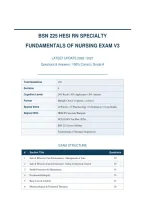
BSN 225 HESI RN SPECIALTY
FUNDAMENTALS OF NURSING EXAM V3
LATEST UPDATE
Questions & Answers | 100% Correct | Grade A
Total Questions 150
Sections 8
Cognitive Levels 20% Recall / 50% Application / 30% Analysis
Format Multiple Choice (4 options, 1 correct)
Special Items 20 Priority / 15 Pharmacology / 10 Delegation / 5 Case Studies
Aligned With HESI RN Specialty Blueprint
NCLEX-RN Test Plan (2026)
BSN 225 Course Syllabus
Fundamentals of Nursing Competencies
EXAM STRUCTURE
# Section Title Questions
1 Safe & Effective Care Environment - Management of Care 20
2 Safe & Effective Care Environment - Safety & Infection Control 20
3 Health Promotion & Maintenance 18
4 Psychosocial Integrity 15
5 Basic Care & Comfort 22
6 Pharmacological & Parenteral Therapies 20
,GRADE A - 100% CORRECT - LATEST UPDATE 2026/2027
7 Reduction of Risk Potential 20
8 Physiological Adaptation 15
TOTAL 150
- Nightingale College -
BSN 225 | Fundamentals of Nursing
BSN 225 HESI RN Specialty Fundamentals of Nursing Exam V3 | Nightingale College Page 2
,GRADE A - 100% CORRECT - LATEST UPDATE 2026/2027
Section 1: Safe & Effective Care Environment - Management of Care
Questions 1-20 | 20 Questions | Topics: client rights, advocacy, legal/ethical issues, informed consent, advance
directives, delegation, prioritization, SBAR, HIPAA, ethical principles, torts
Q1: A registered nurse (RN) on a medical-surgical unit is assigned four clients. Which client should the
RN assess FIRST? [PRIORITY]
A. A client who is 2 days postoperative with a temperature of 100.4°F (38°C)
B. A client with chronic obstructive pulmonary disease (COPD) whose oxygen saturation is 88% on
room air *[CORRECT]*
C. A client awaiting discharge instructions who has questions about medications
D. A client with type 2 diabetes mellitus requesting a snack before lunch
Correct Answer: B
Rationale: Using the ABC priority-setting framework, the COPD client with an SpO2 of 88% is experiencing a disruption
in oxygenation (Breathing) and is physiologically unstable. This client is at risk for respiratory failure and requires
immediate assessment and intervention. The postoperative low-grade fever (A) is expected within the first 48 hours; the
discharge teaching (C) and snack request (D) are routine needs that can be addressed after stabilizing the at-risk client.
The NCLEX-RN Test Plan emphasizes prioritization using ABC and Maslow's hierarchy of needs.
Q2: An RN is delegating care for the shift. Which task is MOST appropriate to assign to an unlicensed
assistive personnel (UAP)? [DELEGATION]
A. Teaching a newly diagnosed diabetic client about foot care
B. Measuring vital signs on a stable client 24 hours after surgery *[CORRECT]*
C. Assessing a stage 2 pressure ulcer for signs of infection
D. Evaluating a client's response to a new opioid analgesic
Correct Answer: B
Rationale: According to the Nurse Practice Act and the ANA Principles of Delegation, UAPs may perform routine,
non-invasive tasks with predictable outcomes for stable clients, such as measuring vital signs on a stable postoperative
client. Teaching (A), assessment (C), and evaluation (D) are components of the nursing process that require professional
nursing judgment and cannot be delegated to UAP. The five rights of delegation (right task, right circumstance, right
person, right direction, right supervision) guide this decision.
BSN 225 HESI RN Specialty Fundamentals of Nursing Exam V3 | Nightingale College Page 3
, GRADE A - 100% CORRECT - LATEST UPDATE 2026/2027
Q3: A client scheduled for an elective cholecystectomy refuses to sign the surgical consent form, stating,
"I'm not sure I want this surgery." What is the nurse's BEST response?
A. Sign the form; the surgeon has already explained the procedure
B. Notify the surgeon so the surgeon can discuss the procedure further with the client
*[CORRECT]*
C. Explain that the surgery has already been scheduled and cannot be cancelled
D. Document the refusal and ask the family to sign the consent on the client's behalf
Correct Answer: B
Rationale: Informed consent requires that the client fully understand the procedure, risks, benefits, and alternatives, and
consent voluntarily without coercion. When a client expresses uncertainty, the nurse must notify the surgeon, who has the
legal responsibility to obtain informed consent and address the client's concerns (B). Forcing or coercing consent (A, C)
violates autonomy. Family members cannot sign consent for a competent adult (D). The Patient Self-Determination Act
and ethical principle of autonomy guide this practice.
Q4: A nurse discovers that a colleague has posted a photo of a client's wound on a personal social media
account, with the client's room number visible. What is the nurse's PRIORITY action?
A. Confront the colleague privately and ask them to remove the post
B. Report the incident to the nursing supervisor immediately *[CORRECT]*
C. Comment on the post reminding the colleague about HIPAA
D. Wait to see if the colleague removes the post on their own
Correct Answer: B
Rationale: Posting any client-identifying information, including photographs and room numbers, is a direct violation of
the Health Insurance Portability and Accountability Act (HIPAA). The nurse's priority is to report the breach to the
nursing supervisor immediately so the organization can investigate, mitigate harm, and follow mandatory
breach-notification protocols (B). Confronting the colleague (A) does not ensure organizational reporting; commenting
publicly (C) further breaches confidentiality; delaying (D) allows continued exposure of protected health information.
Q5: An RN is preparing to administer the first dose of an IV antibiotic when the client states, "I'm
allergic to penicillin." The medication is a penicillin-class drug. Which action should the RN take
FIRST? [PRIORITY]
A. Administer the dose slowly to monitor for a reaction
B. Withhold the medication and notify the prescribing provider *[CORRECT]*
C. Ask the client to describe the allergic reaction in detail
D. Document the allergy in the medical record and administer the drug
Correct Answer: B
Rationale: Patient safety is the priority. The nurse must withhold the medication and notify the provider immediately (B)
because administering a drug to which the client has a documented allergy is a sentinel event and could cause anaphylaxis.
While gathering more detail about the reaction (C) is appropriate, it must not delay withholding and notification.
Administering the drug slowly (A) or with documentation only (D) ignores the serious risk. The right of medication
administration includes the 'right patient, right drug, right dose, right route, right time, right documentation, right reason,
and right response.'
BSN 225 HESI RN Specialty Fundamentals of Nursing Exam V3 | Nightingale College Page 4
FUNDAMENTALS OF NURSING EXAM V3
LATEST UPDATE
Questions & Answers | 100% Correct | Grade A
Total Questions 150
Sections 8
Cognitive Levels 20% Recall / 50% Application / 30% Analysis
Format Multiple Choice (4 options, 1 correct)
Special Items 20 Priority / 15 Pharmacology / 10 Delegation / 5 Case Studies
Aligned With HESI RN Specialty Blueprint
NCLEX-RN Test Plan (2026)
BSN 225 Course Syllabus
Fundamentals of Nursing Competencies
EXAM STRUCTURE
# Section Title Questions
1 Safe & Effective Care Environment - Management of Care 20
2 Safe & Effective Care Environment - Safety & Infection Control 20
3 Health Promotion & Maintenance 18
4 Psychosocial Integrity 15
5 Basic Care & Comfort 22
6 Pharmacological & Parenteral Therapies 20
,GRADE A - 100% CORRECT - LATEST UPDATE 2026/2027
7 Reduction of Risk Potential 20
8 Physiological Adaptation 15
TOTAL 150
- Nightingale College -
BSN 225 | Fundamentals of Nursing
BSN 225 HESI RN Specialty Fundamentals of Nursing Exam V3 | Nightingale College Page 2
,GRADE A - 100% CORRECT - LATEST UPDATE 2026/2027
Section 1: Safe & Effective Care Environment - Management of Care
Questions 1-20 | 20 Questions | Topics: client rights, advocacy, legal/ethical issues, informed consent, advance
directives, delegation, prioritization, SBAR, HIPAA, ethical principles, torts
Q1: A registered nurse (RN) on a medical-surgical unit is assigned four clients. Which client should the
RN assess FIRST? [PRIORITY]
A. A client who is 2 days postoperative with a temperature of 100.4°F (38°C)
B. A client with chronic obstructive pulmonary disease (COPD) whose oxygen saturation is 88% on
room air *[CORRECT]*
C. A client awaiting discharge instructions who has questions about medications
D. A client with type 2 diabetes mellitus requesting a snack before lunch
Correct Answer: B
Rationale: Using the ABC priority-setting framework, the COPD client with an SpO2 of 88% is experiencing a disruption
in oxygenation (Breathing) and is physiologically unstable. This client is at risk for respiratory failure and requires
immediate assessment and intervention. The postoperative low-grade fever (A) is expected within the first 48 hours; the
discharge teaching (C) and snack request (D) are routine needs that can be addressed after stabilizing the at-risk client.
The NCLEX-RN Test Plan emphasizes prioritization using ABC and Maslow's hierarchy of needs.
Q2: An RN is delegating care for the shift. Which task is MOST appropriate to assign to an unlicensed
assistive personnel (UAP)? [DELEGATION]
A. Teaching a newly diagnosed diabetic client about foot care
B. Measuring vital signs on a stable client 24 hours after surgery *[CORRECT]*
C. Assessing a stage 2 pressure ulcer for signs of infection
D. Evaluating a client's response to a new opioid analgesic
Correct Answer: B
Rationale: According to the Nurse Practice Act and the ANA Principles of Delegation, UAPs may perform routine,
non-invasive tasks with predictable outcomes for stable clients, such as measuring vital signs on a stable postoperative
client. Teaching (A), assessment (C), and evaluation (D) are components of the nursing process that require professional
nursing judgment and cannot be delegated to UAP. The five rights of delegation (right task, right circumstance, right
person, right direction, right supervision) guide this decision.
BSN 225 HESI RN Specialty Fundamentals of Nursing Exam V3 | Nightingale College Page 3
, GRADE A - 100% CORRECT - LATEST UPDATE 2026/2027
Q3: A client scheduled for an elective cholecystectomy refuses to sign the surgical consent form, stating,
"I'm not sure I want this surgery." What is the nurse's BEST response?
A. Sign the form; the surgeon has already explained the procedure
B. Notify the surgeon so the surgeon can discuss the procedure further with the client
*[CORRECT]*
C. Explain that the surgery has already been scheduled and cannot be cancelled
D. Document the refusal and ask the family to sign the consent on the client's behalf
Correct Answer: B
Rationale: Informed consent requires that the client fully understand the procedure, risks, benefits, and alternatives, and
consent voluntarily without coercion. When a client expresses uncertainty, the nurse must notify the surgeon, who has the
legal responsibility to obtain informed consent and address the client's concerns (B). Forcing or coercing consent (A, C)
violates autonomy. Family members cannot sign consent for a competent adult (D). The Patient Self-Determination Act
and ethical principle of autonomy guide this practice.
Q4: A nurse discovers that a colleague has posted a photo of a client's wound on a personal social media
account, with the client's room number visible. What is the nurse's PRIORITY action?
A. Confront the colleague privately and ask them to remove the post
B. Report the incident to the nursing supervisor immediately *[CORRECT]*
C. Comment on the post reminding the colleague about HIPAA
D. Wait to see if the colleague removes the post on their own
Correct Answer: B
Rationale: Posting any client-identifying information, including photographs and room numbers, is a direct violation of
the Health Insurance Portability and Accountability Act (HIPAA). The nurse's priority is to report the breach to the
nursing supervisor immediately so the organization can investigate, mitigate harm, and follow mandatory
breach-notification protocols (B). Confronting the colleague (A) does not ensure organizational reporting; commenting
publicly (C) further breaches confidentiality; delaying (D) allows continued exposure of protected health information.
Q5: An RN is preparing to administer the first dose of an IV antibiotic when the client states, "I'm
allergic to penicillin." The medication is a penicillin-class drug. Which action should the RN take
FIRST? [PRIORITY]
A. Administer the dose slowly to monitor for a reaction
B. Withhold the medication and notify the prescribing provider *[CORRECT]*
C. Ask the client to describe the allergic reaction in detail
D. Document the allergy in the medical record and administer the drug
Correct Answer: B
Rationale: Patient safety is the priority. The nurse must withhold the medication and notify the provider immediately (B)
because administering a drug to which the client has a documented allergy is a sentinel event and could cause anaphylaxis.
While gathering more detail about the reaction (C) is appropriate, it must not delay withholding and notification.
Administering the drug slowly (A) or with documentation only (D) ignores the serious risk. The right of medication
administration includes the 'right patient, right drug, right dose, right route, right time, right documentation, right reason,
and right response.'
BSN 225 HESI RN Specialty Fundamentals of Nursing Exam V3 | Nightingale College Page 4


