
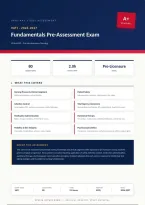
ORIGINAL STUDY ASSESSMENT A+
VERIFIED
VATI · 2026-2027
Fundamentals Pre-Assessment Exam
Virtual ATI · Pre-Licensensure Nursing
80 2.0h Pre-Licensure
QUESTIONS TIME LIMIT LEVEL
▸ W H AT T H I S C O V E R S
Nursing Process & Clinical Judgment Patient Safety
ADPIE, prioritization, critical thinking Fall prevention, restraints, safety events, fire safety
Infection Control Vital Signs & Assessment
Hand hygiene, PPE, isolation precautions, sterile technique Normal/abnormal findings, BP considerations, head-to-toe exam
Medication Administration Parenteral Therapy
Rights, dosage calculation, IM/SC/ID/IV routes IV insertion, maintenance, phlebitis/infiltration, central line care
Mobility & Skin Integrity Psychosocial & Ethics
Immobility complications, pressure injury staging Therapeutic communication, cultural competence, HIPAA, patient rights
ABOUT THIS ASSESSMENT
This assessment evaluates fundamental nursing knowledge and clinical judgment skills expected of pre-licensure nursing students
prior to program progression. Items present scenarios requiring application of safety, infection control, medication administration,
parenteral therapy, and therapeutic communication principles. Detailed rationales link each correct response to NCLEX-style test-
taking strategies and foundational nursing fundamentals.
EXAM CODE QUESTIONS TIME F O R M AT YEAR
VATI 80 2.0 hours MCQ 2026-2027
STUVIA ACTUAL EXAM · O R I G I N A L P R AC T I C E ST U DY M AT E R I A L
,VAT I · F U N D A M E N TA L S P R E -A S S E S S M E N T E X A M · Q U E S T I O N S & A N S W E R K E Y 80 ITEMS
Q1. A nurse is caring for a postoperative patient who continues to report unrelieved pain despite receiving
the prescribed PRN analgesic 30 minutes ago. After reassessing the patient, the nurse calls the prescriber to
discuss modifying the pain regimen and obtain a new order. Which term best describes this nursing
intervention?
A. Interdependent (collaborative) intervention
B. Independent nursing intervention
C. Dependent nursing intervention
D. Protocol-driven standing-order intervention
CORRECT ANSWER: A. Interdependent (collaborative) intervention
RATIONALE: Interdependent, or collaborative, interventions are actions the nurse carries out in cooperation with other
members of the health care team. Calling the prescriber to discuss and obtain a revised order is collaborative in nature.
Independent interventions are autonomous nursing actions, while dependent interventions involve executing a prescriber's
existing order.
Q2. A new graduate nurse is preparing to delegate oral medication administration to a licensed
practical/vocational nurse (LPN/LVN). Which question by the RN best demonstrates use of critical thinking
prior to delegation?
A. Has the LPN completed the annual skills competency checklist this year?
B. Is this patient's condition stable enough that the LPN can safely administer this medication?
C. Will the LPN document the administration promptly in the electronic record?
D. Does the LPN have enough time in the shift to complete the task?
CORRECT ANSWER: B. Is this patient's condition stable enough that the LPN can safely administer this
medication?
RATIONALE: The Right Circumstance of delegation requires the RN to consider whether the patient's condition is stable and
predictable enough for delegation. Patient stability directly affects the safety of delegating medication administration. The other
questions are operationally important but do not reflect the core critical-thinking judgment about patient acuity.
VATI · 2026-2027 · Page 1 of 36
,Q3. A nurse on a medical-surgical unit enters a patient's room and immediately notes the patient is
diaphoretic, breathing rapidly, and clutching the chest. Within seconds the nurse raises the head of the bed,
administers oxygen per protocol, and activates the rapid response team. According to Tanner's Clinical
Judgment Model, the nurse's immediate action of intervening corresponds to which phase?
A. Noticing
B. Interpreting
C. Responding
D. Reflecting-in-action
CORRECT ANSWER: C. Responding
RATIONALE: Tanner's model includes Noticing, Interpreting, Responding, and Reflecting. Responding is the phase in which the
nurse selects and implements a course of action, such as repositioning, applying oxygen, and activating the rapid response team.
Noticing is the initial grasp of the situation, and interpreting is the reasoning step that precedes action.
Q4. A nurse sets the following goal for a postoperative patient: Patient will independently demonstrate
correct incentive spirometer technique by discharge. On the day of discharge the patient still requires verbal
coaching to use the device correctly. Which action best reflects the evaluation step of the nursing process?
A. Document the patient's current performance and notify the next shift in handoff.
B. Identify a new nursing diagnosis of Ineffective Airway Clearance.
C. Reassess the patient for a knowledge deficit regarding lung expansion.
D. Revise the plan to include return demonstration with coaching prior to discharge.
CORRECT ANSWER: D. Revise the plan to include return demonstration with coaching prior to discharge.
RATIONALE: Evaluation involves comparing the patient's actual response to the expected outcomes. When a goal is not met, the
nurse revises the plan of care, which may include additional teaching, a new intervention, or a modified outcome. Modifying the
plan to add coaching prior to discharge is the appropriate evaluation-driven action.
VATI · 2026-2027 · Page 2 of 36
, Q5. A 58-year-old patient newly diagnosed with heart failure tells the nurse, "I just can't cope with all these
new medications and diet restrictions." Which nursing diagnosis is written in the correct PES (Problem-
Etiology-Symptom) format?
A. Heart failure related to decreased cardiac output as evidenced by fatigue.
B. Ineffective Coping related to new medical diagnosis as evidenced by patient statement "I can't cope."
C. Risk for Anxiety related to chronic heart failure.
D. Decreased Cardiac Output manifested by dyspnea and edema.
CORRECT ANSWER: B. Ineffective Coping related to new medical diagnosis as evidenced by patient statement "I
can't cope."
RATIONALE: The PES format consists of the diagnostic label (Problem), a related-to phrase identifying the etiology, and an as-
evidenced-by statement identifying defining characteristics (Symptoms). Option B correctly identifies the problem, the cause, and
supporting data. The other options are missing one or more PES components or are medical diagnoses.
Q6. A nurse caring for four patients on a busy morning shift must prioritize care. Which patient need should
the nurse address first based on Maslow's hierarchy of needs?
A. A patient whose pulse oximetry reading is 88% on room air and who is breathing 28 times per minute.
B. A patient who is anxious because family members have not yet arrived for visiting hours.
C. A patient who is asking to learn how to self-administer insulin before discharge tomorrow.
D. A patient scheduled for a routine dressing change that has been due for one hour.
CORRECT ANSWER: A. A patient whose pulse oximetry reading is 88% on room air and who is breathing 28 times
per minute.
RATIONALE: Maslow's hierarchy prioritizes physiological needs (airway, breathing, circulation) above safety, love and belonging,
esteem, and self-actualization needs. A pulse oximetry of 88% with tachypnea indicates an acute physiological threat requiring
immediate attention. The other needs, while important, are higher on the hierarchy and can be addressed after stabilization.
VATI · 2026-2027 · Page 3 of 36
VERIFIED
VATI · 2026-2027
Fundamentals Pre-Assessment Exam
Virtual ATI · Pre-Licensensure Nursing
80 2.0h Pre-Licensure
QUESTIONS TIME LIMIT LEVEL
▸ W H AT T H I S C O V E R S
Nursing Process & Clinical Judgment Patient Safety
ADPIE, prioritization, critical thinking Fall prevention, restraints, safety events, fire safety
Infection Control Vital Signs & Assessment
Hand hygiene, PPE, isolation precautions, sterile technique Normal/abnormal findings, BP considerations, head-to-toe exam
Medication Administration Parenteral Therapy
Rights, dosage calculation, IM/SC/ID/IV routes IV insertion, maintenance, phlebitis/infiltration, central line care
Mobility & Skin Integrity Psychosocial & Ethics
Immobility complications, pressure injury staging Therapeutic communication, cultural competence, HIPAA, patient rights
ABOUT THIS ASSESSMENT
This assessment evaluates fundamental nursing knowledge and clinical judgment skills expected of pre-licensure nursing students
prior to program progression. Items present scenarios requiring application of safety, infection control, medication administration,
parenteral therapy, and therapeutic communication principles. Detailed rationales link each correct response to NCLEX-style test-
taking strategies and foundational nursing fundamentals.
EXAM CODE QUESTIONS TIME F O R M AT YEAR
VATI 80 2.0 hours MCQ 2026-2027
STUVIA ACTUAL EXAM · O R I G I N A L P R AC T I C E ST U DY M AT E R I A L
,VAT I · F U N D A M E N TA L S P R E -A S S E S S M E N T E X A M · Q U E S T I O N S & A N S W E R K E Y 80 ITEMS
Q1. A nurse is caring for a postoperative patient who continues to report unrelieved pain despite receiving
the prescribed PRN analgesic 30 minutes ago. After reassessing the patient, the nurse calls the prescriber to
discuss modifying the pain regimen and obtain a new order. Which term best describes this nursing
intervention?
A. Interdependent (collaborative) intervention
B. Independent nursing intervention
C. Dependent nursing intervention
D. Protocol-driven standing-order intervention
CORRECT ANSWER: A. Interdependent (collaborative) intervention
RATIONALE: Interdependent, or collaborative, interventions are actions the nurse carries out in cooperation with other
members of the health care team. Calling the prescriber to discuss and obtain a revised order is collaborative in nature.
Independent interventions are autonomous nursing actions, while dependent interventions involve executing a prescriber's
existing order.
Q2. A new graduate nurse is preparing to delegate oral medication administration to a licensed
practical/vocational nurse (LPN/LVN). Which question by the RN best demonstrates use of critical thinking
prior to delegation?
A. Has the LPN completed the annual skills competency checklist this year?
B. Is this patient's condition stable enough that the LPN can safely administer this medication?
C. Will the LPN document the administration promptly in the electronic record?
D. Does the LPN have enough time in the shift to complete the task?
CORRECT ANSWER: B. Is this patient's condition stable enough that the LPN can safely administer this
medication?
RATIONALE: The Right Circumstance of delegation requires the RN to consider whether the patient's condition is stable and
predictable enough for delegation. Patient stability directly affects the safety of delegating medication administration. The other
questions are operationally important but do not reflect the core critical-thinking judgment about patient acuity.
VATI · 2026-2027 · Page 1 of 36
,Q3. A nurse on a medical-surgical unit enters a patient's room and immediately notes the patient is
diaphoretic, breathing rapidly, and clutching the chest. Within seconds the nurse raises the head of the bed,
administers oxygen per protocol, and activates the rapid response team. According to Tanner's Clinical
Judgment Model, the nurse's immediate action of intervening corresponds to which phase?
A. Noticing
B. Interpreting
C. Responding
D. Reflecting-in-action
CORRECT ANSWER: C. Responding
RATIONALE: Tanner's model includes Noticing, Interpreting, Responding, and Reflecting. Responding is the phase in which the
nurse selects and implements a course of action, such as repositioning, applying oxygen, and activating the rapid response team.
Noticing is the initial grasp of the situation, and interpreting is the reasoning step that precedes action.
Q4. A nurse sets the following goal for a postoperative patient: Patient will independently demonstrate
correct incentive spirometer technique by discharge. On the day of discharge the patient still requires verbal
coaching to use the device correctly. Which action best reflects the evaluation step of the nursing process?
A. Document the patient's current performance and notify the next shift in handoff.
B. Identify a new nursing diagnosis of Ineffective Airway Clearance.
C. Reassess the patient for a knowledge deficit regarding lung expansion.
D. Revise the plan to include return demonstration with coaching prior to discharge.
CORRECT ANSWER: D. Revise the plan to include return demonstration with coaching prior to discharge.
RATIONALE: Evaluation involves comparing the patient's actual response to the expected outcomes. When a goal is not met, the
nurse revises the plan of care, which may include additional teaching, a new intervention, or a modified outcome. Modifying the
plan to add coaching prior to discharge is the appropriate evaluation-driven action.
VATI · 2026-2027 · Page 2 of 36
, Q5. A 58-year-old patient newly diagnosed with heart failure tells the nurse, "I just can't cope with all these
new medications and diet restrictions." Which nursing diagnosis is written in the correct PES (Problem-
Etiology-Symptom) format?
A. Heart failure related to decreased cardiac output as evidenced by fatigue.
B. Ineffective Coping related to new medical diagnosis as evidenced by patient statement "I can't cope."
C. Risk for Anxiety related to chronic heart failure.
D. Decreased Cardiac Output manifested by dyspnea and edema.
CORRECT ANSWER: B. Ineffective Coping related to new medical diagnosis as evidenced by patient statement "I
can't cope."
RATIONALE: The PES format consists of the diagnostic label (Problem), a related-to phrase identifying the etiology, and an as-
evidenced-by statement identifying defining characteristics (Symptoms). Option B correctly identifies the problem, the cause, and
supporting data. The other options are missing one or more PES components or are medical diagnoses.
Q6. A nurse caring for four patients on a busy morning shift must prioritize care. Which patient need should
the nurse address first based on Maslow's hierarchy of needs?
A. A patient whose pulse oximetry reading is 88% on room air and who is breathing 28 times per minute.
B. A patient who is anxious because family members have not yet arrived for visiting hours.
C. A patient who is asking to learn how to self-administer insulin before discharge tomorrow.
D. A patient scheduled for a routine dressing change that has been due for one hour.
CORRECT ANSWER: A. A patient whose pulse oximetry reading is 88% on room air and who is breathing 28 times
per minute.
RATIONALE: Maslow's hierarchy prioritizes physiological needs (airway, breathing, circulation) above safety, love and belonging,
esteem, and self-actualization needs. A pulse oximetry of 88% with tachypnea indicates an acute physiological threat requiring
immediate attention. The other needs, while important, are higher on the hierarchy and can be addressed after stabilization.
VATI · 2026-2027 · Page 3 of 36


