
STUVI A ★ A + V E R IF IE D
ACTUAL EXAM
NSG 124 — EXAM 1
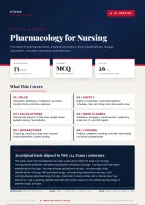
Pharmacology for Nursing
Principles of pharmacokinetics, pharmacodynamics, drug classifications, dosage
calculation, and safe medication administration.
QU ESTI ONS FO R MAT CYCLE
75 items MCQ + 26 /27
Multiple choice, A–D Rationales included Current academic year
What This Covers
01 / PK-PD 02 / SAFETY
Absorption, distribution, metabolism, excretion; Rights of medication, controlled substance
receptor theory and dose-response. schedules, high-alert drugs, look-alike sound-alike.
03 / CALCULATIONS 04 / DRUG CLASSES
Dimensional analysis, IV drip rates, weight-based Antibiotics, analgesics, cardiovascular, respiratory,
pediatric dosing, reconstitution. endocrine, GI, and CNS agents.
05 / INTERACTIONS 06 / LIFESPAN
Drug-drug, drug-food, drug-herb, enzyme Pediatric, pregnant, lactating, and older-adult dosing
induction/inhibition, protein binding. and safety considerations.
A B O UT THIS A S S ES S MEN T
An original bank aligned to NSG 124 Exam 1 outcomes
This bank covers the foundational outcomes assessed on NSG 124 Exam 1 at Herzing:
<strong>pharmacokinetic and pharmacodynamic principles</strong>, <strong>safe medication
administration</strong>, <strong>dosage calculation</strong>, <strong>major drug
classifications</strong> with prototype drugs, <strong>drug interactions</strong>, and
<strong>lifespan pharmacology</strong>. Each item is newly written with a clinical stem, four
distractors, and a teaching rationale that links the correct answer to the underlying physiology or
pharmacologic principle.
Ins t it ut ion: Herz ing Univ ersity L evel: B SN — Sophomore / Junior Tra ck Term: Aca demic Yea r
S T U VIA AC T U AL EXAM · A + V ER I FI ED S TU D Y G U I D E D O C ID : N S G 1 24 -EX1 -P H AR M-26 27
, N S G 1 2 4 — EX A M 1 — P H A R MA C O LO G Y
A + V ER I FI ED
PA R T I
Questions 1 – 38
1. A patient receives an oral medication that is extensively metabolized by first-pass effect. The nurse
understands that this means the drug:
A Is partially inactivated in the liver before B Is absorbed directly into the systemic
reaching systemic circulation, reducing circulation, bypassing the liver.
bioavailability.
C Is excreted unchanged by the kidneys before D Skips gastrointestinal absorption and enters
any metabolism occurs. via the lymphatic system.
C O R R EC T A N S WER A
The first-pass (presystemic) effect describes hepatic metabolism of a drug absorbed from the GI
R AT I O N A L E
tract before it reaches systemic circulation, lowering bioavailability. Drugs with high first-pass effect often
require non-oral routes (sublingual, IV, transdermal) to achieve therapeutic levels.
2. A nurse is preparing to administer digoxin 0.125 mg IV push. The vial contains digoxin 0.25 mg/mL.
How many milliliters should the nurse administer?
A 0.25 mL B 0.5 mL
C 1.0 mL D 2.0 mL
C O R R EC T A N S WER B
Use the formula: volume (mL) = desired dose / concentration on hand. 0.125 mg ÷ 0.25 mg/mL =
R AT I O N A L E
0.5 mL. The nurse should draw up 0.5 mL of the available solution to deliver the prescribed 0.125 mg dose.
3. A patient on warfarin therapy is prescribed a new medication known to displace warfarin from
plasma protein binding sites. The nurse anticipates that this interaction will:
A Decrease the free (active) warfarin level and B Have no clinical effect because warfarin is not
increase its therapeutic effect. protein-bound.
C Increase the free (active) warfarin level and D Increase warfarin metabolism by inducing
raise bleeding risk. hepatic enzymes.
C O R R EC T A N S WER C
Warfarin is highly protein-bound; displacement from albumin increases the free active fraction,
R AT I O N A L E
transiently raising anticoagulant effect and bleeding risk. This is a pharmacokinetic interaction at the
distribution phase, not enzyme induction.
S T U V IA A C T U A L EX A M · N S G 1 24 — EX A M 1 · P a g e 1 of 27
, N S G 1 2 4 — EX A M 1 — P H A R MA C O LO G Y
A + V ER I FI ED
4. A nurse is teaching a patient about a drug with a narrow therapeutic index. Which statement by the
patient indicates understanding?
A I can adjust the dose myself if I miss a dose. B I should stop the medication if I feel better.
C I do not need to worry about side effects with D I will need regular blood tests to keep my drug
this drug. level in a safe, effective range.
C O R R EC T A N S WER D
A narrow therapeutic index means the dose that produces a therapeutic effect is close to the dose
R AT I O N A L E
that produces toxicity. Drugs like warfarin, digoxin, lithium, and phenytoin require serum drug-level monitoring
to keep levels within the safe therapeutic window.
5. A patient is receiving a medication that is a competitive antagonist at the beta-1 receptor. The nurse
understands this drug will:
A Block beta-1 receptors, decreasing heart rate B Activate beta-1 receptors, increasing heart
and contractility. rate.
C Have no effect on beta-1 receptors. D Increase sympathetic outflow from the central
nervous system.
C O R R EC T A N S WER A
A competitive antagonist binds to the receptor without activating it, blocking endogenous
R AT I O N A L E
agonists (e.g., norepinephrine) and reducing receptor-mediated effects. Beta-1 selective antagonists (e.g.,
metoprolol) lower heart rate and contractility by blocking cardiac beta-1 receptors.
6. Which route of administration bypasses absorption entirely and produces 100% bioavailability?
A Sublingual B Intravenous
C Intramuscular D Transdermal
C O R R EC T A N S WER B
Intravenous administration places drug directly into systemic circulation, so bioavailability is by
R AT I O N A L E
definition 100% and absorption is bypassed. Sublingual, IM, and transdermal routes all involve absorption steps
that may reduce bioavailability.
S T U V IA A C T U A L EX A M · N S G 1 24 — EX A M 1 · P a g e 2 of 27
ACTUAL EXAM
NSG 124 — EXAM 1
Pharmacology for Nursing
Principles of pharmacokinetics, pharmacodynamics, drug classifications, dosage
calculation, and safe medication administration.
QU ESTI ONS FO R MAT CYCLE
75 items MCQ + 26 /27
Multiple choice, A–D Rationales included Current academic year
What This Covers
01 / PK-PD 02 / SAFETY
Absorption, distribution, metabolism, excretion; Rights of medication, controlled substance
receptor theory and dose-response. schedules, high-alert drugs, look-alike sound-alike.
03 / CALCULATIONS 04 / DRUG CLASSES
Dimensional analysis, IV drip rates, weight-based Antibiotics, analgesics, cardiovascular, respiratory,
pediatric dosing, reconstitution. endocrine, GI, and CNS agents.
05 / INTERACTIONS 06 / LIFESPAN
Drug-drug, drug-food, drug-herb, enzyme Pediatric, pregnant, lactating, and older-adult dosing
induction/inhibition, protein binding. and safety considerations.
A B O UT THIS A S S ES S MEN T
An original bank aligned to NSG 124 Exam 1 outcomes
This bank covers the foundational outcomes assessed on NSG 124 Exam 1 at Herzing:
<strong>pharmacokinetic and pharmacodynamic principles</strong>, <strong>safe medication
administration</strong>, <strong>dosage calculation</strong>, <strong>major drug
classifications</strong> with prototype drugs, <strong>drug interactions</strong>, and
<strong>lifespan pharmacology</strong>. Each item is newly written with a clinical stem, four
distractors, and a teaching rationale that links the correct answer to the underlying physiology or
pharmacologic principle.
Ins t it ut ion: Herz ing Univ ersity L evel: B SN — Sophomore / Junior Tra ck Term: Aca demic Yea r
S T U VIA AC T U AL EXAM · A + V ER I FI ED S TU D Y G U I D E D O C ID : N S G 1 24 -EX1 -P H AR M-26 27
, N S G 1 2 4 — EX A M 1 — P H A R MA C O LO G Y
A + V ER I FI ED
PA R T I
Questions 1 – 38
1. A patient receives an oral medication that is extensively metabolized by first-pass effect. The nurse
understands that this means the drug:
A Is partially inactivated in the liver before B Is absorbed directly into the systemic
reaching systemic circulation, reducing circulation, bypassing the liver.
bioavailability.
C Is excreted unchanged by the kidneys before D Skips gastrointestinal absorption and enters
any metabolism occurs. via the lymphatic system.
C O R R EC T A N S WER A
The first-pass (presystemic) effect describes hepatic metabolism of a drug absorbed from the GI
R AT I O N A L E
tract before it reaches systemic circulation, lowering bioavailability. Drugs with high first-pass effect often
require non-oral routes (sublingual, IV, transdermal) to achieve therapeutic levels.
2. A nurse is preparing to administer digoxin 0.125 mg IV push. The vial contains digoxin 0.25 mg/mL.
How many milliliters should the nurse administer?
A 0.25 mL B 0.5 mL
C 1.0 mL D 2.0 mL
C O R R EC T A N S WER B
Use the formula: volume (mL) = desired dose / concentration on hand. 0.125 mg ÷ 0.25 mg/mL =
R AT I O N A L E
0.5 mL. The nurse should draw up 0.5 mL of the available solution to deliver the prescribed 0.125 mg dose.
3. A patient on warfarin therapy is prescribed a new medication known to displace warfarin from
plasma protein binding sites. The nurse anticipates that this interaction will:
A Decrease the free (active) warfarin level and B Have no clinical effect because warfarin is not
increase its therapeutic effect. protein-bound.
C Increase the free (active) warfarin level and D Increase warfarin metabolism by inducing
raise bleeding risk. hepatic enzymes.
C O R R EC T A N S WER C
Warfarin is highly protein-bound; displacement from albumin increases the free active fraction,
R AT I O N A L E
transiently raising anticoagulant effect and bleeding risk. This is a pharmacokinetic interaction at the
distribution phase, not enzyme induction.
S T U V IA A C T U A L EX A M · N S G 1 24 — EX A M 1 · P a g e 1 of 27
, N S G 1 2 4 — EX A M 1 — P H A R MA C O LO G Y
A + V ER I FI ED
4. A nurse is teaching a patient about a drug with a narrow therapeutic index. Which statement by the
patient indicates understanding?
A I can adjust the dose myself if I miss a dose. B I should stop the medication if I feel better.
C I do not need to worry about side effects with D I will need regular blood tests to keep my drug
this drug. level in a safe, effective range.
C O R R EC T A N S WER D
A narrow therapeutic index means the dose that produces a therapeutic effect is close to the dose
R AT I O N A L E
that produces toxicity. Drugs like warfarin, digoxin, lithium, and phenytoin require serum drug-level monitoring
to keep levels within the safe therapeutic window.
5. A patient is receiving a medication that is a competitive antagonist at the beta-1 receptor. The nurse
understands this drug will:
A Block beta-1 receptors, decreasing heart rate B Activate beta-1 receptors, increasing heart
and contractility. rate.
C Have no effect on beta-1 receptors. D Increase sympathetic outflow from the central
nervous system.
C O R R EC T A N S WER A
A competitive antagonist binds to the receptor without activating it, blocking endogenous
R AT I O N A L E
agonists (e.g., norepinephrine) and reducing receptor-mediated effects. Beta-1 selective antagonists (e.g.,
metoprolol) lower heart rate and contractility by blocking cardiac beta-1 receptors.
6. Which route of administration bypasses absorption entirely and produces 100% bioavailability?
A Sublingual B Intravenous
C Intramuscular D Transdermal
C O R R EC T A N S WER B
Intravenous administration places drug directly into systemic circulation, so bioavailability is by
R AT I O N A L E
definition 100% and absorption is bypassed. Sublingual, IM, and transdermal routes all involve absorption steps
that may reduce bioavailability.
S T U V IA A C T U A L EX A M · N S G 1 24 — EX A M 1 · P a g e 2 of 27


