
NUR 304 Final Exam
Study online at https://quizlet.com/_7oft5g
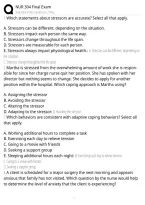
1. Which statements about stressors are accurate? Select all that apply.
A. Stressors can be different, depending on the situation.
B. Stressors impact each person the same way.
C. Stressors change throughout the life span.
D. Stressors are measurable for each person.
E. Stressors always impact physiological health.: A. Stressors can be different, depending on
the situation.
C. Stressors change throughout the life span.
2. Martha is stressed from the overwhelming amount of work she is respon-
sible for since her charge nurse quit her position. She has spoken with her
director but nothing seems to change. She decides to apply for another
position within the hospital. Which coping approach is Martha using?
A. Assigning the stressor
B. Avoiding the stressor
C. Altering the stressor
D. Adapting to the stressor: B. Avoiding the stressor
3. Which behaviors are consistent with adaptive coping behaviors? Select all
that apply.
A. Working additional hours to complete a task
B. Exercising each day to relieve tension
C. Going to a movie with friends
D. Seeking a support group
E. Sleeping additional hours each night: B. Exercising each day to relieve tension
C. Going to a movie with friends
D. Seeking a support group
4. A client is scheduled for a major surgery the next morning and appears
anxious that family has not visited. Which question by the nurse would help
to determine the level of anxiety that the client is experiencing?
, NUR 304 Final Exam
Study online at https://quizlet.com/_7oft5g
A. "Do you have questions about the surgery tomorrow?"
B. "Would you like for me to call a family member to come support you?"
C. "Would you like to talk with another client who had the same surgery?"
D. "You seem worried about something. Would it help to talk about it?": B. "Would
you like for me to call a family member to come support you?"
5. The nurse is caring for a client after abdominal surgery. The client is afraid
of having pain and experiences physiological changes when the stressor of
pain is introduced. Which changes are a result of this stressor? Select all that
apply.
A. Increased blood pressure
B. Vasoconstriction of the skin
C. Increased peristalsis
D. Constriction of the bronchioles
E. Increased glucose in the blood: A. Increased blood pressure
B. Vasoconstriction of the skin
E. Increased glucose in the blood
6. Which of the following are physiological stressors? Select all that apply.
A. Cold exposure
B. Bacteria
C. Obesity
D. High-fat diet
E. Tobacco
F. Active lifestyle
G. Sexual difficulties
H. Vacation: A. Cold exposure
B. Bacteria
C. Obesity
D. High-fat diet
E. Tobacco
, NUR 304 Final Exam
Study online at https://quizlet.com/_7oft5g
7. Which of the following are adaptive coping behaviors? Select all that apply.
A. Seeking advice
B. Overeating
C. Oversleeping
D. Exercising
E. Spending time alone
F. Drinking alcohol
G. Posting on social media
H. Taking a class: A. Seeking advice
D. Exercising
E. Spending time alone
H. Taking a class
8. Which of the following are factors that influence successful adaptation?
Select all that apply.
A. Exaggerated perception of the stressor
B. Healthy lifestyle
C. Church support group
D. Living alone
E. Age
F. Developmental level
G. Good coping skills
H. Hardiness: B. Healthy lifestyle
C. Church support group
E. Age
F. Developmental level
G. Good coping skills
H. Hardiness
9. Which of the following are stages of General Adaptation Syndrome? Select
all that apply.
, NUR 304 Final Exam
Study online at https://quizlet.com/_7oft5g
A. Recovery
B. Homeostasis
C. Alarm
D. Inflammatory
E. Reflexive
F. Resistance
G. Exhaustion
H. Multifaceted: A. Recovery
C. Alarm
F. Resistance
G. Exhaustion
10. Which of the following are physiological responses to stress?
Select all that apply.
A. Excess saliva
B. Hyperventilation
C. Decreased heart rate
D. Dilated pupils
E. Headaches
F. Eczema
G. Dysrhythmias
H. Decreased glucose: B. Hyperventilation
D. Dilated pupils
E. Headaches
F. Eczema
G. Dysrhythmias
11. Which of the following are psychological responses to stress? Select all that
apply.
A. Difficulty learning
B. Preoccupation
C. Rebellion
Study online at https://quizlet.com/_7oft5g
1. Which statements about stressors are accurate? Select all that apply.
A. Stressors can be different, depending on the situation.
B. Stressors impact each person the same way.
C. Stressors change throughout the life span.
D. Stressors are measurable for each person.
E. Stressors always impact physiological health.: A. Stressors can be different, depending on
the situation.
C. Stressors change throughout the life span.
2. Martha is stressed from the overwhelming amount of work she is respon-
sible for since her charge nurse quit her position. She has spoken with her
director but nothing seems to change. She decides to apply for another
position within the hospital. Which coping approach is Martha using?
A. Assigning the stressor
B. Avoiding the stressor
C. Altering the stressor
D. Adapting to the stressor: B. Avoiding the stressor
3. Which behaviors are consistent with adaptive coping behaviors? Select all
that apply.
A. Working additional hours to complete a task
B. Exercising each day to relieve tension
C. Going to a movie with friends
D. Seeking a support group
E. Sleeping additional hours each night: B. Exercising each day to relieve tension
C. Going to a movie with friends
D. Seeking a support group
4. A client is scheduled for a major surgery the next morning and appears
anxious that family has not visited. Which question by the nurse would help
to determine the level of anxiety that the client is experiencing?
, NUR 304 Final Exam
Study online at https://quizlet.com/_7oft5g
A. "Do you have questions about the surgery tomorrow?"
B. "Would you like for me to call a family member to come support you?"
C. "Would you like to talk with another client who had the same surgery?"
D. "You seem worried about something. Would it help to talk about it?": B. "Would
you like for me to call a family member to come support you?"
5. The nurse is caring for a client after abdominal surgery. The client is afraid
of having pain and experiences physiological changes when the stressor of
pain is introduced. Which changes are a result of this stressor? Select all that
apply.
A. Increased blood pressure
B. Vasoconstriction of the skin
C. Increased peristalsis
D. Constriction of the bronchioles
E. Increased glucose in the blood: A. Increased blood pressure
B. Vasoconstriction of the skin
E. Increased glucose in the blood
6. Which of the following are physiological stressors? Select all that apply.
A. Cold exposure
B. Bacteria
C. Obesity
D. High-fat diet
E. Tobacco
F. Active lifestyle
G. Sexual difficulties
H. Vacation: A. Cold exposure
B. Bacteria
C. Obesity
D. High-fat diet
E. Tobacco
, NUR 304 Final Exam
Study online at https://quizlet.com/_7oft5g
7. Which of the following are adaptive coping behaviors? Select all that apply.
A. Seeking advice
B. Overeating
C. Oversleeping
D. Exercising
E. Spending time alone
F. Drinking alcohol
G. Posting on social media
H. Taking a class: A. Seeking advice
D. Exercising
E. Spending time alone
H. Taking a class
8. Which of the following are factors that influence successful adaptation?
Select all that apply.
A. Exaggerated perception of the stressor
B. Healthy lifestyle
C. Church support group
D. Living alone
E. Age
F. Developmental level
G. Good coping skills
H. Hardiness: B. Healthy lifestyle
C. Church support group
E. Age
F. Developmental level
G. Good coping skills
H. Hardiness
9. Which of the following are stages of General Adaptation Syndrome? Select
all that apply.
, NUR 304 Final Exam
Study online at https://quizlet.com/_7oft5g
A. Recovery
B. Homeostasis
C. Alarm
D. Inflammatory
E. Reflexive
F. Resistance
G. Exhaustion
H. Multifaceted: A. Recovery
C. Alarm
F. Resistance
G. Exhaustion
10. Which of the following are physiological responses to stress?
Select all that apply.
A. Excess saliva
B. Hyperventilation
C. Decreased heart rate
D. Dilated pupils
E. Headaches
F. Eczema
G. Dysrhythmias
H. Decreased glucose: B. Hyperventilation
D. Dilated pupils
E. Headaches
F. Eczema
G. Dysrhythmias
11. Which of the following are psychological responses to stress? Select all that
apply.
A. Difficulty learning
B. Preoccupation
C. Rebellion


