
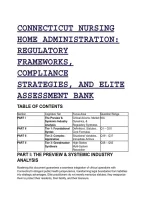
CONNECTICUT NURSING
HOME ADMINISTRATION:
REGULATORY
FRAMEWORKS,
COMPLIANCE
STRATEGIES, AND ELITE
ASSESSMENT BANK
TABLE OF CONTENTS
Section Cognitive Tier Focus Area Question Range
PART I The Preview & Critical Axioms, Market N/A
Systemic Industry Dynamics, &
Analysis Regulatory Synthesis
PART II Tier 1: Foundational Definitions, Statutes, Q1 – Q18
Syntax Core Formulas
PART II Tier 2: Complex Situational Variables, Q19 – Q37
Application Immediate Actions
PART II Tier 3: Grandmaster High-Stakes Q38 – Q55
Synthesis Multi-System
Resolution
PART I: THE PREVIEW & SYSTEMIC INDUSTRY
ANALYSIS
Mastering this document guarantees a seamless integration of clinical operations with
Connecticut's stringent public health jurisprudence, transforming legal boundaries from liabilities
into strategic advantages. Elite practitioners do not merely memorize statutes; they weaponize
them to protect their residents, their facility, and their licensure.
,The "Critical Axioms" Cheat Sheet
● The CMS vs. CT Staffing Threshold: CMS 2024 Final Rule mandates 3.48 total HPRD
(0.55 RN, 2.45 NA) and 24/7 RN coverage. CT 19-13-D8t mandates distinct day/night
ratios (CCNH: 1.40 day / 0.50 night). The facility must always staff to the higher, more
stringent standard.
● The Reportable Event Triad (19-13-D8t(g)): Class A (Death/Immediate Danger) requires
immediate reporting and a 72-hour full report. Class D (Serious Injury/Significant Change)
requires a 72-hour report. Class E (Minor Injury) requires internal logging and standard
reporting.
● Life Safety Power Protocol: Generators (NFPA 110/101) demand weekly inspections, a
monthly 30-minute run at 30% load, and for Level 1 systems, a 4-hour continuous run
every 36 months.
● Medicaid PDPM & Cost Limits: CT DSS rate setting utilizes a 90% minimum occupancy
divisor. Cost limits are capped at 135% for Direct Care, 115% for Indirect, and 100% for
Admin/General of the statewide median.
● The 30-Day Notice Mandate: Involuntary room-to-room transfers and facility discharges
require a minimum of 30 days written notice, bypassed only for documented health/safety
emergencies (CGS 19a-550).
Systemic Industry Analysis: Connecticut Long-Term Care Dynamics
The operational landscape for Connecticut nursing home administrators is defined by a rigid
intersection of state public health mandates, federal staffing rules, and zero-sum Medicaid
reimbursement structures. The analysis indicates that successful administration requires
synthesizing these competing frameworks into a unified operational strategy.
The Staffing and Reimbursement Squeeze
A primary structural threat to long-term care operations in Connecticut is the divergence
between the Centers for Medicare & Medicaid Services (CMS) staffing mandates and the
Connecticut Department of Social Services (DSS) reimbursement caps. The CMS 2024 Final
Rule imposes a strict federal floor of 3.48 Hours Per Resident Day (HPRD), specifically isolating
0.55 HPRD for Registered Nurses (RNs) and 2.45 for Nurse Aides (NAs), alongside a
non-negotiable 24/7 RN presence. However, the State of Connecticut enforces localized
regulations under 19-13-D8t, measuring staffing in shift-specific blocks (1.40 HPRD for the 7
a.m. to 9 p.m. shift, and 0.50 HPRD for the 9 p.m. to 7 a.m. shift).
Staffing Metric Federal (CMS) Requirement Connecticut (DPH)
Requirement
Total Minimum HPRD 3.48 (24-hour total) 1.90 (calculated via shift
minimums)
RN Specific Minimum 0.55 HPRD Not distinctly isolated per shift
Nurse Aide Minimum 2.45 HPRD Combined in total nursing
personnel
Coverage Requirement 24/7 RN on-site Licensed personnel per shift
ratios
The underlying trend reveals that while federal law acts as the absolute floor for total hours,
, state laws govern the micro-distribution of those hours across shifts. Furthermore, proposed
state legislation aims to push the state minimum to 3.6 HPRD, superseding the federal floor
entirely.
This creates a severe financial friction point. While facilities must increase direct care payroll to
meet these mandates, DSS strictly caps Medicaid Direct Care cost reimbursement at 135% of
the statewide median (e.g., $211.61 in Fairfield County). The ripple effect is profound: facilities
cannot simply spend their way into compliance without absorbing massive un-reimbursed costs.
To survive, administrators must master the Patient Driven Payment Model (PDPM). By capturing
higher acuity through accurate Minimum Data Set (MDS) coding, facilities raise their Case Mix
Index (CMI), driving higher per-diem rates without crossing the percentage caps.
Regulatory Enforcement and Transparency
Connecticut categorizes facility failures through a severe penalty matrix. The Department of
Public Health (DPH) leverages the "Reportable Event" system (19-13-D8t(g)) to track immediate
risks. Class A events—defined by death or immediate danger of death—trigger immediate
reporting mandates, while Class D events (serious injuries) allow a 72-hour window.
| Citation Class | Definition / Impact | Statutory Penalty | | :--- | :--- | :--- | | Class A | Direct,
immediate danger of death or serious harm to a patient. | $20,000 fine | | Class B | Potential for
more than minimal harm; significant regulatory failure. | $10,000 fine | | Class C/D/E | Lower-tier
administrative or minor physical impact events. | Variable/Internal Logging |
A critical insight from regulatory data is that cover-ups compound liability. Failure to report a
Class D fracture or a missing Medical Director immediately transforms a clinical error into a
Class B or Class A administrative citation. Furthermore, citations cannot be hidden; CGS
19a-540 mandates that Class A and B citations be prominently posted within the facility until
vacated or corrected.
Environmental Controls and Patient Rights
The physical plant of a nursing home is legally intertwined with the Patients' Bill of Rights (CGS
19a-550). NFPA 101 (Life Safety Code) and NFPA 110 govern emergency power, demanding
that Level 1 generators endure a 30-minute monthly run at 30% load, and a punishing 4-hour
test every 36 months. If a generator fails during a winter outage, the facility risks violating the
state-mandated 75°F minimum ambient temperature for patient areas.
When temperatures plummet, standard patient rights—such as the 30-day written notice
required for involuntary room transfers or discharges—are legally bypassed due to the
immediate danger to health and welfare. The administrator must seamlessly pivot from routine
compliance to emergency evacuation protocols, underscoring that environmental integrity is the
absolute prerequisite for delivering clinical care.
PART II: THE ELITE TEST BANK
Tier 1: Foundational Syntax & Application
Q1: An administrator is auditing their continuing education (CEU) files prior to license renewal.
Based on the principles of Connecticut Department of Public Health (DPH) requirements, which
minimum threshold is the PIVOT WORD for renewal? A) 24 hours of continuing education
HOME ADMINISTRATION:
REGULATORY
FRAMEWORKS,
COMPLIANCE
STRATEGIES, AND ELITE
ASSESSMENT BANK
TABLE OF CONTENTS
Section Cognitive Tier Focus Area Question Range
PART I The Preview & Critical Axioms, Market N/A
Systemic Industry Dynamics, &
Analysis Regulatory Synthesis
PART II Tier 1: Foundational Definitions, Statutes, Q1 – Q18
Syntax Core Formulas
PART II Tier 2: Complex Situational Variables, Q19 – Q37
Application Immediate Actions
PART II Tier 3: Grandmaster High-Stakes Q38 – Q55
Synthesis Multi-System
Resolution
PART I: THE PREVIEW & SYSTEMIC INDUSTRY
ANALYSIS
Mastering this document guarantees a seamless integration of clinical operations with
Connecticut's stringent public health jurisprudence, transforming legal boundaries from liabilities
into strategic advantages. Elite practitioners do not merely memorize statutes; they weaponize
them to protect their residents, their facility, and their licensure.
,The "Critical Axioms" Cheat Sheet
● The CMS vs. CT Staffing Threshold: CMS 2024 Final Rule mandates 3.48 total HPRD
(0.55 RN, 2.45 NA) and 24/7 RN coverage. CT 19-13-D8t mandates distinct day/night
ratios (CCNH: 1.40 day / 0.50 night). The facility must always staff to the higher, more
stringent standard.
● The Reportable Event Triad (19-13-D8t(g)): Class A (Death/Immediate Danger) requires
immediate reporting and a 72-hour full report. Class D (Serious Injury/Significant Change)
requires a 72-hour report. Class E (Minor Injury) requires internal logging and standard
reporting.
● Life Safety Power Protocol: Generators (NFPA 110/101) demand weekly inspections, a
monthly 30-minute run at 30% load, and for Level 1 systems, a 4-hour continuous run
every 36 months.
● Medicaid PDPM & Cost Limits: CT DSS rate setting utilizes a 90% minimum occupancy
divisor. Cost limits are capped at 135% for Direct Care, 115% for Indirect, and 100% for
Admin/General of the statewide median.
● The 30-Day Notice Mandate: Involuntary room-to-room transfers and facility discharges
require a minimum of 30 days written notice, bypassed only for documented health/safety
emergencies (CGS 19a-550).
Systemic Industry Analysis: Connecticut Long-Term Care Dynamics
The operational landscape for Connecticut nursing home administrators is defined by a rigid
intersection of state public health mandates, federal staffing rules, and zero-sum Medicaid
reimbursement structures. The analysis indicates that successful administration requires
synthesizing these competing frameworks into a unified operational strategy.
The Staffing and Reimbursement Squeeze
A primary structural threat to long-term care operations in Connecticut is the divergence
between the Centers for Medicare & Medicaid Services (CMS) staffing mandates and the
Connecticut Department of Social Services (DSS) reimbursement caps. The CMS 2024 Final
Rule imposes a strict federal floor of 3.48 Hours Per Resident Day (HPRD), specifically isolating
0.55 HPRD for Registered Nurses (RNs) and 2.45 for Nurse Aides (NAs), alongside a
non-negotiable 24/7 RN presence. However, the State of Connecticut enforces localized
regulations under 19-13-D8t, measuring staffing in shift-specific blocks (1.40 HPRD for the 7
a.m. to 9 p.m. shift, and 0.50 HPRD for the 9 p.m. to 7 a.m. shift).
Staffing Metric Federal (CMS) Requirement Connecticut (DPH)
Requirement
Total Minimum HPRD 3.48 (24-hour total) 1.90 (calculated via shift
minimums)
RN Specific Minimum 0.55 HPRD Not distinctly isolated per shift
Nurse Aide Minimum 2.45 HPRD Combined in total nursing
personnel
Coverage Requirement 24/7 RN on-site Licensed personnel per shift
ratios
The underlying trend reveals that while federal law acts as the absolute floor for total hours,
, state laws govern the micro-distribution of those hours across shifts. Furthermore, proposed
state legislation aims to push the state minimum to 3.6 HPRD, superseding the federal floor
entirely.
This creates a severe financial friction point. While facilities must increase direct care payroll to
meet these mandates, DSS strictly caps Medicaid Direct Care cost reimbursement at 135% of
the statewide median (e.g., $211.61 in Fairfield County). The ripple effect is profound: facilities
cannot simply spend their way into compliance without absorbing massive un-reimbursed costs.
To survive, administrators must master the Patient Driven Payment Model (PDPM). By capturing
higher acuity through accurate Minimum Data Set (MDS) coding, facilities raise their Case Mix
Index (CMI), driving higher per-diem rates without crossing the percentage caps.
Regulatory Enforcement and Transparency
Connecticut categorizes facility failures through a severe penalty matrix. The Department of
Public Health (DPH) leverages the "Reportable Event" system (19-13-D8t(g)) to track immediate
risks. Class A events—defined by death or immediate danger of death—trigger immediate
reporting mandates, while Class D events (serious injuries) allow a 72-hour window.
| Citation Class | Definition / Impact | Statutory Penalty | | :--- | :--- | :--- | | Class A | Direct,
immediate danger of death or serious harm to a patient. | $20,000 fine | | Class B | Potential for
more than minimal harm; significant regulatory failure. | $10,000 fine | | Class C/D/E | Lower-tier
administrative or minor physical impact events. | Variable/Internal Logging |
A critical insight from regulatory data is that cover-ups compound liability. Failure to report a
Class D fracture or a missing Medical Director immediately transforms a clinical error into a
Class B or Class A administrative citation. Furthermore, citations cannot be hidden; CGS
19a-540 mandates that Class A and B citations be prominently posted within the facility until
vacated or corrected.
Environmental Controls and Patient Rights
The physical plant of a nursing home is legally intertwined with the Patients' Bill of Rights (CGS
19a-550). NFPA 101 (Life Safety Code) and NFPA 110 govern emergency power, demanding
that Level 1 generators endure a 30-minute monthly run at 30% load, and a punishing 4-hour
test every 36 months. If a generator fails during a winter outage, the facility risks violating the
state-mandated 75°F minimum ambient temperature for patient areas.
When temperatures plummet, standard patient rights—such as the 30-day written notice
required for involuntary room transfers or discharges—are legally bypassed due to the
immediate danger to health and welfare. The administrator must seamlessly pivot from routine
compliance to emergency evacuation protocols, underscoring that environmental integrity is the
absolute prerequisite for delivering clinical care.
PART II: THE ELITE TEST BANK
Tier 1: Foundational Syntax & Application
Q1: An administrator is auditing their continuing education (CEU) files prior to license renewal.
Based on the principles of Connecticut Department of Public Health (DPH) requirements, which
minimum threshold is the PIVOT WORD for renewal? A) 24 hours of continuing education


