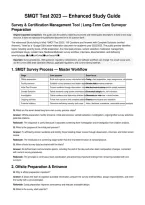
SMQT Test 2023 — Enhanced Study Guide
Survey & Certification Management Tool | Long-Term Care Surveyor
Preparation
Original expanded companion: This guide uses the publicly visible Stuvia preview and related public descriptions to build a new study
resource. It does not reproduce the paid/locked document or its full question bank.
The referenced Stuvia listing is titled “SMQT Test 2023 | 150 Questions and Answers with Complete Solutions (verified
Answers),” listed as a 13-page Q&A;/exam-elaboration document for academic year 2022/2023. The public preview identifies
topics including severity levels, offsite preparation, the initial pool process, sample selection, medication management,
psychotropic drugs, resident care, Medicare/Medicaid, survey workflow, interviews, documentation, and deficiency
severity/scope. ■cite■turn0view0■turn0search0■
Important: Survey procedures, CMS guidance, regulatory interpretations, and software workflows can change. For actual survey work,
use the current CMS State Operations Manual, applicable regulations, and current training materials.
1. SMQT Survey Process — Master Workflow
Stage Core purpose Exam focus
Offsite preparation Build and organize survey information beforeTiming,
entry shell preparation, team assignments, documents
Facility entrance Establish survey presence and obtain required
Census,
information
lists, entrance materials
Initial Pool Process Screen residents through observation, interview,
Identify
andconcerns
record review
and potential sample residents
Sample Selection Select residents using system information and
Care
survey
areas,
findings
complaints, risk indicators
Investigation Gather evidence and determine whether requirements
Observation
are
+ interview
met + record review
Ongoing activities Follow new concerns and complete additional
Team
tasks
communication and validation
Potential citations Determine deficiency severity and scope Harm, likelihood, prevalence, reasonable-person analysis
Q: What are the seven broad long-term-care survey process steps?
Answer: Offsite preparation; facility entrance; initial pool process; sample selection; investigation; ongoing/other survey activities;
potential citations.
Rationale: The sequence is useful because it separates screening from investigation and investigation from citation analysis.
Q: What is the purpose of the initial pool process?
Answer: To efficiently screen residents and identify those needing closer review through observation, interview, and initial record
review.
Rationale: The initial pool is a screening stage rather than the final determination of noncompliance.
Q: When should survey data be shared with the team?
Answer: At defined team communication points, including the end of the day and when team composition changes, consistent
with current survey procedures.
Rationale: The principle is continuous team coordination and preventing important findings from remaining isolated with one
surveyor.
2. Offsite Preparation & Entrance
Q: Why is offsite preparation important?
Answer: It allows the team to organize available information, prepare the survey shell/workflow, assign responsibilities, and enter
the facility with a structured plan.
Rationale: Good preparation improves consistency and reduces avoidable delays.
Q: What is the survey shell used for?
, Answer: It organizes survey-specific resident and facility information within the survey workflow.
Rationale: Software functions can change; know the purpose rather than memorizing outdated screen labels.
Q: What information should be checked at entrance?
Answer: Current census and required facility lists/documents, including information needed to identify recent admissions and
relevant resident populations.
Rationale: Always use the current entrance checklist for the survey type.
Q: What should a surveyor do when facility information conflicts with system-populated information?
Answer: Document the discrepancy and follow current procedures for reconciliation/notes.
Rationale: Conflicts should be resolved transparently rather than silently overwriting evidence.
3. Initial Pool & Sample Selection
Q: What resident characteristics can increase priority for review?
Answer: Potential care-area concerns, complaints, abuse concerns, recent changes, high-risk clinical issues, and other
indicators specified by current survey procedures.
Rationale: Selection should be evidence-driven rather than based on assumptions about a resident.
Q: What interview statuses commonly matter?
Answer: Interviewable, noninterviewable, refused, unavailable, and out of facility.
Rationale: Correct status affects which investigative methods can be used.
Q: What if a resident cannot finish an interview?
Answer: Attempt completion later when appropriate; if it remains incomplete, use available observation and record-review
evidence and document the situation according to procedure.
Rationale: Do not fabricate answers or treat missing interview data as evidence of compliance/noncompliance by itself.
Q: What is the purpose of sample selection?
Answer: To select a manageable set of residents and issues that provides meaningful coverage of identified risks and survey
requirements.
Rationale: The sample is a structured investigative tool, not simply a random list.
4. Severity, Scope & Deficiency Reasoning
Concept Meaning Common trap
Severity Degree of actual or potential harm Confusing potential harm with actual harm
Scope How broadly the deficient practice affects residents
Calling a hall-wide issue “widespread” automatically
Isolated Limited occurrence Assuming one observation proves a systemic pattern
Pattern More than isolated but not pervasive Ignoring denominator/universe
Widespread Across the entire population or pervasive Treating “many” as automatically widespread
Jeopardy Noncompliance causing or likely to cause serious
Using injury,
the term
harm,
for every
impairment,
seriousorconcern
death
Q: What is jeopardy?
Answer: A level of noncompliance associated with serious injury, harm, impairment, or death, as defined by the applicable
regulatory framework.
Rationale: Jeopardy is a severity concept requiring careful evidence-based analysis.
Q: How should a surveyor think about severity when there is no actual harm?
Answer: Assess the likelihood and potential magnitude of harm, including whether the deficient practice could cause serious
consequences.
Survey & Certification Management Tool | Long-Term Care Surveyor
Preparation
Original expanded companion: This guide uses the publicly visible Stuvia preview and related public descriptions to build a new study
resource. It does not reproduce the paid/locked document or its full question bank.
The referenced Stuvia listing is titled “SMQT Test 2023 | 150 Questions and Answers with Complete Solutions (verified
Answers),” listed as a 13-page Q&A;/exam-elaboration document for academic year 2022/2023. The public preview identifies
topics including severity levels, offsite preparation, the initial pool process, sample selection, medication management,
psychotropic drugs, resident care, Medicare/Medicaid, survey workflow, interviews, documentation, and deficiency
severity/scope. ■cite■turn0view0■turn0search0■
Important: Survey procedures, CMS guidance, regulatory interpretations, and software workflows can change. For actual survey work,
use the current CMS State Operations Manual, applicable regulations, and current training materials.
1. SMQT Survey Process — Master Workflow
Stage Core purpose Exam focus
Offsite preparation Build and organize survey information beforeTiming,
entry shell preparation, team assignments, documents
Facility entrance Establish survey presence and obtain required
Census,
information
lists, entrance materials
Initial Pool Process Screen residents through observation, interview,
Identify
andconcerns
record review
and potential sample residents
Sample Selection Select residents using system information and
Care
survey
areas,
findings
complaints, risk indicators
Investigation Gather evidence and determine whether requirements
Observation
are
+ interview
met + record review
Ongoing activities Follow new concerns and complete additional
Team
tasks
communication and validation
Potential citations Determine deficiency severity and scope Harm, likelihood, prevalence, reasonable-person analysis
Q: What are the seven broad long-term-care survey process steps?
Answer: Offsite preparation; facility entrance; initial pool process; sample selection; investigation; ongoing/other survey activities;
potential citations.
Rationale: The sequence is useful because it separates screening from investigation and investigation from citation analysis.
Q: What is the purpose of the initial pool process?
Answer: To efficiently screen residents and identify those needing closer review through observation, interview, and initial record
review.
Rationale: The initial pool is a screening stage rather than the final determination of noncompliance.
Q: When should survey data be shared with the team?
Answer: At defined team communication points, including the end of the day and when team composition changes, consistent
with current survey procedures.
Rationale: The principle is continuous team coordination and preventing important findings from remaining isolated with one
surveyor.
2. Offsite Preparation & Entrance
Q: Why is offsite preparation important?
Answer: It allows the team to organize available information, prepare the survey shell/workflow, assign responsibilities, and enter
the facility with a structured plan.
Rationale: Good preparation improves consistency and reduces avoidable delays.
Q: What is the survey shell used for?
, Answer: It organizes survey-specific resident and facility information within the survey workflow.
Rationale: Software functions can change; know the purpose rather than memorizing outdated screen labels.
Q: What information should be checked at entrance?
Answer: Current census and required facility lists/documents, including information needed to identify recent admissions and
relevant resident populations.
Rationale: Always use the current entrance checklist for the survey type.
Q: What should a surveyor do when facility information conflicts with system-populated information?
Answer: Document the discrepancy and follow current procedures for reconciliation/notes.
Rationale: Conflicts should be resolved transparently rather than silently overwriting evidence.
3. Initial Pool & Sample Selection
Q: What resident characteristics can increase priority for review?
Answer: Potential care-area concerns, complaints, abuse concerns, recent changes, high-risk clinical issues, and other
indicators specified by current survey procedures.
Rationale: Selection should be evidence-driven rather than based on assumptions about a resident.
Q: What interview statuses commonly matter?
Answer: Interviewable, noninterviewable, refused, unavailable, and out of facility.
Rationale: Correct status affects which investigative methods can be used.
Q: What if a resident cannot finish an interview?
Answer: Attempt completion later when appropriate; if it remains incomplete, use available observation and record-review
evidence and document the situation according to procedure.
Rationale: Do not fabricate answers or treat missing interview data as evidence of compliance/noncompliance by itself.
Q: What is the purpose of sample selection?
Answer: To select a manageable set of residents and issues that provides meaningful coverage of identified risks and survey
requirements.
Rationale: The sample is a structured investigative tool, not simply a random list.
4. Severity, Scope & Deficiency Reasoning
Concept Meaning Common trap
Severity Degree of actual or potential harm Confusing potential harm with actual harm
Scope How broadly the deficient practice affects residents
Calling a hall-wide issue “widespread” automatically
Isolated Limited occurrence Assuming one observation proves a systemic pattern
Pattern More than isolated but not pervasive Ignoring denominator/universe
Widespread Across the entire population or pervasive Treating “many” as automatically widespread
Jeopardy Noncompliance causing or likely to cause serious
Using injury,
the term
harm,
for every
impairment,
seriousorconcern
death
Q: What is jeopardy?
Answer: A level of noncompliance associated with serious injury, harm, impairment, or death, as defined by the applicable
regulatory framework.
Rationale: Jeopardy is a severity concept requiring careful evidence-based analysis.
Q: How should a surveyor think about severity when there is no actual harm?
Answer: Assess the likelihood and potential magnitude of harm, including whether the deficient practice could cause serious
consequences.