
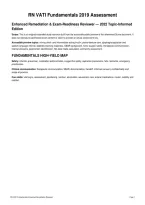
RN VATI Fundamentals 2019 Assessment
Enhanced Remediation & Exam-Readiness Reviewer — 2022 Topic-Informed
Edition
Scope: This is an original expanded study resource built from the accessible public preview of the referenced Stuvia document. It
does not reproduce paid/locked exam content or claim to provide an actual assessment key.
Accessible preview topics: mixing short- and intermediate-acting insulin, partial-denture care, dysphagia/aspiration and
speech-language referral, diabetes teaching readiness, SBAR background, home oxygen safety, therapeutic communication,
internal stressors, postmortem identification, NG-tube intake calculation, and family assessment.
FUNDAMENTALS HIGH-YIELD MAP
Safety: infection prevention, medication administration, oxygen/fire safety, aspiration precautions, falls, restraints, emergency
prioritization.
Clinical communication: therapeutic communication, SBAR, documentation, handoff, informed consent, confidentiality and
scope of practice.
Core skills: vital signs, assessment, positioning, nutrition, elimination, wound/skin care, enteral medications, insulin, mobility and
comfort.
RN VATI Fundamentals Enhanced Remediation Reviewer Page 1
, 1. MEDICATION ADMINISTRATION & INSULIN
Q1. What is the classic order for mixing regular insulin with NPH insulin?
A: When mixing compatible short-acting/regular insulin with NPH, the traditional sequence is 'clear before cloudy':
inject air into NPH, inject air into regular insulin, withdraw regular insulin, then withdraw NPH. Avoid contaminating the
regular-insulin vial with NPH.
Q2. Why is insulin administration a high-alert safety task?
A: Insulin can cause serious hypoglycemia if the dose, concentration, timing, or meal relationship is incorrect. Verify
the medication, concentration, dose, glucose data, meal timing, and institutional double-check requirements.
Q3. What symptoms suggest hypoglycemia?
A: Sweating, tremor, hunger, palpitations, anxiety, weakness, confusion, behavior change, seizures, or loss of
consciousness can occur. Treat promptly according to the patient's condition and protocol.
Q4. What should the nurse do before administering a medication?
A: Verify the medication order, patient identity, allergies, indication, dose, route, timing, relevant assessment data, and
required parameters. Follow medication rights and facility policy.
Q5. Why should medications not be documented as administered before administration?
A: Documentation must accurately reflect care that occurred. Pre-charting can create medication errors and obscures
whether a dose was actually given.
Q6. What is a medication reconciliation process intended to accomplish?
A: It compares the patient's current medication use with new orders during transitions of care to identify omissions,
duplications, interactions, and unintended changes.
RN VATI Fundamentals Enhanced Remediation Reviewer Page 2
Enhanced Remediation & Exam-Readiness Reviewer — 2022 Topic-Informed
Edition
Scope: This is an original expanded study resource built from the accessible public preview of the referenced Stuvia document. It
does not reproduce paid/locked exam content or claim to provide an actual assessment key.
Accessible preview topics: mixing short- and intermediate-acting insulin, partial-denture care, dysphagia/aspiration and
speech-language referral, diabetes teaching readiness, SBAR background, home oxygen safety, therapeutic communication,
internal stressors, postmortem identification, NG-tube intake calculation, and family assessment.
FUNDAMENTALS HIGH-YIELD MAP
Safety: infection prevention, medication administration, oxygen/fire safety, aspiration precautions, falls, restraints, emergency
prioritization.
Clinical communication: therapeutic communication, SBAR, documentation, handoff, informed consent, confidentiality and
scope of practice.
Core skills: vital signs, assessment, positioning, nutrition, elimination, wound/skin care, enteral medications, insulin, mobility and
comfort.
RN VATI Fundamentals Enhanced Remediation Reviewer Page 1
, 1. MEDICATION ADMINISTRATION & INSULIN
Q1. What is the classic order for mixing regular insulin with NPH insulin?
A: When mixing compatible short-acting/regular insulin with NPH, the traditional sequence is 'clear before cloudy':
inject air into NPH, inject air into regular insulin, withdraw regular insulin, then withdraw NPH. Avoid contaminating the
regular-insulin vial with NPH.
Q2. Why is insulin administration a high-alert safety task?
A: Insulin can cause serious hypoglycemia if the dose, concentration, timing, or meal relationship is incorrect. Verify
the medication, concentration, dose, glucose data, meal timing, and institutional double-check requirements.
Q3. What symptoms suggest hypoglycemia?
A: Sweating, tremor, hunger, palpitations, anxiety, weakness, confusion, behavior change, seizures, or loss of
consciousness can occur. Treat promptly according to the patient's condition and protocol.
Q4. What should the nurse do before administering a medication?
A: Verify the medication order, patient identity, allergies, indication, dose, route, timing, relevant assessment data, and
required parameters. Follow medication rights and facility policy.
Q5. Why should medications not be documented as administered before administration?
A: Documentation must accurately reflect care that occurred. Pre-charting can create medication errors and obscures
whether a dose was actually given.
Q6. What is a medication reconciliation process intended to accomplish?
A: It compares the patient's current medication use with new orders during transitions of care to identify omissions,
duplications, interactions, and unintended changes.
RN VATI Fundamentals Enhanced Remediation Reviewer Page 2


