
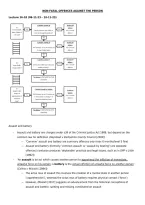
NON-FATAL OFFENCES AGAINST THE PERSON
Lecture 16-18 (06-11-23 – 10-11-23)
Assault and battery
Assault and battery are charged under s39 of the Criminal Justice Act 1988, but depend on the
common law for definition (Haystead v Derbyshire County Council [2000])
‘Common’ assault and battery are summary offences only (max 6 months/level 5 fine)
Assault and battery (formerly ‘common assault’ or ‘assault by beating’) are separate
offences (confusion produces ‘deplorable’ practical and legal issues, such as in DPP v Little
[1992])
‘An assault is an act which causes another person to apprehend the infliction of immediate,
unlawful force on his person; a battery is the actual infliction of unlawful force on another person’
(Collins v Wilcock [1984])
The actus reus of assault this involves the creation of a mental state in another person
(‘apprehension’), whereas the actus reus of battery requires physical contact (‘force’)
However, Misalati [2017] suggests an advancement from the historical conceptions of
assault and battery- spitting and missing constituted an assault
, The mens rea of both assault and battery is either intention or recklessness (Cunningham
recklessness (G)- D must realise the potential effect of his conduct) as per Savage and Parmenter
[1992]
Both cases affirmed Venna [1976]- ‘it is common ground that the mental element of assault
is an intention to cause the victim to apprehend immediate and unlawful violence or
recklessness whether such apprehension be caused’
Assault
Ireland, (Burstow) [1997]
R v Ireland [1998]- criminal case of assault in which the defendants made silent phone calls
to the claimants (pre-harassment legislation)- ruled that silence could amount to assault if
intentional and threatening (circumstantial ruling) and D was charged with assault
occasioning ABH (s47- includes psychiatric harm)
Also ruled that words could give rise to an assault- ‘a thing said is also a thing done’ (shift
from the ruling in Meade & Belt [1823] whereby ‘no words or singing’ could amount to
assault)
Concerned itself with the mental state of V (ruled that she ‘may fear the possibility of
immediate personal violence’)- wide interpretation of the actus reus of assault
Constanza [1997]
D bombarded V with letters and phone calls and kept watch on her house, causing her to
suffer clinical depression- charged under s47
Suggestion by D that, having been sent 800 letters, she could not possibly fear immediate
violence
Broad application so as to protect harassment victims prior to its implementation in statute
under the Protection from Harassment Act 1997
Words can negate an assault (Tuberville v Savage [1669])
However, if the defendant does not understand the meaning of the negating words (eg.
‘assize time’), the words can still have a negating effect which the defendant can rely on if it
could be reasonably expected that the claimant understand the words
No assault if D’s actions or words do not suggest an immediate threat, even if V is
understandably concerned about D’s future intentions
If V must do something to avert the immediate threat, it will remain an assault (Read v Coker
[1853])
Battery
Where injury occurs, battery remains a suitable charge, though if the injury is more than ‘transient
or trifling’, a more serious charge may be appropriate under s47 (cross-check with CPS charging
standard)
https://www.cps.gov.uk/legal-guidance/offences-against-person-incorporating-charging-
standard


