
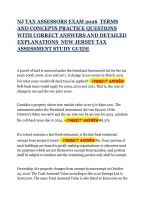
NJ TAX ASSESSORS EXAM 2026 TERMS
AND CONCEPTS PRACTICE QUESTIONS
WITH CORRECT ANSWERS AND DETAILED
EXPLANATIONS NEW JERSEY TAX
ASSESSMENT STUDY GUIDE
A parcel of land is assessed under the Farmland Assessment Act for the tax
years 2008, 2009, 2010 and 2011. A change in use occurs in March, 2011.
For what years would roll-back taxes be applied? - CORRECT ANSWER-
Roll-back taxes would apply for 2009, 2010 and 2011. That is, the year of
change in use and the two prior years.
Consider a property whose true market value in 2013 is $500,000. The
assessment under the Farmland Assessment Act was $9,000. If the
Director's Ratio was 90% and the tax rate was $1.90/100 for 2013, calculate
the roll-back taxes due in 2014. - CORRECT ANSWER-$8,379
If a school contains a fast-food restaurant, is the fast-food restaurant
exempt from property taxes? - CORRECT ANSWER-No. if any portion of
such buildings are leased to profit-making organizations or otherwise used
for purposes which are not themselves exempt from taxation, said portion
shall be subject to taxation and the remaining portion only shall be exempt.
Ownership of a property changes from exempt to nonexempt on October
25, 2010. The Total Assessed Value according to the 2010 Exempt List is
$200,000. The same Total Assessed Value is also listed as $200,000 on the
,2011 Exempt List. If the Tax Rate in 2010 is $3.60/$1000 and $3.80/$100
in 2011. Calculate the Added Assessment. - CORRECT ANSWER-$8,800
A "Further Statement" for exemption must be filed no later than November
1 every ____ year. - CORRECT ANSWER-3rd
What is the difference between a revaluation and reassessment? -
CORRECT ANSWER-A revaluation is done by a professional appraisal
firm outside of the municipality. A reassessment is done by the municipal
assessor and staff.
Give the equation for Assessment-Sales Ratio. - CORRECT ANSWER-
Assessment-Sales Ratio = Assessed Value/Sale Price
A Director's Ratio of ___ or less denotes noncompliance. - CORRECT
ANSWER-85%
A continual decline of Assessment-Sales Ratio in a district from the 100%
level of taxable value shows a lack of assessment ______ and may indicate
a need for reassessment/revaluation. - CORRECT ANSWER-Maintenance
What does the Coefficient of Deviation measure? - CORRECT ANSWER-
The Coefficient of Deviation measures the variability of the Assessment-
Sales Ratio. . A higher Coefficient of Deviation indicates a poorer degree of
assessment uniformity in a taxing district and a likely need for
reassessment/revaluation. A lower Coefficient of Deviation indicates a
better degree of assessment uniformity.
, Is a Coefficient of Deviation of 20% considered acceptable? - CORRECT
ANSWER-No. The current acceptable figure for Coefficients of Deviation is
15%, although some authorities advocate 10% in light of improved
assessment practices, computerization, and increased valuations.
Distinguish between the General Coefficient of Deviation, the Stratified
Coefficient of Deviation, and the Segmented Coefficient of Deviation. -
CORRECT ANSWER-The General Coefficient of Deviation measures
variation in Assessment-Sales ratio for all properties sampled without
regard to property class. The Stratified Coefficient of Deviation measures
assessment uniformity within each class of property. The Segmented
Coefficient of Deviation measures the degree of uniformity of one property
class against all property classes combined.
The process by which assessed valuations of real property are adjusted in a
particular area to establish a more equitable division of the total tax burden
within the area. - CORRECT ANSWER-Equalization
The ratios developed for inter-equalization are based on the
____________. - CORRECT ANSWER-Assessment Sales Ratio Study
What is the purpose of the County Equalization Table? - CORRECT
ANSWER-Inter-municipal equalization
*For this question refer to Problem #1 on Word Document titled "Real
Property Appraisal Problems"
AND CONCEPTS PRACTICE QUESTIONS
WITH CORRECT ANSWERS AND DETAILED
EXPLANATIONS NEW JERSEY TAX
ASSESSMENT STUDY GUIDE
A parcel of land is assessed under the Farmland Assessment Act for the tax
years 2008, 2009, 2010 and 2011. A change in use occurs in March, 2011.
For what years would roll-back taxes be applied? - CORRECT ANSWER-
Roll-back taxes would apply for 2009, 2010 and 2011. That is, the year of
change in use and the two prior years.
Consider a property whose true market value in 2013 is $500,000. The
assessment under the Farmland Assessment Act was $9,000. If the
Director's Ratio was 90% and the tax rate was $1.90/100 for 2013, calculate
the roll-back taxes due in 2014. - CORRECT ANSWER-$8,379
If a school contains a fast-food restaurant, is the fast-food restaurant
exempt from property taxes? - CORRECT ANSWER-No. if any portion of
such buildings are leased to profit-making organizations or otherwise used
for purposes which are not themselves exempt from taxation, said portion
shall be subject to taxation and the remaining portion only shall be exempt.
Ownership of a property changes from exempt to nonexempt on October
25, 2010. The Total Assessed Value according to the 2010 Exempt List is
$200,000. The same Total Assessed Value is also listed as $200,000 on the
,2011 Exempt List. If the Tax Rate in 2010 is $3.60/$1000 and $3.80/$100
in 2011. Calculate the Added Assessment. - CORRECT ANSWER-$8,800
A "Further Statement" for exemption must be filed no later than November
1 every ____ year. - CORRECT ANSWER-3rd
What is the difference between a revaluation and reassessment? -
CORRECT ANSWER-A revaluation is done by a professional appraisal
firm outside of the municipality. A reassessment is done by the municipal
assessor and staff.
Give the equation for Assessment-Sales Ratio. - CORRECT ANSWER-
Assessment-Sales Ratio = Assessed Value/Sale Price
A Director's Ratio of ___ or less denotes noncompliance. - CORRECT
ANSWER-85%
A continual decline of Assessment-Sales Ratio in a district from the 100%
level of taxable value shows a lack of assessment ______ and may indicate
a need for reassessment/revaluation. - CORRECT ANSWER-Maintenance
What does the Coefficient of Deviation measure? - CORRECT ANSWER-
The Coefficient of Deviation measures the variability of the Assessment-
Sales Ratio. . A higher Coefficient of Deviation indicates a poorer degree of
assessment uniformity in a taxing district and a likely need for
reassessment/revaluation. A lower Coefficient of Deviation indicates a
better degree of assessment uniformity.
, Is a Coefficient of Deviation of 20% considered acceptable? - CORRECT
ANSWER-No. The current acceptable figure for Coefficients of Deviation is
15%, although some authorities advocate 10% in light of improved
assessment practices, computerization, and increased valuations.
Distinguish between the General Coefficient of Deviation, the Stratified
Coefficient of Deviation, and the Segmented Coefficient of Deviation. -
CORRECT ANSWER-The General Coefficient of Deviation measures
variation in Assessment-Sales ratio for all properties sampled without
regard to property class. The Stratified Coefficient of Deviation measures
assessment uniformity within each class of property. The Segmented
Coefficient of Deviation measures the degree of uniformity of one property
class against all property classes combined.
The process by which assessed valuations of real property are adjusted in a
particular area to establish a more equitable division of the total tax burden
within the area. - CORRECT ANSWER-Equalization
The ratios developed for inter-equalization are based on the
____________. - CORRECT ANSWER-Assessment Sales Ratio Study
What is the purpose of the County Equalization Table? - CORRECT
ANSWER-Inter-municipal equalization
*For this question refer to Problem #1 on Word Document titled "Real
Property Appraisal Problems"


