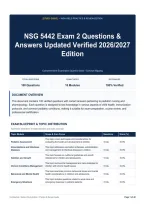
[STUDY GUIDE] • HIGH-YIELD PRACTICE & REVIEW EDITION
NSG 5442 Exam 2 Questions &
Answers Updated Verified 2026/2027
Edition
Comprehensive Examination Question Bank • Concept Mapping
TOTAL QUESTIONS EXAM TOPICS RATIONALES
100 Questions 10 Modules 100% Verified
DOCUMENT OVERVIEW
This document contains 100 verified questions with correct answers pertaining to pediatric nursing and
pharmacology. Each question is designed to test knowledge in various aspects of child health, immunization
protocols, and common pediatric conditions, making it suitable for exam preparation, course review, and
professional certification.
EXAM BLUEPRINT & TOPIC DISTRIBUTION
Systematic breakdown of subject domains and exam coverage.
Topic Module Scope & Core Focus Questions Share (%)
This topic covers techniques and considerations for
Pediatric Assessment evaluating the health and development of children. 10 Qs 10.0%
Immunizations and Infectious This topic addresses vaccination schedules, administration,
Diseases and management of infectious diseases in children. 10 Qs 10.0%
This topic focuses on nutritional guidelines and growth
Nutrition and Growth milestones for children and adolescents. 10 Qs 10.0%
This topic involves the management and care strategies for
Chronic Conditions Management children with chronic health issues. 10 Qs 10.0%
This topic examines common behavioral issues and mental
Behavioral and Mental Health health considerations in children and adolescents. 10 Qs 10.0%
This topic includes questions related to acute care and
Emergency Situations emergency response in pediatric patients. 10 Qs 10.0%
Confidential • Student Study Edition • Practice & Review Guide Page 1 of 40
,STUDENT STUDY & MASTERY EDITION PRACTICE & REVIEW GUIDE
This topic focuses on the impact of family structure and
Family Dynamics and Parenting parenting styles on child health and development. 10 Qs 10.0%
Sleep and Developmental This topic addresses sleep patterns and developmental
Concerns issues in young children. 10 Qs 10.0%
This topic covers the protocols for diagnosing and treating
Infectious Disease Protocols common infectious diseases in pediatrics. 10 Qs 10.0%
Physical Examination This topic focuses on the techniques used for conducting
Techniques physical examinations in children. 10 Qs 10.0%
Total Exam Coverage 10 Integrated Topic Modules 100 Qs 100.0%
Confidential • Student Study Edition • Practice & Review Guide Page 2 of 40
,STUDENT STUDY & MASTERY EDITION PRACTICE & REVIEW GUIDE
TOPIC 1: PEDIATRIC ASSESSMENT
10 Questions • 10.0% of Exam • This topic covers techniques and considerations for evaluating the health and development of
children.
QUESTION 1
A 5-year-old child is hit in the face with a baseball bat and is brought to the clinic by a
parent. An exam reveals three avulsed front teeth. Radiologic studies are negative for
facial
fractures. What is the recommended treatment?
A. Prescribe tetracycline 4.4 mg/kg twice daily for 7 to 10 days.
B. Refer the child to a dentist for reimplantation of the avulsed teeth.
C. Refer the child to a dentist immediately for further examination
D. Remove th.e teeth, place them in saline, and refer the child to a dentist.
Answer: C. Refer the child to a dentist immediately for further examination.
QUESTION 2
The primary care pediatric nurse practitioner is examining a 6-year-old Child who
attends first grade. The child reports "hating" school. The parent states that the child
pretends to be sick frequently in order to stay home from school. To further assess this
situation, the nurse practitioner will first ask the child
A. about school performance and grades.
B. why school is so distressing.
C. to name one or two friends.
D. whether bullying is taking place.
Answer: C. to name one or two friends.
Confidential • Student Study Edition • Practice & Review Guide Page 3 of 40
, STUDENT STUDY & MASTERY EDITION PRACTICE & REVIEW GUIDE
QUESTION 3
The primary care pediatric nurse practitioner is preparing to conduct a well child
assessment of an 8-year-old child. How will the nurse practitioner begin the exam?
A. Ask the child about school, friends, home activities, and sports
B. Discuss the purpose of the visit and explain the procedures that will be performed
C. Offer age appropriate information about usual developmental tasks
D. Provide information about healthy nutrition and physical activities
Answer: A. Ask the child about school, friends, home activities, and sports.
QUESTION 4
The primary care pediatric nurse practitioner is examining a school age child who
complains of frequent stomach pain and headaches. The parent reports that the child
misses several days of school each month. The child has a normal exam. Before
proceeding with further diagnostic tests, what will the nurse practitioner initially ask
the parent?
A. About the timing of the symptoms each day and during the week
B. How well the child performs in school and in extracurricular activities
C. If the parent feels a strong need to protect the child from problems
D. Whether there are any unusual stressors or circumstances at home
Answer: A. About the timing of the symptoms each day and during the week.
QUESTION 5
The primary care pediatric nurse practitioner is evaluating recurrent stomach pain in a
school age child. The child's exam is normal. The nurse practitioner learns that the
child reports pain most evenings after school and refuses to participate in sports but
does not have nausea or vomiting. The child's grandmother recently had gallbladder
surgery. Which action is correct?
A. Encourage the child to keep a log of pain, stool patterns, and dietary intake
B. Order radiologic studies and laboratory tests to rule out systemic causes
C. Reassure the child and encourage resuming sports when symptoms subside
D. Refer the child to a counselor to discuss anxiety about health problems
Answer: A. Encourage the child to keep a log of pain, stool patterns, and dietary intake.
Confidential • Student Study Edition • Practice & Review Guide Page 4 of 40