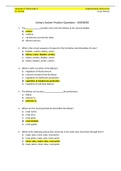
Urinary System practice correct questions and answers
1. The transfer urine from the kidneys to the urinary bladder. a) ureters b) urethras c) vas deferens and uterine tubes d) efferent arteries 2. What is the correct sequence of organs for the formation and elimination of urine? a) bladder, urethra, kidney, ureter b) kidney, ureter, bladder, urethra c) kidney, urethra, bladder, ureter d) kidney, bladder, ureter, urethra 3. Which is NOT a function of the kidneys? a) regulation of blood pressure b) removal of wastes from the blood c) regulation of erythrocyte production d) regulation of lymphocyte production e) regulation of acid-base balance 4. The kidneys are located the peritoneum. a) Within b) anterior to c) posterior to 5. Where are the renal pyramids located within the kidney? a) renal cortex b) renal sinus c) renal pelvis d) renal medulla e) renal papilla 6. Which of the following choices lists structures in the order that urine flows through them? a) major calyx, minor calyx, renal pelvis b) renal pelvis, major calyx, minor pelvis c) minor calyx, major calyx, renal pelvis d) major pelvis, minor calyx, renal pelvis e) major calyx, renal pelvis, minor calyx 7. The first structure in the kidney to collect newly formed urine is the: a) renal capsule b) minor calyx c) renal pelvis d) renal sinus e) renal cortex 8. The renal corpuscle is located within the: a) collecting duct b) renal medulla c) renal cortex d) renal pelvis 9. The thick tangle of capillary loops found within a corpuscle is known as the: a) Bowman b) convoluted capillary bed c) glomerular capsule d) glomerulus e) nephron 10. Which is NOT correct regarding nephrons: a) the renal corpuscle includes the glomerulus and the glomerular capsule b) the renal tubule is composed of the proximal convoluted tubule, nephron loop, and distal convoluted tubule c) the nephron is the functional filtration unit in the kidney d) eighty-five percent of nephrons are cortical nephrons e) the renal corpuscle may be located in the renal cortex or renal medulla 11. The main parts of the juxtaglomerular apparatus are the: a) principal cells and macula densa b) granular cells and macula densa c) granular cells and intercalated cells d) intercalated cells and principal cells e) principal cells and granular cells 12. Granular cells synthesize and release the enzyme: a) angiotensinogen b) antidiuretic hormone c) renin d) calcitriol 13. Which is the correct sequence of arteries that a drop of blood would flow through as it entered the kidney and moves toward a glomerulus? a) Segmental artery – interlobar artery – interlobular artery – renal artery – arcuate artery b) Interlobar artery – segmental artery – interlobular artery – renal artery – arcuate artery c) Renal artery – interlobar artery – segmental artery – arcuate artery – interlobular artery d) Renal artery – segmental artery – interlobar artery – arcuate artery – interlobular artery e) Arcuate artery – interlobular artery – segmental artery – interlobar artery – renal artery 14. Fluid contained with a minor calyx is called urine. a) true b) false 15. Place the regions of the nephron in the correct order for the process of urine formation. a) Capsular space of glomerulus b) Nephron loop c) Collecting duct A, E, B, D, C d) Distal convoluted tubule e) Proximal convoluted tubule 16. Urine passes from a papillary duct into a: a) Major calyx, then to a minor calyx, then to a ureter b) Minor calyx, then to a major calyx, then to the renal pelvis c) Ureter, then to a minor calyx, then to a major calyx d) Renal pelvis, then to a major calyx, then to a ureter e) Collecting duct, then to a minor calyx, then to a major calyx 17. Which step(s) in the process of urine formation occur in the renal tubule? a) Filtration only b) Secretion only c) Reabsorption only d) Filtration, secretion, and reabsorption e) Secretion and reabsorption only 18. How are the processes of reabsorption and secretion related? a) They both involve movement of material from the blood into the tubular fluid b) Materials m
Document information
- Uploaded on
- August 16, 2021
- Number of pages
- 13
- Written in
- 2021/2022
- Type
- Exam (elaborations)
- Contains
- Questions & answers