
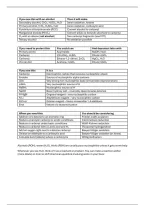
If you see this with an alcohol Then it will make
Secondary alcohol, CrO3, H2SO4, H2O Jones oxidation, ketone
Primary alcohol, CrO3, H2SO4, H2O Jones oxidation, carboxylic acid
Pyridinium chlorochromate (PCC) Convert alcohol to carbonyl
Manganese dioxide (MnO2) Convert allylic or benzylic alcohols to carbonyl
O3 with an alkene (not alcohol) Two carbonyl fragments (see MT1)
Tertiary alcohol No oxidation possible
If you need to protect this You could use And deprotect later with
Primary amine Acyl halide NaOH, heat
Carbonyl (CH3OH)2, H2SO4 Dilute H2SO4
Carbonyl Ethane-1,2-dithiol, ZnCl2 HgCl2, H2O
Vicinal diol Acetone, H2SO4 Dilute H2SO4
If you see this It is a
Carbonyl Electrophilic carbon that receives nucleophilic attack
Enolate Source of nucleophilic alpha carbons
LDA Very strong non-nucleophilic base (irreversible deprotonation)
LiAlH4 Very nucleophilic source of H-
NaBH4 Nucleophilic source of H-
NaOH Basic hydroxy salt – reversibly deprotonates ketones
R-MgBr Grignard reagent – very nucleophilic carbon
R-Li Alkyllithium reagent – very nucleophilic carbon
R2CuLi Gilman reagent – favors irreversible 1,4 additions
Enol Ketone via tautomerization
When you need this You should be considering
Addition of a ketone to an aromatic ring Friedel-crafts acylation
Reduce a benzylic carbonyl in acidic conditions Clemmensen reduction
Reduce a carbonyl under basic conditions Wolff-Kishner reduction
Reduce a carbonyl with a Lewis acid and H2 Thioacetal hydrogenation
Add an oxygen right next to a ketone carbonyl Baeyer-Villiger oxidation
Oxidize an aldehyde to a carboxylic acid Baeyer-Villiger oxidation (or Jones)
A double bond (alkene) where a carbonyl is Wittig olefination
Alcohols (ROH), water (H2O), thiols (RSH) are usually poor nucleophiles unless it gets some help
Whenever you see H2O, think of it as a reactant or product. You can make a reaction wetter
(more dilute) or drier to shift chemical equilibria involving water in your favor.
, Carbonyls have electrophilic carbons that allow for nucleophilic attack
This is due to the highly polar oxygen-carbon bond that withdraws electron density from
the carbon, leaving the carbon electron deficient.
Strong nucleophiles (which are basic) can often directly attack this electrophilic carbon
which creates an anion intermediate, which can then react with a workup to form an
alcohol.
Weaker nucleophiles (under acidic conditions) can still attack this electrophilic carbon if
the carbonyl oxygen is protonated with a strong acid, which weakens the C-O double
bond and therefore increases the electrophilicity of the carbon.
Aldehydes or ketones can be synthesized via oxidation of alcohols
Jones oxidation: oxidation of secondary alcohols to ketones
Note that if you attempted this reaction with a primary alcohol, the presence of sulfuric
acid and water will allow for the nucleophilic attack of water onto the aldehyde, resulting
in a carboxylic acid instead!


