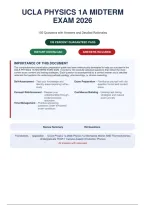
UCLA PHYSICS 1A MIDTERM
EXAM 2026
150 Questions with Answers and Detailed Rationales
100 PERCENT GUARANTEED PASS
INSTANT DOWNLOAD ANSWERS INCLUDED
IMPORTANCE OF THIS DOCUMENT
This comprehensive examination preparation guide has been meticulously developed to help you succeed in the
UCLA PHYSICS 1A MIDTERM EXAM 2026. It contains 150 carefully selected questions that reflect the most
current exam content and testing strategies. Each question is accompanied by a correct answer and a detailed
rationale that explains the underlying pathophysiology, pharmacology, or clinical reasoning.
Self-Assessment – Test your knowledge and Exam Preparation – Familiarize yourself with the
identify areas requiring further question format and content
study areas
Concept Reinforcement – Deepen your Confidence Building – Develop test-taking
understanding through strategies and reduce
evidence-based exam anxiety
rationales
Time Management – Practice answering
questions under simulated
exam conditions
Review Summary 150 Questions
Foundations - Application - UCLA Physics 1a 2026 Physics 1a Mechanics Waves AND Thermodynamics
Undergraduate YEAR 1 Calculus-based Introductory Physics
All answers with rationales
,Table of Contents
Content Area Questions Key Topics
Kinematics IN ONE 1-25 Speed, Horizontal, Constant, Force, Block
Dimension
Kinematics IN TWO AND 26-50 Speed, Force, Radius, Block, Magnitude
Three Dimensions
Newton S LAWS OF Motion 51-75 Speed, Horizontal, Block, Radius, Ground
Applications OF Newton S 76-100 Speed, Radius, Force, Horizontal, Block
LAWS Friction Circular
Motion
WORK Energy AND Power 101-125 Horizontal, Block, Speed, Angle, Object
Conservation OF Energy 126-150 Force, Speed, Horizontal, Constant, Magnitude
TOTAL 150 All questions include answers and detailed rationales
,Section A - Kinematics IN ONE Dimension
Q1.
A ball is thrown straight upward with an initial speed of 20 m/s. Ignoring air resistance,
what is the ball's velocity 3.0 s after being thrown?
A. 10 m/s upward B. 10 m/s downward
C. 20 m/s downward D. 0 m/s
Correct: B - 10 m/s downward
Rationale:Using v = v0 + at with v0 = +20 m/s, a = -9.8 m/s², and t = 3.0 s gives v = 20 - 29.4
= -9.4 m/s, which rounds to approximately 10 m/s downward. The negative sign indicates the
ball is moving downward after reaching its peak.
Why the other answers are wrong:
A. This would be the velocity if gravity were ignored or if the ball were still ascending, but after
3.0 s it is descending.
C. The magnitude is too large; the ball's speed decreases by about 9.8 m/s each second, not
20 m/s.
D. The ball reaches zero velocity at its peak (about 2.04 s), not at 3.0 s.
Reference: Serway & Jewett, Physics for Scientists and Engineers, 10th Ed., Ch. 2
Q2.
A 5.0-kg block is pushed across a horizontal floor by a constant horizontal force of 30 N. If
the coefficient of kinetic friction is 0.20, what is the block's acceleration?
A. 4.0 m/s² B. 6.0 m/s²
C. 2.0 m/s² D. 8.0 m/s²
Correct: A - 4.0 m/s²
Rationale:The net force is F - f_k = 30 N - (0.20)(5.0 kg)(9.8 m/s²) = 30 - 9.8 = 20.2 N. Then
a = F_net/m = 20.2/5.0 4.0 m/s².
Why the other answers are wrong:
B. This ignores friction entirely (30/5 = 6 m/s²).
C. This incorrectly subtracts a larger friction force or uses mass incorrectly.
D. This adds friction instead of subtracting it.
Reference: Halliday, Resnick, & Walker, Fundamentals of Physics, 12th Ed., Ch. 6
Page 3
, Section A - Kinematics IN ONE Dimension
Q3.
A 2.0-kg object moving at 3.0 m/s collides head-on with a 4.0-kg object at rest. If the
collision is perfectly elastic, what is the final velocity of the 2.0-kg object?
A. 1.0 m/s in the original direction B. 1.0 m/s opposite to the original direction
C. 3.0 m/s opposite to the original direction D. 0 m/s
Correct: B - 1.0 m/s opposite to the original direction
Rationale:For a perfectly elastic collision with a stationary target, v1' = (m1 - m2)/(m1 + m2) *
v1 = (2-4)/(6) * 3 = -1.0 m/s, meaning 1.0 m/s opposite to the original direction.
Why the other answers are wrong:
A. The sign is incorrect; the lighter object rebounds backward.
C. This would be the case if the target were much more massive, but here the mass ratio is
1:2.
D. This would occur only if the masses were equal and the collision were elastic.
Reference: Knight, Physics for Scientists and Engineers, 4th Ed., Ch. 10
Q4.
A solid sphere and a hollow sphere of the same mass and radius roll without slipping
down an incline. Which one reaches the bottom first?
A. The solid sphere B. The hollow sphere
C. Both reach at the same time D. It depends on the angle of the incline
Correct: A - The solid sphere
Rationale:The solid sphere has a smaller moment of inertia (2/5 MR²) compared to the
hollow sphere (2/3 MR²), so less energy goes into rotation and more into translation, giving it
greater acceleration.
Why the other answers are wrong:
B. The hollow sphere has a larger moment of inertia, so it accelerates more slowly.
C. The mass distribution affects rotational inertia, so they do not tie.
D. The angle affects both equally; the ranking depends only on the moment of inertia.
Reference: Young & Freedman, University Physics, 15th Ed., Ch. 10
Q5.
A simple pendulum has a period of 2.0 s on Earth. What is its period on the surface of the
Moon, where g is about 1/6 that of Earth?
A. 0.82 s B. 2.0 s
Page 4
EXAM 2026
150 Questions with Answers and Detailed Rationales
100 PERCENT GUARANTEED PASS
INSTANT DOWNLOAD ANSWERS INCLUDED
IMPORTANCE OF THIS DOCUMENT
This comprehensive examination preparation guide has been meticulously developed to help you succeed in the
UCLA PHYSICS 1A MIDTERM EXAM 2026. It contains 150 carefully selected questions that reflect the most
current exam content and testing strategies. Each question is accompanied by a correct answer and a detailed
rationale that explains the underlying pathophysiology, pharmacology, or clinical reasoning.
Self-Assessment – Test your knowledge and Exam Preparation – Familiarize yourself with the
identify areas requiring further question format and content
study areas
Concept Reinforcement – Deepen your Confidence Building – Develop test-taking
understanding through strategies and reduce
evidence-based exam anxiety
rationales
Time Management – Practice answering
questions under simulated
exam conditions
Review Summary 150 Questions
Foundations - Application - UCLA Physics 1a 2026 Physics 1a Mechanics Waves AND Thermodynamics
Undergraduate YEAR 1 Calculus-based Introductory Physics
All answers with rationales
,Table of Contents
Content Area Questions Key Topics
Kinematics IN ONE 1-25 Speed, Horizontal, Constant, Force, Block
Dimension
Kinematics IN TWO AND 26-50 Speed, Force, Radius, Block, Magnitude
Three Dimensions
Newton S LAWS OF Motion 51-75 Speed, Horizontal, Block, Radius, Ground
Applications OF Newton S 76-100 Speed, Radius, Force, Horizontal, Block
LAWS Friction Circular
Motion
WORK Energy AND Power 101-125 Horizontal, Block, Speed, Angle, Object
Conservation OF Energy 126-150 Force, Speed, Horizontal, Constant, Magnitude
TOTAL 150 All questions include answers and detailed rationales
,Section A - Kinematics IN ONE Dimension
Q1.
A ball is thrown straight upward with an initial speed of 20 m/s. Ignoring air resistance,
what is the ball's velocity 3.0 s after being thrown?
A. 10 m/s upward B. 10 m/s downward
C. 20 m/s downward D. 0 m/s
Correct: B - 10 m/s downward
Rationale:Using v = v0 + at with v0 = +20 m/s, a = -9.8 m/s², and t = 3.0 s gives v = 20 - 29.4
= -9.4 m/s, which rounds to approximately 10 m/s downward. The negative sign indicates the
ball is moving downward after reaching its peak.
Why the other answers are wrong:
A. This would be the velocity if gravity were ignored or if the ball were still ascending, but after
3.0 s it is descending.
C. The magnitude is too large; the ball's speed decreases by about 9.8 m/s each second, not
20 m/s.
D. The ball reaches zero velocity at its peak (about 2.04 s), not at 3.0 s.
Reference: Serway & Jewett, Physics for Scientists and Engineers, 10th Ed., Ch. 2
Q2.
A 5.0-kg block is pushed across a horizontal floor by a constant horizontal force of 30 N. If
the coefficient of kinetic friction is 0.20, what is the block's acceleration?
A. 4.0 m/s² B. 6.0 m/s²
C. 2.0 m/s² D. 8.0 m/s²
Correct: A - 4.0 m/s²
Rationale:The net force is F - f_k = 30 N - (0.20)(5.0 kg)(9.8 m/s²) = 30 - 9.8 = 20.2 N. Then
a = F_net/m = 20.2/5.0 4.0 m/s².
Why the other answers are wrong:
B. This ignores friction entirely (30/5 = 6 m/s²).
C. This incorrectly subtracts a larger friction force or uses mass incorrectly.
D. This adds friction instead of subtracting it.
Reference: Halliday, Resnick, & Walker, Fundamentals of Physics, 12th Ed., Ch. 6
Page 3
, Section A - Kinematics IN ONE Dimension
Q3.
A 2.0-kg object moving at 3.0 m/s collides head-on with a 4.0-kg object at rest. If the
collision is perfectly elastic, what is the final velocity of the 2.0-kg object?
A. 1.0 m/s in the original direction B. 1.0 m/s opposite to the original direction
C. 3.0 m/s opposite to the original direction D. 0 m/s
Correct: B - 1.0 m/s opposite to the original direction
Rationale:For a perfectly elastic collision with a stationary target, v1' = (m1 - m2)/(m1 + m2) *
v1 = (2-4)/(6) * 3 = -1.0 m/s, meaning 1.0 m/s opposite to the original direction.
Why the other answers are wrong:
A. The sign is incorrect; the lighter object rebounds backward.
C. This would be the case if the target were much more massive, but here the mass ratio is
1:2.
D. This would occur only if the masses were equal and the collision were elastic.
Reference: Knight, Physics for Scientists and Engineers, 4th Ed., Ch. 10
Q4.
A solid sphere and a hollow sphere of the same mass and radius roll without slipping
down an incline. Which one reaches the bottom first?
A. The solid sphere B. The hollow sphere
C. Both reach at the same time D. It depends on the angle of the incline
Correct: A - The solid sphere
Rationale:The solid sphere has a smaller moment of inertia (2/5 MR²) compared to the
hollow sphere (2/3 MR²), so less energy goes into rotation and more into translation, giving it
greater acceleration.
Why the other answers are wrong:
B. The hollow sphere has a larger moment of inertia, so it accelerates more slowly.
C. The mass distribution affects rotational inertia, so they do not tie.
D. The angle affects both equally; the ranking depends only on the moment of inertia.
Reference: Young & Freedman, University Physics, 15th Ed., Ch. 10
Q5.
A simple pendulum has a period of 2.0 s on Earth. What is its period on the surface of the
Moon, where g is about 1/6 that of Earth?
A. 0.82 s B. 2.0 s
Page 4