
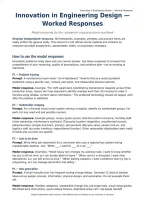
Innovation in Engineering Design — Worked Responses
Innovation in Engineering Design —
Worked Responses
Model reasoning for the companion original practice workbook
Original independent resource. All frameworks, examples, prompts, and practice items are
newly written for general study. This resource is not official course material and contains no
instructor-provided assignments, assessments, slides, or proprietary examples.
How to use the model responses
Innovation problems rarely have only one correct answer. Use these responses to compare the
completeness of your reasoning, quality of assumptions, and evidence plan—not as wording to
memorize.
P1 — Problem framing
Prompt. A maintenance team wants “an AI dashboard.” Rewrite this as a neutral problem
statement using a specific user, context, pain point, and measurable desired outcome.
Model response. Example: “For shift supervisors coordinating maintenance requests across three
production areas, reduce the time required to identify overdue work from 20 minutes to under 5
minutes using reliable, current status information.” The preferred technology should not appear until
after the problem is validated.
P2 — Stakeholder mapping
Prompt. For a fictional smart locker system serving a hospital, identify six stakeholder groups. For
each, list one need and one possible concern.
Model response. Example groups: nurses (quick access; infection-control concerns), facilities staff
(clear ownership; maintenance workload), IT/security (system integration; unauthorized access),
patients/visitors (simple directions; privacy), procurement (lifecycle value; vendor lock-in), and
logistics staff (accurate inventory; replenishment burden). Other reasonable stakeholders earn credit
if needs and concerns are specific.
P3 — Jobs to be done
Prompt. Write three job statements for a commuter who uses a regional bus system during
unpredictable weather. Use: “When ___, I want to ___, so I can ___.”
Model response. Examples: “When heavy rain changes my walking route, I want to know whether
my bus is still on time, so I can decide when to leave.” “When service is disrupted, I want clear
alternatives, so I can still arrive at work.” “When waiting outdoors, I want confidence that my trip is
progressing, so I can manage discomfort and safety.”
P4 — Idea generation
Prompt. A small manufacturer has frequent tooling-change delays. Generate 12 distinct solution
ideas across people, process, information, physical design, and automation. Do not evaluate them
yet.
Model response. Possible categories: standardize change kits, pre-stage tools, visual setup guides,
QR-linked work instructions, quick-release fixtures, dedicated setup cart, role-based handoff
Original independent study resource | Not affiliated with or endorsed by any university or instructor
Innovation in Engineering Design —
Worked Responses
Model reasoning for the companion original practice workbook
Original independent resource. All frameworks, examples, prompts, and practice items are
newly written for general study. This resource is not official course material and contains no
instructor-provided assignments, assessments, slides, or proprietary examples.
How to use the model responses
Innovation problems rarely have only one correct answer. Use these responses to compare the
completeness of your reasoning, quality of assumptions, and evidence plan—not as wording to
memorize.
P1 — Problem framing
Prompt. A maintenance team wants “an AI dashboard.” Rewrite this as a neutral problem
statement using a specific user, context, pain point, and measurable desired outcome.
Model response. Example: “For shift supervisors coordinating maintenance requests across three
production areas, reduce the time required to identify overdue work from 20 minutes to under 5
minutes using reliable, current status information.” The preferred technology should not appear until
after the problem is validated.
P2 — Stakeholder mapping
Prompt. For a fictional smart locker system serving a hospital, identify six stakeholder groups. For
each, list one need and one possible concern.
Model response. Example groups: nurses (quick access; infection-control concerns), facilities staff
(clear ownership; maintenance workload), IT/security (system integration; unauthorized access),
patients/visitors (simple directions; privacy), procurement (lifecycle value; vendor lock-in), and
logistics staff (accurate inventory; replenishment burden). Other reasonable stakeholders earn credit
if needs and concerns are specific.
P3 — Jobs to be done
Prompt. Write three job statements for a commuter who uses a regional bus system during
unpredictable weather. Use: “When ___, I want to ___, so I can ___.”
Model response. Examples: “When heavy rain changes my walking route, I want to know whether
my bus is still on time, so I can decide when to leave.” “When service is disrupted, I want clear
alternatives, so I can still arrive at work.” “When waiting outdoors, I want confidence that my trip is
progressing, so I can manage discomfort and safety.”
P4 — Idea generation
Prompt. A small manufacturer has frequent tooling-change delays. Generate 12 distinct solution
ideas across people, process, information, physical design, and automation. Do not evaluate them
yet.
Model response. Possible categories: standardize change kits, pre-stage tools, visual setup guides,
QR-linked work instructions, quick-release fixtures, dedicated setup cart, role-based handoff
Original independent study resource | Not affiliated with or endorsed by any university or instructor


