The Innovation in Engineering Design Toolkit is an original Excel-based resource for students and early-stage project teams who need practical templates for evaluating concepts, planning experiments, and managing assumptions and risks. It contains three editable worksheets that support key stages of the innovation and engineering-design process: a Weighted Decision Matrix, an Experiment Canvas, and an Assumptions and Risk Log.
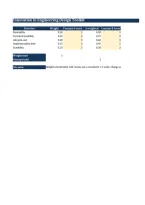
The Weighted Decision Matrix sheet helps users compare up to three concepts using clearly defined criteria and weighted scores. It includes five example criteria—desirability, technical feasibility, lifecycle cost, implementation time, and scalability—with editable weights and 1–5 concept scores. Built-in formulas automatically calculate each weighted score, total the criterion weights, and calculate an overall total for each concept. A use note reminds users that weights should total 1.00 and encourages sensitivity testing by adjusting weights to determine whether rankings change under different priorities. This template is useful for engineering design projects, concept selection, product-development proposals, and design-thinking assignments.
The Experiment Canvas provides a structured one-page planning format for designing evidence-based tests. Users can document the decision being informed, target user or segment, assumption or risk, testable hypothesis, prototype or intervention, test method, metric and success threshold, sample size or duration, result, and recommended next action. It is designed to help users avoid building more than necessary before testing the uncertainty that matters most. The template can support usability tests, interviews, pilot programs, A/B comparisons, bench tests, process trials, and proof-of-concept experiments.
The Assumptions and Risk Log provides a simple, editable way to identify and prioritize uncertainty. It includes fields for the assumption or risk, why it matters, evidence currently available, likelihood rating, impact rating, and the next evidence-gathering action. This makes it useful for documenting project risks, identifying weak assumptions before implementation, and deciding which uncertainties should be tested first.
This toolkit is particularly suited for innovation engineering, engineering design, design thinking, product development, entrepreneurship, innovation management, project planning, and capstone design. It is an independent original study and planning resource; it is not official instructor, university, or course material.
Content preview
Innovation in Engineering Design Toolkit
Criterion Weight Concept A score A weighted Concept B score
Desirability 0.30 3 0.90 3
Technical feasibility 0.25 3 0.75 3
Lifecycle cost 0.20 3 0.60 3
Implementation time 0.15 3 0.45 3
Scalability 0.10 3 0.30 3
Weight total 1
Concept total 3
Use note: Weights should total 1.00. Scores use a consistent 1–5 scale. Change weights to test sensitivity
, B weighted Concept C score C weighted
0.90 3 0.90
0.75 3 0.75
0.60 3 0.60
0.45 3 0.45
0.30 3 0.30
3 3
le. Change weights to test sensitivity.