
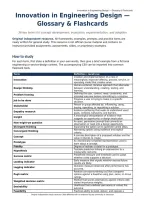
Innovation in Engineering Design — Glossary & Flashcards
Innovation in Engineering Design —
Glossary & Flashcards
36 key terms for concept development, evaluation, experimentation, and adoption
Original independent resource. All frameworks, examples, prompts, and practice items are
newly written for general study. This resource is not official course material and contains no
instructor-provided assignments, assessments, slides, or proprietary examples.
How to study
For each term, first state a definition in your own words, then give a brief example from a fictional
engineering or service-design context. The accompanying CSV can be imported into common
flashcard tools.
Term Definition / recall cue
Creation and implementation of a new or
Innovation meaningfully improved offering, process, service, or
operating model that creates value.
Human-centered, iterative approach that alternates
Design thinking between understanding, creating, testing, and
learning.
Defining the user, context, need, constraints, and
Problem framing
intended outcome before committing to a solution.
Progress a user is trying to make in a specific
Job to be done
situation.
Person or group affected by, influencing, using,
Stakeholder
buying, operating, or regulating a solution.
Evidence-gathering that seeks to understand users’
Empathy research
goals, contexts, behaviors, and barriers.
A meaningful interpretation of evidence that
Insight
suggests an opportunity or design implication.
An open, generative prompt that converts an
How-might-we question
observation or need into a design opportunity.
Divergent thinking Expanding the option set to generate varied ideas.
Narrowing options using evidence and explicit
Convergent thinking
criteria.
A concise description of a proposed solution and the
Concept
value it intends to create.
An intentionally simplified representation used to
Prototype
learn about a concept.
Fidelity Degree of realism or detail in a prototype.
Testable prediction linking an intervention to a
Hypothesis
measurable outcome.
Predefined measure and threshold used to judge
Success metric
whether a test supports a decision.
Early measure that signals whether desired future
Leading indicator
results are likely.
Outcome measure observed after performance has
Lagging indicator
occurred.
Relative concept-screening tool that compares
Pugh matrix options against a baseline using plus, same, or minus
ratings.
Method that scores alternatives against criteria with
Weighted decision matrix
stated importance weights.
Likelihood that a defined user wants or values the
Desirability
outcome.
Feasibility Practical ability to build, deliver, and operate a
Original independent study resource | Not affiliated with or endorsed by any university or instructor
Innovation in Engineering Design —
Glossary & Flashcards
36 key terms for concept development, evaluation, experimentation, and adoption
Original independent resource. All frameworks, examples, prompts, and practice items are
newly written for general study. This resource is not official course material and contains no
instructor-provided assignments, assessments, slides, or proprietary examples.
How to study
For each term, first state a definition in your own words, then give a brief example from a fictional
engineering or service-design context. The accompanying CSV can be imported into common
flashcard tools.
Term Definition / recall cue
Creation and implementation of a new or
Innovation meaningfully improved offering, process, service, or
operating model that creates value.
Human-centered, iterative approach that alternates
Design thinking between understanding, creating, testing, and
learning.
Defining the user, context, need, constraints, and
Problem framing
intended outcome before committing to a solution.
Progress a user is trying to make in a specific
Job to be done
situation.
Person or group affected by, influencing, using,
Stakeholder
buying, operating, or regulating a solution.
Evidence-gathering that seeks to understand users’
Empathy research
goals, contexts, behaviors, and barriers.
A meaningful interpretation of evidence that
Insight
suggests an opportunity or design implication.
An open, generative prompt that converts an
How-might-we question
observation or need into a design opportunity.
Divergent thinking Expanding the option set to generate varied ideas.
Narrowing options using evidence and explicit
Convergent thinking
criteria.
A concise description of a proposed solution and the
Concept
value it intends to create.
An intentionally simplified representation used to
Prototype
learn about a concept.
Fidelity Degree of realism or detail in a prototype.
Testable prediction linking an intervention to a
Hypothesis
measurable outcome.
Predefined measure and threshold used to judge
Success metric
whether a test supports a decision.
Early measure that signals whether desired future
Leading indicator
results are likely.
Outcome measure observed after performance has
Lagging indicator
occurred.
Relative concept-screening tool that compares
Pugh matrix options against a baseline using plus, same, or minus
ratings.
Method that scores alternatives against criteria with
Weighted decision matrix
stated importance weights.
Likelihood that a defined user wants or values the
Desirability
outcome.
Feasibility Practical ability to build, deliver, and operate a
Original independent study resource | Not affiliated with or endorsed by any university or instructor


