
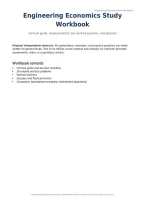
Engineering Economics Study Workbook
Engineering Economics Study
Workbook
Formula guide, original practice set, worked solutions, and glossary
Original independent resource. All explanations, examples, and practice questions are newly
written for general study. This is not official course material and contains no instructor-provided
assessments, slides, or proprietary content.
Workbook contents
Formula guide and decision workflow
20 original practice problems
Worked solutions
Glossary and flashcard terms
Companion spreadsheet templates (distributed separately)
Original independent study resource | Not affiliated with or endorsed by any university or instructor
, Engineering Economics Study Workbook
Part I — Formula Guide
1. Time value of money
A dollar today can be invested, while a dollar received later cannot. Convert every alternative to the
same point in time before comparing it.
2. Core factor relationships
Use i as the effective interest rate per period and n as the number of periods. The rate period and
cash-flow period must match.
3. Worth methods
Present worth (PW), annual worth (AW/EUAW), future worth (FW), and rate of return are equivalent
comparison lenses when applied consistently.
4. Decision rules
For independent projects, accept if PW ≥ 0 at the MARR. For mutually exclusive alternatives, choose
the alternative with the best economically equivalent measure over a common study period.
5. Depreciation and taxes
Depreciation is a noncash expense but can create a tax shield. After-tax cash flow should be built
from revenues, costs, depreciation, and taxes—not by simply taxing a gross cash-flow number.
6. Uncertainty and sensitivity
Test the assumptions that can change the recommendation: demand, operating cost, salvage value,
project life, and MARR.
Factor Equation Use
Compound amount: move a
F/P F = P(1+i)^n
present value forward
Present worth of a single future
P/F P = F(1+i)^−n
amount
F/A F = A[((1+i)^n−1)/i] Future worth of a uniform series
A/F A = F[i/((1+i)^n−1)] Sinking-fund deposit
P/A P = A[((1+i)^n−1)/(i(1+i)^n)] Present worth of a uniform series
A/P A = P[i(1+i)^n/((1+i)^n−1)] Capital-recovery factor
Present worth of an arithmetic
P/G P = G[((1+i)^n−in−1)/(i²(1+i)^n)] gradient; first increment occurs in
year 2
Decision workflow
Draw the timeline and sign every flow.
Align rate and period.
Select a measure appropriate to the choice.
Calculate consistently.
State the decision rule and conclusion.
Original independent study resource | Not affiliated with or endorsed by any university or instructor
Engineering Economics Study
Workbook
Formula guide, original practice set, worked solutions, and glossary
Original independent resource. All explanations, examples, and practice questions are newly
written for general study. This is not official course material and contains no instructor-provided
assessments, slides, or proprietary content.
Workbook contents
Formula guide and decision workflow
20 original practice problems
Worked solutions
Glossary and flashcard terms
Companion spreadsheet templates (distributed separately)
Original independent study resource | Not affiliated with or endorsed by any university or instructor
, Engineering Economics Study Workbook
Part I — Formula Guide
1. Time value of money
A dollar today can be invested, while a dollar received later cannot. Convert every alternative to the
same point in time before comparing it.
2. Core factor relationships
Use i as the effective interest rate per period and n as the number of periods. The rate period and
cash-flow period must match.
3. Worth methods
Present worth (PW), annual worth (AW/EUAW), future worth (FW), and rate of return are equivalent
comparison lenses when applied consistently.
4. Decision rules
For independent projects, accept if PW ≥ 0 at the MARR. For mutually exclusive alternatives, choose
the alternative with the best economically equivalent measure over a common study period.
5. Depreciation and taxes
Depreciation is a noncash expense but can create a tax shield. After-tax cash flow should be built
from revenues, costs, depreciation, and taxes—not by simply taxing a gross cash-flow number.
6. Uncertainty and sensitivity
Test the assumptions that can change the recommendation: demand, operating cost, salvage value,
project life, and MARR.
Factor Equation Use
Compound amount: move a
F/P F = P(1+i)^n
present value forward
Present worth of a single future
P/F P = F(1+i)^−n
amount
F/A F = A[((1+i)^n−1)/i] Future worth of a uniform series
A/F A = F[i/((1+i)^n−1)] Sinking-fund deposit
P/A P = A[((1+i)^n−1)/(i(1+i)^n)] Present worth of a uniform series
A/P A = P[i(1+i)^n/((1+i)^n−1)] Capital-recovery factor
Present worth of an arithmetic
P/G P = G[((1+i)^n−in−1)/(i²(1+i)^n)] gradient; first increment occurs in
year 2
Decision workflow
Draw the timeline and sign every flow.
Align rate and period.
Select a measure appropriate to the choice.
Calculate consistently.
State the decision rule and conclusion.
Original independent study resource | Not affiliated with or endorsed by any university or instructor


