
CLASS 10 PHYSICS EXAM GUIDE CBSE & State Boards
4 Core Chapters
Complete Revision & High-Yield Summary | Physics Board Preparation
01 Electricity
KEY EQUATIONS & MASTER FORMULAS
I=Q/t V=W/Q V=I·R
Current (A = C/s) Potential Diff. (V = J/C) Ohm's Law
R = ρ · (l / A) H = I² · R · t P = VI = I²R = V²/R
Resistivity (ρ in Ω·m) Joule's Heating Law Electric Power (Watts)
Core Laws & Definitions Joule's Law & Commercial Power
I
Ohm's Law: The electric current ( ) flowing through a Joule's Law of Heating: Heat produced ( ) is H
metallic conductor is directly proportional to the directly proportional to (1) square of current ( ), (2) I²
V
potential difference ( ) across its ends, provided R
resistance ( ), and (3) time ( ). t
temperature remains constant ( V ∝ I). Commercial Unit of Energy: 1 kilowatt-hour ( 1 kWh)
1 Ampere: Flow of 1 Coulomb of charge per second. =3.6 × 10 Joules
⁶ .
1 Volt: Work done of 1 Joule to move a charge of 1 Heating Element Applications: Electric iron, toaster,
Coulomb from one point to another. and heater use alloys like Nichrome due to high
Factors Affecting Resistance: Direct to length ( ), l resistivity and non-oxidation at high temperatures.
A
inverse to cross-sectional area ( ), and depends on Fuse Wire: Protective device made of lead-tin alloy
material & temperature. with low melting point.
R₁
R₁ R₂ R₃
R₂
R₃
V
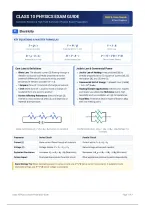
Series Combination: R_s = R₁ + R₂ + R₃ (Current I is constant) Parallel Combination: 1/R_p = 1/R₁ + 1/R₂ + 1/R₃ (Voltage V is
constant)
Parameter Series Circuit Parallel Circuit
I
Current ( ) Same current flows through all resistors. Current splits: I = I₁ + I₂ + I₃
V
Voltage ( ) Voltage divides: V = V₁ + V₂ + V₃ Same voltage across each resistor.
Equivalent Resistance Increases: R_s = R₁ + R₂ + R₃ (Maximum) Decreases: 1/R_p = 1/R₁ + 1/R₂ + 1/R₃ (Minimum)
Failure Impact One break disconnects the entire circuit. Other appliances continue to work independently.
Exam Strategy Tip: When calculating power in series circuits, use P = I²R (since current is constant). In parallel circuits
(domestic wiring), use P = V²/R (since voltage is constant).
Class 10 Physics Board Preparation Guide Page 1 of 3
4 Core Chapters
Complete Revision & High-Yield Summary | Physics Board Preparation
01 Electricity
KEY EQUATIONS & MASTER FORMULAS
I=Q/t V=W/Q V=I·R
Current (A = C/s) Potential Diff. (V = J/C) Ohm's Law
R = ρ · (l / A) H = I² · R · t P = VI = I²R = V²/R
Resistivity (ρ in Ω·m) Joule's Heating Law Electric Power (Watts)
Core Laws & Definitions Joule's Law & Commercial Power
I
Ohm's Law: The electric current ( ) flowing through a Joule's Law of Heating: Heat produced ( ) is H
metallic conductor is directly proportional to the directly proportional to (1) square of current ( ), (2) I²
V
potential difference ( ) across its ends, provided R
resistance ( ), and (3) time ( ). t
temperature remains constant ( V ∝ I). Commercial Unit of Energy: 1 kilowatt-hour ( 1 kWh)
1 Ampere: Flow of 1 Coulomb of charge per second. =3.6 × 10 Joules
⁶ .
1 Volt: Work done of 1 Joule to move a charge of 1 Heating Element Applications: Electric iron, toaster,
Coulomb from one point to another. and heater use alloys like Nichrome due to high
Factors Affecting Resistance: Direct to length ( ), l resistivity and non-oxidation at high temperatures.
A
inverse to cross-sectional area ( ), and depends on Fuse Wire: Protective device made of lead-tin alloy
material & temperature. with low melting point.
R₁
R₁ R₂ R₃
R₂
R₃
V
Series Combination: R_s = R₁ + R₂ + R₃ (Current I is constant) Parallel Combination: 1/R_p = 1/R₁ + 1/R₂ + 1/R₃ (Voltage V is
constant)
Parameter Series Circuit Parallel Circuit
I
Current ( ) Same current flows through all resistors. Current splits: I = I₁ + I₂ + I₃
V
Voltage ( ) Voltage divides: V = V₁ + V₂ + V₃ Same voltage across each resistor.
Equivalent Resistance Increases: R_s = R₁ + R₂ + R₃ (Maximum) Decreases: 1/R_p = 1/R₁ + 1/R₂ + 1/R₃ (Minimum)
Failure Impact One break disconnects the entire circuit. Other appliances continue to work independently.
Exam Strategy Tip: When calculating power in series circuits, use P = I²R (since current is constant). In parallel circuits
(domestic wiring), use P = V²/R (since voltage is constant).
Class 10 Physics Board Preparation Guide Page 1 of 3


