
• Wrong document? Swap it for free
  • Written by students who passed
  • Immediately available after payment
  • Read online or as PDF
Sell
Where do you study
Your language
Document preview thumbnail
Preview 4 out of 725 pages
Exam (elaborations)

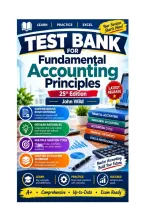
Test Bank for Fundamental Accounting Principles, 25th Edition By John Wild latest release Exam Questions Graded A+.pdf

Document preview thumbnail
Preview 4 out of 725 pages

Strengthen your understanding of accounting concepts and prepare more effectively for quizzes, tests, exams, and coursework with this comprehensive Test Bank for Fundamental Accounting Principles, 25th Edition. This resource follows the 26-chapter organization of the textbook and provides examination-focused coverage across fundamental financial accounting, reporting, financial analysis, and managerial accounting concepts. Designed to support structured chapter-by-chapter study, the material covers essential accounting principles from recording transactions and completing the accounting cycle through managerial accounting, budgeting, cost analysis, performance measurement, and capital budgeting. Complete 26-Chapter Coverage Chapter 1: Accounting in Business Introduces accounting and its role in business decision-making, including users of accounting information, business activities, financial accounting, managerial accounting, and fundamental accounting concepts. Chapter 2: Analyzing and Recording Transactions Covers the accounting equation, accounts, debits and credits, transaction analysis, journalizing, posting, ledgers, and trial balances. Chapter 3: Adjusting Accounts for Financial Statements Focuses on adjusting accounts, accrual accounting, deferrals, accruals, revenue and expense recognition, and preparation of adjusted financial information. Chapter 4: Completing the Accounting Cycle Reviews the complete accounting cycle, financial statement preparation, closing entries, post-closing trial balances, and related accounting procedures. Chapter 5: Accounting for Merchandising Operations Examines merchandising activities, inventory transactions, sales and purchases, cost of goods sold, and accounting for merchandising businesses. Chapter 6: Inventories and Cost of Sales Covers inventory measurement, inventory costing, cost of sales, inventory valuation, and the effect of inventory decisions on financial statements. Chapter 7: Accounting Information Systems Explores accounting information systems, transaction processing, internal information flows, accounting records, and technology used in accounting operations. Chapter 8: Cash, Fraud, and Internal Control Focuses on cash management, internal controls, fraud prevention and detection, bank reconciliations, and safeguarding organizational assets. Chapter 9: Accounting for Receivables Covers accounts receivable, notes receivable, recognition and valuation of receivables, bad debts, and related accounting procedures. Chapter 10: Plant Assets, Natural Resources, and Intangibles Examines long-term assets, acquisition and disposal, depreciation, natural resources, intangible assets, amortization, and asset reporting. Chapter 11: Current Liabilities and Payroll Accounting Reviews current liabilities, payroll accounting, employee-related obligations, taxes, accrued liabilities, and short-term financing responsibilities. Chapter 12: Accounting for Partnerships Covers partnership formation, allocation of income, partner contributions and withdrawals, changes in partnership ownership, and partnership liquidation. Chapter 13: Accounting for Corporations Examines corporate organization, stock transactions, shareholders' equity, dividends, retained earnings, and corporate financial reporting. Chapter 14: Long-Term Liabilities Focuses on long-term debt, bonds, notes payable, bond issuance, interest, and accounting for long-term obligations. Chapter 15: Investments Covers investment accounting, investment transactions, valuation, income recognition, and financial reporting considerations. Chapter 16: Reporting the Statement of Cash Flows Reviews cash-flow reporting, operating activities, investing activities, financing activities, and preparation and interpretation of the statement of cash flows. Chapter 17: Analysis of Financial Statements Covers financial statement analysis, comparative analysis, common-size analysis, ratios, profitability, liquidity, solvency, and other measures used to evaluate financial performance. Chapter 18: Managerial Accounting Concepts and Principles Introduces managerial accounting and its role in internal decision-making, including costs, managerial information, planning, and performance evaluation. Chapter 19: Job Order Costing Examines job order costing systems, manufacturing costs, cost allocation, job cost sheets, overhead application, and cost determination. Chapter 20: Process Costing Covers process costing, equivalent units, production costs, cost assignment, and accounting for continuous manufacturing processes. Chapter 21: Cost Behavior and Cost-Volume-Profit Analysis Focuses on fixed and variable costs, mixed costs, contribution margin, break-even analysis, target profit, and cost-volume-profit relationships. Chapter 22: Master Budgets and Planning Reviews budgeting concepts, sales and production budgets, operating budgets, cash budgets, and the preparation of comprehensive master budgets. Chapter 23: Flexible Budgets and Standard Costs Covers flexible budgeting, standard costs, variance analysis, performance evaluation, and comparison of actual and expected results. Chapter 24: Performance Measurement and Responsibility Accounting Examines responsibility accounting, responsibility centers, performance measurement, decentralized operations, and evaluation of managerial performance. Chapter 25: Relevant Costs for Managerial Decisions Focuses on relevant and irrelevant costs, differential analysis, short-term decisions, special orders, make-or-buy decisions, product decisions, and resource allocation. Chapter 26: Capital Budgeting and Investment Analysis Covers long-term investment decisions, capital budgeting techniques, investment analysis, cash flows, and evaluation of proposed capital projects. The 26-chapter structure is consistently reflected in available 25th-edition listings and previews. Key Topics Covered Accounting fundamentals and business activities Accounting equation and transaction analysis Debits, credits, journals, and ledgers Adjusting entries and accrual accounting Financial statements and the accounting cycle Merchandising operations Inventory and cost of sales Accounting information systems Cash management and internal control Fraud prevention and detection Accounts and notes receivable Plant assets and depreciation Natural resources and intangible assets Current liabilities and payroll Partnership accounting Corporate accounting Long-term liabilities and bonds Investments Statement of cash flows Financial statement analysis Managerial accounting Job order costing Process costing Cost-volume-profit analysis Master budgeting Flexible budgets Standard costs and variance analysis Responsibility accounting Relevant costs and managerial decisions Capital budgeting and investment analysis Exam-Focused Preparation This test bank provides structured practice across the major concepts covered in Fundamental Accounting Principles, 25th Edition. It can be used alongside the textbook to reinforce concepts and identify areas that require additional study. Ideal for: Exam and quiz preparation Chapter-by-chapter review Accounting coursework Practice and self-assessment Financial accounting revision Managerial accounting revision Reviewing calculations and accounting concepts Preparing for cumulative examinations Reinforcing difficult accounting topics Comprehensive Accounting Review From introductory accounting concepts and transaction analysis to financial statement preparation, inventory, liabilities, investments, cash-flow reporting, and financial analysis, the resource provides broad coverage of the financial accounting curriculum. The later chapters extend into managerial accounting topics including costing systems, cost-volume-profit analysis, budgeting, performance measurement, relevant costs, and capital investment decisions. This makes the resource useful for reviewing the progression from fundamental accounting principles to more advanced decision-making applications. Whether you are reviewing individual chapters or preparing for a comprehensive accounting examination, this resource offers a structured way to reinforce the concepts and problem-solving areas covered throughout the 25th edition. Get your Test Bank for Fundamental Accounting Principles, 25th Edition and make your accounting exam preparation more focused, organized, and efficient.

Content preview

,Test Bank for Fundamental Accounting Principles, 25th Edition by John Wild 2025 latest release

Chapter 1: Accounting in Business

Section A: Multiple Choice Questions (1–60)

1. What is the primary purpose of accounting?

A) To record financial transactions

B) To eliminate business risk

C) To provide information for decision-making

D) To calculate taxes for the government

Correct Answer: C
Rationale: The primary purpose of accounting is to provide financial information that helps people make
better decisions.


2. The accounting equation is:

A) Assets + Liabilities = Equity

B) Assets = Liabilities + Equity

C) Revenues - Expenses = Net Income

D) Assets = Revenues - Expenses

Correct Answer: B
Rationale: The fundamental accounting equation is Assets = Liabilities + Equity.


3. Creditors are best described as:

A) Owners of the business

B) Those who owe money to the business

C) Individuals or entities to whom the business owes money

D) Government tax authorities

Correct Answer: C
Rationale: Creditors are individuals or entities to whom the business owes money.


4. Which of the following is an example of an asset?

A) Loan from the bank

,B) Accounts Payable

C) Office Supplies

D) Common Stock

Correct Answer: C
Rationale: Office Supplies is an asset. The others are liabilities or equity accounts.


5. Paying a cash dividend to shareholders will:

A) Increase assets and increase equity

B) Decrease assets and decrease equity

C) Increase liabilities and decrease equity

D) Have no effect on the accounting equation

Correct Answer: B
Rationale: Paying dividends decreases both assets (cash) and equity (retained earnings).


6. Which of the following is an external user of accounting information?

A) Purchasing manager

B) Human resource manager

C) Lender

D) Chief executive officer

Correct Answer: C
Rationale: Lenders are external users. Managers and the CEO are internal users.


7. The area of accounting aimed at serving the decision-making needs of internal users is:

A) Financial accounting

B) Managerial accounting

C) External auditing D) SEC reporting

Correct Answer: B
Rationale: Managerial accounting serves the decision-making needs of internal users.


8. Which of the following factors is NOT a component of the fraud triangle?

, A) Opportunity

B) Pressure

C) Rationalization

D) All of the above are components

Correct Answer: D
Rationale: The fraud triangle consists of opportunity, pressure, and rationalization.


9. A corporation is:

A) A business legally separate from its owners

B) Controlled by the FASB

C) Not responsible for its own acts and debts

D) The same as a limited liability partnership

Correct Answer: A
Rationale: A corporation is a business legally separate from its owners.


10. The group that sets international preferred accounting practices is called the:

A) AICPA

B) IASB

C) CAP

D) SEC

Correct Answer: B
Rationale: The IASB sets international accounting standards.


11. The accounting concept that requires every business to be accounted for separately from other
business entities is known as the: A) Time-period assumption

B) Business entity assumption

C) Going-concern assumption

D) Revenue recognition principle

Correct Answer: B
Rationale: The business entity assumption requires separation of business and personal records.

Connected book
 image
Publisher: 2002 ISBN: 9780070892200 Edition: Unknown

Document information

Uploaded on
September 30, 2026
Number of pages
725
Written in
2026/2027
Type
Exam (elaborations)
Contains
Questions & answers
$21.99

Wrong document? Swap it for free Within 14 days of purchase and before downloading, you can choose a different document. You can simply spend the amount again.
Written by students who passed
Immediately available after payment
Read online or as PDF

Seller avatar
Reputation scores are based on the amount of documents a seller has sold for a fee and the reviews they have received for those documents. There are three levels: Bronze, Silver and Gold. The better the reputation, the more your can rely on the quality of the sellers work.
examsolutions1
4.4
(26)
Sold
114
Followers
78
Items
647
Last sold
1 hour ago


Why students choose Stuvia

Created by fellow students, verified by reviews

Quality you can trust: written by students who passed their tests and reviewed by others who've used these notes.

Didn't get what you expected? Choose another document

No worries! You can instantly pick a different document that better fits what you're looking for.

Pay as you like, start learning right away

No subscription, no commitments. Pay the way you're used to via credit card and download your PDF document instantly.

Student with book image

“Bought, downloaded, and aced it. It really can be that simple.”

Alisha Student

Working on your references?

Create accurate citations in APA, MLA and Harvard with our free citation generator.

Working on your references?

Frequently asked questions

