
NURS 435- Neuropharmacology | UPDATED Questions with 100%
Verified Answers
Question:
neuropharmacology
Answer:
-Study of drugs that alter the processes controlled by the nervous system
-Drugs act to help the body help itself
-By mimicking or blocking neuronal regulation, drugs can modify multiple activities and
processes in the body
Question:
afferent neurons
Answer:
transmit information to the CNS
Question:
efferent neurons
Answer:
carry information away from the CNS
Question:
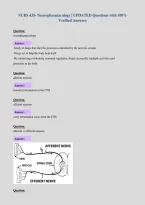
afferent vs efferent neurons
Answer:
Question:
,steps in synaptic transmission
Answer:
-Synthesis of transmitter (T from QRS)
-Storage of transmitter
-Release of transmitter
-Binding of transmitter to receptor to cause response
-Termination of transmission, release from receptor
Question:
neurotransmitters
Answer:
-Synthesized in the presynaptic neurons and stored in synaptic vesicles.
-Released from the vesicles in the synapse
-THIS IS WHERE MEDICATIONS CAN WORK!
Question:
medication effect on synthesis of transmitter
Answer:
Increase, Decrease, or synthesize more efficient transmitter
Question:
medication effect on storage of transmitter
Answer:
Reduce storage of transmitter, less transmitter available for release
Question:
medication effect on release of transmitter
Answer:
Increase or decrease transmitter to receptor activity
Question:
medication effect on receptor
Answer:
,-Bind directly to receptor and cause activation
-Bind directly to receptor and block receptor activity
-Bind to receptor components and thereby enhance receptor activation by natural
neurotransmitters
Question:
medication effect on termination of transmission, release from
receptor
Answer:
-Block reuptake or
-Inhibit breakdown of transmitter
Question:
three major types of neurotransmitters
Answer:
-amino acids
-neuropeptides
-monoamines: epinephrine and norepinephrine
Question:
peripheral nervous system
Answer:
-somatic motor system
-autonomic nervous system (parasympathetic, sympathetic)
Question:
autonomic nervous system
Answer:
-regulates the heart
-regulates smooth muscle
-regulates secretory glands
-strongly affected by emotional influences
Question:
, autonomic tone
Answer:
the steady, day-to-day influence exerted by the autonomic nervous system on a
particular organ or organ system. Autonomic tone provides a basal level of control over
which reflex regulation is superimposed.
Question:
parasympathetic nervous system
Answer:
"Housekeeping tasks of the body", "rest and digest"
Seven regulatory functions
-Slowing the heart rate
-Increasing gastric secretions
-Emptying the bladder
-Emptying the bowel
-Focusing the eye for near vision
-Constricting the pupil
-Contracting bronchial smooth muscle
Question:
sympathetic nervous system
Answer:
-regulating the cardiovascular system
-regulating body temperature
-implementing the acute stress response (fight or flight)
Question:
fight or flight vs. rest and digest
Answer:


