
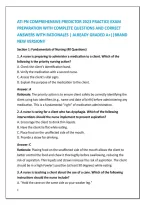
ATI PN COMPREHENSIVE PREDICTOR 2023 PRACTICE EXAM
PREPARATION WITH COMPLETE QUESTIONS AND CORRECT
ANSWERS WITH RATIONALES | ALREADY GRADED A+||BRAND
NEW VERSION!!
Section 1: Fundamentals of Nursing (40 Questions)
1. A nurse is preparing to administer a medication to a client. Which of the
following is the priority nursing action?
A. Check the client's identification band.
B. Verify the medication with a second nurse.
C. Assess the client's vital signs.
D. Explain the purpose of the medication to the client.
Answer: A
Rationale: The priority action is to ensure client safety by correctly identifying the
client using two identifiers (e.g., name and date of birth) before administering any
medication. This is a fundamental "right" of medication administration.
2. A nurse is caring for a client who has dysphagia. Which of the following
interventions should the nurse implement to prevent aspiration?
A. Encourage the client to drink thin liquids.
B. Have the client lie flat while eating.
C. Place food on the unaffected side of the mouth.
D. Provide a straw for drinking.
Answer: C
Rationale: Placing food on the unaffected side of the mouth allows the client to
better control the food and chew it thoroughly before swallowing, reducing the
risk of aspiration. Thin liquids and straws increase the risk of aspiration. The client
should be in a high-Fowler's position (at least 90 degrees) while eating.
3. A nurse is teaching a client about the use of a cane. Which of the following
instructions should the nurse include?
A. "Hold the cane on the same side as your weaker leg."
1
,B. "Advance the cane with your weaker leg."
C. "Move the cane and your stronger leg together."
D. "Hold the cane on the opposite side of your weaker leg."
Answer: D
Rationale: The cane should be held on the side opposite the weaker leg to provide
a wide base of support and shift weight away from the weak side. The client
should move the cane and the weaker leg forward together, then move the
stronger leg.
4. A nurse is assessing a client for dehydration. Which of the following findings
should the nurse expect?
A. Bounding pulse
B. Dry, sticky mucous membranes
C. Distended neck veins
D. Hypertension
Answer: B
Rationale: Dry, sticky mucous membranes are a classic sign of dehydration. Other
signs include poor skin turgor, thirst, decreased urine output, and hypotension
with a weak, thready pulse. Bounding pulse, distended neck veins, and
hypertension are signs of fluid overload.
5. A nurse is performing a sterile dressing change. Which of the following actions
indicates a break in sterile technique?
A. The nurse opens the sterile dressing package away from the body.
B. The nurse keeps the sterile field above waist level.
C. The nurse pours sterile solution from a height of 15 cm (6 in).
D. The nurse's sterile glove touches the client's skin.
Answer: D
Rationale: Any contact between sterile items and non-sterile surfaces (like the
client's skin) is a break in sterile technique. The other actions are correct
principles of maintaining a sterile field.
2
,6. A nurse is calculating the intake and output for a client. The client has had 8
oz of coffee, 4 oz of gelatin, and 240 mL of IV fluids. What is the total intake in
mL? (Round to the nearest whole number).
A. 480 mL
B. 600 mL
C. 720 mL
D. 840 mL
Answer: B
Rationale: First, convert ounces to milliliters (1 oz = 30 mL).
• 8 oz coffee = 8 x 30 = 240 mL
• 4 oz gelatin = 4 x 30 = 120 mL
• IV fluids = 240 mL
Total intake = 240 + 120 + 240 = 600 mL.
7. A nurse is caring for a client who is on bed rest. Which of the following
interventions is most important to prevent a pressure injury?
A. Massage reddened areas over bony prominences.
B. Reposition the client every 2 hours.
C. Apply a heating pad to the client's sacrum.
D. Keep the head of the bed elevated at 45 degrees.
Answer: B
Rationale: Repositioning the client at least every 2 hours is the most critical
intervention to relieve pressure over bony prominences and prevent pressure
injuries. Massaging reddened areas can cause further tissue damage. Heat can
increase metabolic demand and risk of injury.
8. A nurse is teaching a client about a low-sodium diet. Which of the following
food choices by the client indicates a need for further teaching?
A. Fresh fruit
B. Canned soup
C. Grilled chicken breast
D. Steamed broccoli
3
, Answer: B
Rationale: Canned soups are typically very high in sodium and should be avoided
on a low-sodium diet. Fresh fruits, unprocessed meats, and fresh vegetables are
generally low in sodium.
9. A nurse is preparing to administer an intramuscular (IM) injection to an adult
client. Which of the following sites is the preferred site for this injection?
A. Deltoid
B. Ventrogluteal
C. Vastus lateralis
D. Dorsogluteal
Answer: B
Rationale: The ventrogluteal site is the preferred site for IM injections in adults
because it is free of major blood vessels and nerves, and it has a well-developed
muscle mass. The dorsogluteal site is no longer recommended due to the risk of
sciatic nerve injury.
10. A nurse is caring for a client who has a prescription for NPO (nothing by
mouth). Which of the following actions should the nurse take?
A. Provide mouth care every 4 hours.
B. Offer ice chips as desired.
C. Place a "NPO" sign above the client's bed.
D. Allow the client to sip water with medications.
Answer: C
Rationale: Placing an "NPO" sign above the bed alerts all staff members that the
client should not receive anything by mouth. Mouth care should be provided
more frequently (e.g., every 2 hours) for comfort. Ice chips and water are not
allowed for an NPO client.
11. A nurse is assessing a client's pain. Which of the following is a subjective
finding?
A. Heart rate of 110/min
B. Client's report of "sharp, stabbing pain"
4
PREPARATION WITH COMPLETE QUESTIONS AND CORRECT
ANSWERS WITH RATIONALES | ALREADY GRADED A+||BRAND
NEW VERSION!!
Section 1: Fundamentals of Nursing (40 Questions)
1. A nurse is preparing to administer a medication to a client. Which of the
following is the priority nursing action?
A. Check the client's identification band.
B. Verify the medication with a second nurse.
C. Assess the client's vital signs.
D. Explain the purpose of the medication to the client.
Answer: A
Rationale: The priority action is to ensure client safety by correctly identifying the
client using two identifiers (e.g., name and date of birth) before administering any
medication. This is a fundamental "right" of medication administration.
2. A nurse is caring for a client who has dysphagia. Which of the following
interventions should the nurse implement to prevent aspiration?
A. Encourage the client to drink thin liquids.
B. Have the client lie flat while eating.
C. Place food on the unaffected side of the mouth.
D. Provide a straw for drinking.
Answer: C
Rationale: Placing food on the unaffected side of the mouth allows the client to
better control the food and chew it thoroughly before swallowing, reducing the
risk of aspiration. Thin liquids and straws increase the risk of aspiration. The client
should be in a high-Fowler's position (at least 90 degrees) while eating.
3. A nurse is teaching a client about the use of a cane. Which of the following
instructions should the nurse include?
A. "Hold the cane on the same side as your weaker leg."
1
,B. "Advance the cane with your weaker leg."
C. "Move the cane and your stronger leg together."
D. "Hold the cane on the opposite side of your weaker leg."
Answer: D
Rationale: The cane should be held on the side opposite the weaker leg to provide
a wide base of support and shift weight away from the weak side. The client
should move the cane and the weaker leg forward together, then move the
stronger leg.
4. A nurse is assessing a client for dehydration. Which of the following findings
should the nurse expect?
A. Bounding pulse
B. Dry, sticky mucous membranes
C. Distended neck veins
D. Hypertension
Answer: B
Rationale: Dry, sticky mucous membranes are a classic sign of dehydration. Other
signs include poor skin turgor, thirst, decreased urine output, and hypotension
with a weak, thready pulse. Bounding pulse, distended neck veins, and
hypertension are signs of fluid overload.
5. A nurse is performing a sterile dressing change. Which of the following actions
indicates a break in sterile technique?
A. The nurse opens the sterile dressing package away from the body.
B. The nurse keeps the sterile field above waist level.
C. The nurse pours sterile solution from a height of 15 cm (6 in).
D. The nurse's sterile glove touches the client's skin.
Answer: D
Rationale: Any contact between sterile items and non-sterile surfaces (like the
client's skin) is a break in sterile technique. The other actions are correct
principles of maintaining a sterile field.
2
,6. A nurse is calculating the intake and output for a client. The client has had 8
oz of coffee, 4 oz of gelatin, and 240 mL of IV fluids. What is the total intake in
mL? (Round to the nearest whole number).
A. 480 mL
B. 600 mL
C. 720 mL
D. 840 mL
Answer: B
Rationale: First, convert ounces to milliliters (1 oz = 30 mL).
• 8 oz coffee = 8 x 30 = 240 mL
• 4 oz gelatin = 4 x 30 = 120 mL
• IV fluids = 240 mL
Total intake = 240 + 120 + 240 = 600 mL.
7. A nurse is caring for a client who is on bed rest. Which of the following
interventions is most important to prevent a pressure injury?
A. Massage reddened areas over bony prominences.
B. Reposition the client every 2 hours.
C. Apply a heating pad to the client's sacrum.
D. Keep the head of the bed elevated at 45 degrees.
Answer: B
Rationale: Repositioning the client at least every 2 hours is the most critical
intervention to relieve pressure over bony prominences and prevent pressure
injuries. Massaging reddened areas can cause further tissue damage. Heat can
increase metabolic demand and risk of injury.
8. A nurse is teaching a client about a low-sodium diet. Which of the following
food choices by the client indicates a need for further teaching?
A. Fresh fruit
B. Canned soup
C. Grilled chicken breast
D. Steamed broccoli
3
, Answer: B
Rationale: Canned soups are typically very high in sodium and should be avoided
on a low-sodium diet. Fresh fruits, unprocessed meats, and fresh vegetables are
generally low in sodium.
9. A nurse is preparing to administer an intramuscular (IM) injection to an adult
client. Which of the following sites is the preferred site for this injection?
A. Deltoid
B. Ventrogluteal
C. Vastus lateralis
D. Dorsogluteal
Answer: B
Rationale: The ventrogluteal site is the preferred site for IM injections in adults
because it is free of major blood vessels and nerves, and it has a well-developed
muscle mass. The dorsogluteal site is no longer recommended due to the risk of
sciatic nerve injury.
10. A nurse is caring for a client who has a prescription for NPO (nothing by
mouth). Which of the following actions should the nurse take?
A. Provide mouth care every 4 hours.
B. Offer ice chips as desired.
C. Place a "NPO" sign above the client's bed.
D. Allow the client to sip water with medications.
Answer: C
Rationale: Placing an "NPO" sign above the bed alerts all staff members that the
client should not receive anything by mouth. Mouth care should be provided
more frequently (e.g., every 2 hours) for comfort. Ice chips and water are not
allowed for an NPO client.
11. A nurse is assessing a client's pain. Which of the following is a subjective
finding?
A. Heart rate of 110/min
B. Client's report of "sharp, stabbing pain"
4


