
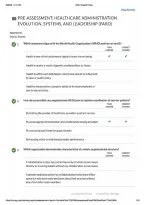
WGU Health Care Exam Questions with Correct Answers – Complete Study Guide for Healthcare Administration and Management
This is a complete exam question and answer study guide for WGU Health Care, containing multiple-choice questions with verified correct answers for healthcare administration and management. The document is a comprehensive review resource covering healthcare policy, organizational theory, leadership, quality improvement, and cultural competence. Topics covered include the World Health Organization's (WHO) position on health as a fundamental human right; accountable care organizations (ACOs) and care coordination; matrix organizational structures; the Affordable Care Act (ACA) and coverage for preexisting conditions; the Action Collaborative on Clinician Well-Being and Resilience and burnout reduction; the establishment and purpose of Medicare in 1965; the False Claims Act and preventing fraudulent documentation and billing; COBRA and continuation of health insurance coverage after job loss; the Medicare Modernization Act (MMA) of 2003 and changing demographics; telehealth and clinician collaboration; clinical decision support systems (CDSS) for diagnosis; the laboratory information system (LIS) and patient communication; organizational model analysis and predicting future behavior; the synoptic model within the rational model of healthcare analysis; continuous monitoring and workflow success; evidence-based practice and procedural standardization; qualitative and quantitative research as complementary; the open systems model and enhanced communication and collaboration; environmental scanning and strategic planning; aligning resources with market demand; compliance and resource management; interprofessional teams and patient-centered decision-making; patient-centered care models; strategic threats to organizational performance; knowledge assets and competitive advantage; authentic leadership and integrity; leadership theories including Machiavellian, path-goal, and transformational; Weber's bureaucratic theory of management and standardized practices; human relations theory and collaborative protocol review; Theory Y approaches to employee motivation; management functions including planning, organizing, controlling, and directing; leadership functions including building trust and collaboration; servant leadership and health disparities; autocratic leadership during infectious outbreaks; lateral leadership and cross-functional teamwork; Vroom's expectancy theory and employee motivation; sources of power including reward, coercive, legitimate, expert, and referent power; the five-stage theory of group development including norming, storming, adjourning, and performing; value-based care and organizational performance; factors affecting rural healthcare organizations; diversity and organizational culture; leadership inflexibility and organizational culture; staff engagement and buy-in for evidence-based practices; adequacy of training for new technology; culturally proficient care including respect, knowledge, attitude, and awareness; religious sensitivity and Jehovah's Witness patients; cultural modesty preferences and gender-concordant care; LGBTQ+ patient treatment and diverse representation; health disparities in African American and Native American populations; implicit bias and structural inequities; cultural understanding and religious tolerance; and barriers to telehealth integration including patient privacy protection. Each question is followed by its verified correct answer, making this study guide useful for exam preparation, concept review, and practice with healthcare administration, management, and policy content. Students can use it to reinforce understanding of healthcare systems, leadership theories, organizational behavior, and culturally competent care. The course (WGU Health Care), document type (exam questions with correct answers), and content coverage are all verified from the uploaded file. No author or edition is stated in the document, so these could not be confirmed.
Document information
- Uploaded on
- September 30, 2026
- Number of pages
- 20
- Written in
- 2026/2027
- Type
- Exam (elaborations)
- Contains
- Questions & answers


