
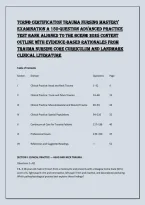
TCRN® Certification Trauma Nursing Mastery
Examination A 150-Question Advanced Practice
Test Bank Aligned to the BCEN® 2025 Content
Outline with Evidence-Based Rationales from
Trauma Nursing Core Curriculum and Landmark
Clinical Literature
Table of Contents
Section Domain Questions Page
I Clinical Practice: Head and Neck Trauma 1–32 4
II Clinical Practice: Trunk and Pelvis Trauma 33–68 12
III Clinical Practice: Musculoskeletal and Wound Trauma 69–93 24
IV Clinical Practice: Special Populations 94–116 32
V Continuum of Care for Trauma Patients 117–138 40
VI Professional Issues 139–150 47
VII References and Suggested Readings — 51
SECTION I: CLINICAL PRACTICE — HEAD AND NECK TRAUMA
(Questions 1–32)
🟢 1. A 28-year-old male is thrown from a motorcycle and presents with a Glasgow Coma Scale (GCS)
score of 6, right pupil 6 mm and nonreactive, left pupil 3 mm and reactive, and decerebrate posturing.
Which pathophysiological process best explains these findings?
,A. Diffuse axonal injury without mass effect
B. Uncal herniation with compression of the oculomotor nerve
C. Primary brainstem injury with loss of cortical function
D. Epidural hematoma with venous bleeding
🔴🔴 Correct Answer: B. Uncal herniation occurs when a supratentorial mass (commonly an epidural or
subdural hematoma) pushes the uncus of the temporal lobe medially, compressing the oculomotor
nerve (CN III) and causing ipsilateral pupillary dilation. Decerebrate posturing indicates disruption at the
level of the brainstem. This is a neurological emergency requiring immediate neurosurgical intervention
.
🟢 2. A patient with a basilar skull fracture is most likely to exhibit which of the following clinical signs?
A. Battle's sign and raccoon eyes
B. Hemotympanum and CSF otorrhea
C. Unilateral pupillary dilation
D. Decorticate posturing
🔴🔴 Correct Answer: B. Basilar skull fractures classically present with hemotympanum, CSF otorrhea or
rhinorrhea, and cranial nerve deficits. Battle's sign (bruising behind the ear) and raccoon eyes are also
associated but hemotympanum and CSF leakage are more specific to basilar fractures .
🟢 3. The trauma nurse is caring for a patient with a severe traumatic brain injury. The patient's ICP is 28
mmHg and MAP is 85 mmHg. What is the calculated cerebral perfusion pressure (CPP)?
A. 57 mmHg
B. 113 mmHg
C. 28 mmHg
D. 85 mmHg
🔴🔴 Correct Answer: A. CPP = MAP − ICP. Therefore, 85 − 28 = 57 mmHg. The target CPP for severe TBI
is typically 60–70 mmHg. A CPP below 50 mmHg is associated with significantly increased mortality .
🟢 4. A patient with a suspected cervical spine injury develops hypotension (BP 78/45 mmHg),
bradycardia (HR 52 beats/min), and warm, dry skin. Which type of shock should the nurse suspect?
A. Hemorrhagic shock
B. Neurogenic shock
C. Cardiogenic shock
D. Septic shock
🔴🔴 Correct Answer: B. Neurogenic shock results from loss of sympathetic innervation following high
spinal cord injury, producing vasodilation (warm, dry skin), hypotension, and bradycardia. Hemorrhagic
shock would present with tachycardia and cool, clammy skin .
,🟢 5. A trauma patient with a known subdural hematoma has an elevated INR of 4.2. The trauma nurse
should anticipate which of the following interventions as the most rapid reversal strategy?
A. Administration of vitamin K
B. Infusion of prothrombin complex concentrate
C. Platelet transfusion
D. Fresh frozen plasma infusion over 4 hours
🔴🔴 Correct Answer: B. Prothrombin complex concentrate works within 15 minutes of infusion
completion, making it the most rapid reversal agent for warfarin-associated coagulopathy. Vitamin K
takes 6–24 hours to work, which is too slow for an intracranial bleed .
🟢 6. Which of the following findings in a patient with a severe TBI indicates impending herniation and
requires immediate intervention?
A. GCS score decreasing from 14 to 10 over 30 minutes
B. Pupils equal and reactive at 3 mm
C. Blood pressure 130/85 mmHg with HR 88 beats/min
D. Patient reporting mild headache
🔴🔴 Correct Answer: A. A declining GCS score is a critical indicator of neurological deterioration and
rising intracranial pressure. A drop of 4 points over 30 minutes represents a significant change requiring
immediate intervention including head elevation, osmotic therapy, and neurosurgical consultation .
🟢 7. A patient with extensive facial fractures presents with copious oropharyngeal bleeding and an
inability to maintain a patent airway. Endotracheal intubation has been unsuccessful. The nurse should
anticipate which of the following interventions?
A. Needle cricothyrotomy
B. Surgical tracheostomy
C. Video laryngoscopy
D. Surgical cricothyrotomy
🔴🔴 Correct Answer: D. Surgical cricothyrotomy is the definitive surgical airway in the "can't intubate,
can't ventilate" scenario in the emergency setting. Needle cricothyrotomy is a temporizing measure.
Surgical tracheostomy is not performed emergently at the bedside for acute airway compromise .
🟢 8. A patient with a suspected spinal cord injury at the T6 level suddenly develops severe hypertension,
bradycardia, and a pounding headache. The trauma nurse recognizes this as:
A. Neurogenic shock
B. Autonomic dysreflexia
, C. Spinal shock
D. Malignant hyperthermia
🔴🔴 Correct Answer: B. Autonomic dysreflexia occurs in patients with spinal cord injuries at T6 or
above. It is characterized by severe hypertension, bradycardia, and headache due to unopposed
sympathetic outflow below the level of injury. It is a medical emergency requiring immediate
intervention.
🟢 9. A patient who sustained a traumatic brain injury is being monitored for signs of diabetes insipidus.
Which of the following findings would the nurse expect?
A. Decreased urine output and hypernatremia
B. Increased urine output and hypernatremia
C. Decreased urine output and hyponatremia
D. Increased urine output and hyponatremia
🔴🔴 Correct Answer: B. Diabetes insipidus following TBI results from decreased antidiuretic hormone
(ADH) secretion, leading to massive diuresis (increased urine output) and hypernatremia due to free
water loss. Treatment includes vasopressin administration and fluid replacement.
🟢 10. A trauma patient with a Glasgow Coma Scale score of 6 is being mechanically ventilated. Which of
the following ventilator strategies is most appropriate for preventing secondary brain injury?
A. Hyperventilation to a PaCO₂ of 25 mmHg
B. Maintaining PaCO₂ between 35–40 mmHg
C. Permissive hypercapnia with PaCO₂ of 50 mmHg
D. High tidal volumes to maximize oxygenation
🔴🔴 Correct Answer: B. Maintaining normocapnia (PaCO₂ 35–40 mmHg) is recommended for most
patients with severe TBI. Hyperventilation causes cerebral vasoconstriction and can worsen ischemia.
Permissive hypercapnia is contraindicated as it increases ICP.
🟢 11. Which of the following assessment findings is consistent with a fracture of the occipital bone?
A. Bruising behind the ear (Battle's sign)
B. Periorbital ecchymosis (raccoon eyes)
C. Malocclusion of the jaw
D. Subconjunctival hemorrhage
🔴🔴 Correct Answer: A. Bruising behind the ear is consistent with bleeding caused by a fracture of the
occipital bone. Blood gathers between the occipital bone and skin. Raccoon eyes are associated with
basilar skull fractures, and malocclusion is associated with mandibular fractures .
Examination A 150-Question Advanced Practice
Test Bank Aligned to the BCEN® 2025 Content
Outline with Evidence-Based Rationales from
Trauma Nursing Core Curriculum and Landmark
Clinical Literature
Table of Contents
Section Domain Questions Page
I Clinical Practice: Head and Neck Trauma 1–32 4
II Clinical Practice: Trunk and Pelvis Trauma 33–68 12
III Clinical Practice: Musculoskeletal and Wound Trauma 69–93 24
IV Clinical Practice: Special Populations 94–116 32
V Continuum of Care for Trauma Patients 117–138 40
VI Professional Issues 139–150 47
VII References and Suggested Readings — 51
SECTION I: CLINICAL PRACTICE — HEAD AND NECK TRAUMA
(Questions 1–32)
🟢 1. A 28-year-old male is thrown from a motorcycle and presents with a Glasgow Coma Scale (GCS)
score of 6, right pupil 6 mm and nonreactive, left pupil 3 mm and reactive, and decerebrate posturing.
Which pathophysiological process best explains these findings?
,A. Diffuse axonal injury without mass effect
B. Uncal herniation with compression of the oculomotor nerve
C. Primary brainstem injury with loss of cortical function
D. Epidural hematoma with venous bleeding
🔴🔴 Correct Answer: B. Uncal herniation occurs when a supratentorial mass (commonly an epidural or
subdural hematoma) pushes the uncus of the temporal lobe medially, compressing the oculomotor
nerve (CN III) and causing ipsilateral pupillary dilation. Decerebrate posturing indicates disruption at the
level of the brainstem. This is a neurological emergency requiring immediate neurosurgical intervention
.
🟢 2. A patient with a basilar skull fracture is most likely to exhibit which of the following clinical signs?
A. Battle's sign and raccoon eyes
B. Hemotympanum and CSF otorrhea
C. Unilateral pupillary dilation
D. Decorticate posturing
🔴🔴 Correct Answer: B. Basilar skull fractures classically present with hemotympanum, CSF otorrhea or
rhinorrhea, and cranial nerve deficits. Battle's sign (bruising behind the ear) and raccoon eyes are also
associated but hemotympanum and CSF leakage are more specific to basilar fractures .
🟢 3. The trauma nurse is caring for a patient with a severe traumatic brain injury. The patient's ICP is 28
mmHg and MAP is 85 mmHg. What is the calculated cerebral perfusion pressure (CPP)?
A. 57 mmHg
B. 113 mmHg
C. 28 mmHg
D. 85 mmHg
🔴🔴 Correct Answer: A. CPP = MAP − ICP. Therefore, 85 − 28 = 57 mmHg. The target CPP for severe TBI
is typically 60–70 mmHg. A CPP below 50 mmHg is associated with significantly increased mortality .
🟢 4. A patient with a suspected cervical spine injury develops hypotension (BP 78/45 mmHg),
bradycardia (HR 52 beats/min), and warm, dry skin. Which type of shock should the nurse suspect?
A. Hemorrhagic shock
B. Neurogenic shock
C. Cardiogenic shock
D. Septic shock
🔴🔴 Correct Answer: B. Neurogenic shock results from loss of sympathetic innervation following high
spinal cord injury, producing vasodilation (warm, dry skin), hypotension, and bradycardia. Hemorrhagic
shock would present with tachycardia and cool, clammy skin .
,🟢 5. A trauma patient with a known subdural hematoma has an elevated INR of 4.2. The trauma nurse
should anticipate which of the following interventions as the most rapid reversal strategy?
A. Administration of vitamin K
B. Infusion of prothrombin complex concentrate
C. Platelet transfusion
D. Fresh frozen plasma infusion over 4 hours
🔴🔴 Correct Answer: B. Prothrombin complex concentrate works within 15 minutes of infusion
completion, making it the most rapid reversal agent for warfarin-associated coagulopathy. Vitamin K
takes 6–24 hours to work, which is too slow for an intracranial bleed .
🟢 6. Which of the following findings in a patient with a severe TBI indicates impending herniation and
requires immediate intervention?
A. GCS score decreasing from 14 to 10 over 30 minutes
B. Pupils equal and reactive at 3 mm
C. Blood pressure 130/85 mmHg with HR 88 beats/min
D. Patient reporting mild headache
🔴🔴 Correct Answer: A. A declining GCS score is a critical indicator of neurological deterioration and
rising intracranial pressure. A drop of 4 points over 30 minutes represents a significant change requiring
immediate intervention including head elevation, osmotic therapy, and neurosurgical consultation .
🟢 7. A patient with extensive facial fractures presents with copious oropharyngeal bleeding and an
inability to maintain a patent airway. Endotracheal intubation has been unsuccessful. The nurse should
anticipate which of the following interventions?
A. Needle cricothyrotomy
B. Surgical tracheostomy
C. Video laryngoscopy
D. Surgical cricothyrotomy
🔴🔴 Correct Answer: D. Surgical cricothyrotomy is the definitive surgical airway in the "can't intubate,
can't ventilate" scenario in the emergency setting. Needle cricothyrotomy is a temporizing measure.
Surgical tracheostomy is not performed emergently at the bedside for acute airway compromise .
🟢 8. A patient with a suspected spinal cord injury at the T6 level suddenly develops severe hypertension,
bradycardia, and a pounding headache. The trauma nurse recognizes this as:
A. Neurogenic shock
B. Autonomic dysreflexia
, C. Spinal shock
D. Malignant hyperthermia
🔴🔴 Correct Answer: B. Autonomic dysreflexia occurs in patients with spinal cord injuries at T6 or
above. It is characterized by severe hypertension, bradycardia, and headache due to unopposed
sympathetic outflow below the level of injury. It is a medical emergency requiring immediate
intervention.
🟢 9. A patient who sustained a traumatic brain injury is being monitored for signs of diabetes insipidus.
Which of the following findings would the nurse expect?
A. Decreased urine output and hypernatremia
B. Increased urine output and hypernatremia
C. Decreased urine output and hyponatremia
D. Increased urine output and hyponatremia
🔴🔴 Correct Answer: B. Diabetes insipidus following TBI results from decreased antidiuretic hormone
(ADH) secretion, leading to massive diuresis (increased urine output) and hypernatremia due to free
water loss. Treatment includes vasopressin administration and fluid replacement.
🟢 10. A trauma patient with a Glasgow Coma Scale score of 6 is being mechanically ventilated. Which of
the following ventilator strategies is most appropriate for preventing secondary brain injury?
A. Hyperventilation to a PaCO₂ of 25 mmHg
B. Maintaining PaCO₂ between 35–40 mmHg
C. Permissive hypercapnia with PaCO₂ of 50 mmHg
D. High tidal volumes to maximize oxygenation
🔴🔴 Correct Answer: B. Maintaining normocapnia (PaCO₂ 35–40 mmHg) is recommended for most
patients with severe TBI. Hyperventilation causes cerebral vasoconstriction and can worsen ischemia.
Permissive hypercapnia is contraindicated as it increases ICP.
🟢 11. Which of the following assessment findings is consistent with a fracture of the occipital bone?
A. Bruising behind the ear (Battle's sign)
B. Periorbital ecchymosis (raccoon eyes)
C. Malocclusion of the jaw
D. Subconjunctival hemorrhage
🔴🔴 Correct Answer: A. Bruising behind the ear is consistent with bleeding caused by a fracture of the
occipital bone. Blood gathers between the occipital bone and skin. Raccoon eyes are associated with
basilar skull fractures, and malocclusion is associated with mandibular fractures .


