
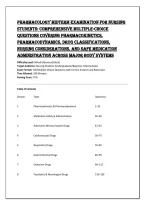
Pharmacology Midterm Examination for Nursing
Students: Comprehensive Multiple-Choice
Questions Covering Pharmacokinetics,
Pharmacodynamics, Drug Classifications,
Nursing Considerations, and Safe Medication
Administration Across Major Body Systems
Difficulty Level: Mixed (Advanced/Hard)
Target Audience: Nursing Students (Undergraduate/Beginner-Intermediate)
Exam Format: 150 Multiple-Choice Questions with Correct Answers and Rationales
Time Allowed: 180 Minutes
Passing Score: 75%
Table of Contents
Section Topic Questions
1 Pharmacokinetics & Pharmacodynamics 1–25
2 Medication Safety & Administration 26–40
3 Autonomic Nervous System Drugs 41–55
4 Cardiovascular Drugs 56–75
5 Respiratory Drugs 76–85
6 Gastrointestinal Drugs 86–95
7 Endocrine Drugs 96–115
8 Psychiatric & Neurological Drugs 116–130
,Section Topic Questions
9 Anti-Infective Agents 131–145
10 Pain Management & Analgesics 146–150
Section 1: Pharmacokinetics & Pharmacodynamics (Questions 1–25)
🟢 1. A nurse is reviewing the pharmacokinetics of a newly prescribed medication. Which process
describes the movement of a drug from the site of administration into the bloodstream?
A. Distribution
B. Metabolism
C. Absorption
D. Excretion
🔴🔴 Correct Answer: C. Absorption
Rationale: Absorption is the process by which a drug moves from its site of administration into the
systemic circulation. Distribution refers to the movement of drugs throughout body tissues, metabolism
involves the biochemical transformation of drugs, and excretion is the elimination of drugs from the
body.
🟢 2. A patient takes oral morphine for chronic pain but reports inadequate relief. The nurse explains that
a significant portion of the drug is inactivated before reaching systemic circulation. Which phenomenon
accounts for this?
A. Protein binding
B. First-pass effect
C. Blood-brain barrier
D. Renal clearance
🔴🔴 Correct Answer: B. First-pass effect
Rationale: The first-pass effect occurs when drugs administered orally are absorbed through the
gastrointestinal tract and transported to the liver via the portal vein, where a significant portion may be
metabolized before reaching systemic circulation. This reduces bioavailability and is why some
medications require higher oral doses compared to parenteral routes.
🟢 3. A nurse administers a drug with a half-life of 12 hours. Approximately how long will it take for the
drug to reach steady-state concentration with repeated dosing?
,A. 12 hours
B. 24 hours
C. 60 hours
D. 120 hours
🔴🔴 Correct Answer: C. 60 hours
Rationale: It takes approximately 4 to 5 half-lives for a drug to reach steady-state concentration with
repeated dosing. For a drug with a 12-hour half-life, steady state is achieved in approximately 48 to 60
hours (4 × 12 = 48 hours). At steady state, the rate of drug administration equals the rate of elimination.
🟢 4. A patient with liver cirrhosis is prescribed a medication that is extensively metabolized by the liver.
Which adjustment should the nurse anticipate?
A. Increasing the dose due to rapid clearance
B. Decreasing the dose or extending the dosing interval
C. No adjustment is needed for hepatic impairment
D. Switching to an intravenous formulation only
🔴🔴 Correct Answer: B. Decreasing the dose or extending the dosing interval
Rationale: Liver cirrhosis impairs hepatic drug metabolism, leading to decreased clearance and
prolonged half-life of medications metabolized by the liver. The nurse should anticipate a dosage
reduction or extended dosing interval to prevent drug toxicity. According to FDA guidelines, hepatic
impairment requires careful dose adjustment for drugs with significant first-pass metabolism.
🟢 5. A drug has a narrow therapeutic index. Which nursing intervention is MOST important when
administering this medication?
A. Administering the drug with food
B. Monitoring drug levels closely and assessing for signs of toxicity
C. Giving the medication only once daily
D. Diluting the medication in a large volume of IV fluid
🔴🔴 Correct Answer: B. Monitoring drug levels closely and assessing for signs of toxicity
Rationale: A narrow therapeutic index means the difference between a therapeutic dose and a toxic
dose is small. Close monitoring of drug levels and assessment for signs of toxicity are essential to
prevent adverse effects. Administering with food, giving once daily, or diluting the medication do not
address the core safety concern of a narrow therapeutic index.
🟢 6. Which term best describes "what the body does to the drug"?
A. Pharmacodynamics
B. Pharmacotherapeutics
, C. Pharmacokinetics
D. Pharmacognosy
🔴🔴 Correct Answer: C. Pharmacokinetics
Rationale: Pharmacokinetics is the study of what the body does to a drug, encompassing absorption,
distribution, metabolism, and excretion (ADME). Pharmacodynamics is what the drug does to the body.
Pharmacotherapeutics refers to the use of drugs to treat disease, and pharmacognosy is the study of
natural drug sources.
🟢 7. A nurse is administering a medication that is highly protein-bound. The patient's serum albumin
level is low. What effect should the nurse anticipate?
A. Decreased drug effect due to reduced binding
B. Increased free drug concentration and risk of toxicity
C. No change in drug effect
D. Increased drug excretion
🔴🔴 Correct Answer: B. Increased free drug concentration and risk of toxicity
Rationale: When serum albumin is low, fewer binding sites are available, leading to an increased
concentration of free (unbound) drug in the bloodstream. This can intensify the drug's effects and
increase the risk of toxicity. Nurses should monitor for adverse effects in patients with
hypoalbuminemia.
🟢 8. Which route of administration has 100% bioavailability?
A. Oral
B. Intravenous
C. Intramuscular
D. Subcutaneous
🔴🔴 Correct Answer: B. Intravenous
Rationale: Intravenous administration delivers the drug directly into the bloodstream, bypassing
absorption barriers and first-pass metabolism, resulting in 100% bioavailability. Oral, intramuscular, and
subcutaneous routes are subject to absorption processes that reduce bioavailability.
🟢 9. A patient is prescribed a drug that is a competitive antagonist. What effect does this drug have at
the receptor site?
A. It activates the receptor to produce a response
B. It binds to the receptor and blocks the agonist's effect
C. It permanently destroys the receptor
D. It increases the sensitivity of the receptor
Students: Comprehensive Multiple-Choice
Questions Covering Pharmacokinetics,
Pharmacodynamics, Drug Classifications,
Nursing Considerations, and Safe Medication
Administration Across Major Body Systems
Difficulty Level: Mixed (Advanced/Hard)
Target Audience: Nursing Students (Undergraduate/Beginner-Intermediate)
Exam Format: 150 Multiple-Choice Questions with Correct Answers and Rationales
Time Allowed: 180 Minutes
Passing Score: 75%
Table of Contents
Section Topic Questions
1 Pharmacokinetics & Pharmacodynamics 1–25
2 Medication Safety & Administration 26–40
3 Autonomic Nervous System Drugs 41–55
4 Cardiovascular Drugs 56–75
5 Respiratory Drugs 76–85
6 Gastrointestinal Drugs 86–95
7 Endocrine Drugs 96–115
8 Psychiatric & Neurological Drugs 116–130
,Section Topic Questions
9 Anti-Infective Agents 131–145
10 Pain Management & Analgesics 146–150
Section 1: Pharmacokinetics & Pharmacodynamics (Questions 1–25)
🟢 1. A nurse is reviewing the pharmacokinetics of a newly prescribed medication. Which process
describes the movement of a drug from the site of administration into the bloodstream?
A. Distribution
B. Metabolism
C. Absorption
D. Excretion
🔴🔴 Correct Answer: C. Absorption
Rationale: Absorption is the process by which a drug moves from its site of administration into the
systemic circulation. Distribution refers to the movement of drugs throughout body tissues, metabolism
involves the biochemical transformation of drugs, and excretion is the elimination of drugs from the
body.
🟢 2. A patient takes oral morphine for chronic pain but reports inadequate relief. The nurse explains that
a significant portion of the drug is inactivated before reaching systemic circulation. Which phenomenon
accounts for this?
A. Protein binding
B. First-pass effect
C. Blood-brain barrier
D. Renal clearance
🔴🔴 Correct Answer: B. First-pass effect
Rationale: The first-pass effect occurs when drugs administered orally are absorbed through the
gastrointestinal tract and transported to the liver via the portal vein, where a significant portion may be
metabolized before reaching systemic circulation. This reduces bioavailability and is why some
medications require higher oral doses compared to parenteral routes.
🟢 3. A nurse administers a drug with a half-life of 12 hours. Approximately how long will it take for the
drug to reach steady-state concentration with repeated dosing?
,A. 12 hours
B. 24 hours
C. 60 hours
D. 120 hours
🔴🔴 Correct Answer: C. 60 hours
Rationale: It takes approximately 4 to 5 half-lives for a drug to reach steady-state concentration with
repeated dosing. For a drug with a 12-hour half-life, steady state is achieved in approximately 48 to 60
hours (4 × 12 = 48 hours). At steady state, the rate of drug administration equals the rate of elimination.
🟢 4. A patient with liver cirrhosis is prescribed a medication that is extensively metabolized by the liver.
Which adjustment should the nurse anticipate?
A. Increasing the dose due to rapid clearance
B. Decreasing the dose or extending the dosing interval
C. No adjustment is needed for hepatic impairment
D. Switching to an intravenous formulation only
🔴🔴 Correct Answer: B. Decreasing the dose or extending the dosing interval
Rationale: Liver cirrhosis impairs hepatic drug metabolism, leading to decreased clearance and
prolonged half-life of medications metabolized by the liver. The nurse should anticipate a dosage
reduction or extended dosing interval to prevent drug toxicity. According to FDA guidelines, hepatic
impairment requires careful dose adjustment for drugs with significant first-pass metabolism.
🟢 5. A drug has a narrow therapeutic index. Which nursing intervention is MOST important when
administering this medication?
A. Administering the drug with food
B. Monitoring drug levels closely and assessing for signs of toxicity
C. Giving the medication only once daily
D. Diluting the medication in a large volume of IV fluid
🔴🔴 Correct Answer: B. Monitoring drug levels closely and assessing for signs of toxicity
Rationale: A narrow therapeutic index means the difference between a therapeutic dose and a toxic
dose is small. Close monitoring of drug levels and assessment for signs of toxicity are essential to
prevent adverse effects. Administering with food, giving once daily, or diluting the medication do not
address the core safety concern of a narrow therapeutic index.
🟢 6. Which term best describes "what the body does to the drug"?
A. Pharmacodynamics
B. Pharmacotherapeutics
, C. Pharmacokinetics
D. Pharmacognosy
🔴🔴 Correct Answer: C. Pharmacokinetics
Rationale: Pharmacokinetics is the study of what the body does to a drug, encompassing absorption,
distribution, metabolism, and excretion (ADME). Pharmacodynamics is what the drug does to the body.
Pharmacotherapeutics refers to the use of drugs to treat disease, and pharmacognosy is the study of
natural drug sources.
🟢 7. A nurse is administering a medication that is highly protein-bound. The patient's serum albumin
level is low. What effect should the nurse anticipate?
A. Decreased drug effect due to reduced binding
B. Increased free drug concentration and risk of toxicity
C. No change in drug effect
D. Increased drug excretion
🔴🔴 Correct Answer: B. Increased free drug concentration and risk of toxicity
Rationale: When serum albumin is low, fewer binding sites are available, leading to an increased
concentration of free (unbound) drug in the bloodstream. This can intensify the drug's effects and
increase the risk of toxicity. Nurses should monitor for adverse effects in patients with
hypoalbuminemia.
🟢 8. Which route of administration has 100% bioavailability?
A. Oral
B. Intravenous
C. Intramuscular
D. Subcutaneous
🔴🔴 Correct Answer: B. Intravenous
Rationale: Intravenous administration delivers the drug directly into the bloodstream, bypassing
absorption barriers and first-pass metabolism, resulting in 100% bioavailability. Oral, intramuscular, and
subcutaneous routes are subject to absorption processes that reduce bioavailability.
🟢 9. A patient is prescribed a drug that is a competitive antagonist. What effect does this drug have at
the receptor site?
A. It activates the receptor to produce a response
B. It binds to the receptor and blocks the agonist's effect
C. It permanently destroys the receptor
D. It increases the sensitivity of the receptor


