
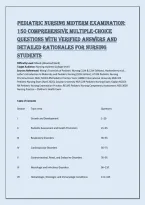
Pediatric Nursing Midterm Examination:
150 Comprehensive Multiple-Choice
Questions with Verified Answers and
Detailed Rationales for Nursing
Students
Difficulty Level: Mixed (Advanced/Hard)
Target Audience: Nursing students (college-level)
Sources Referenced: Wong's Essentials of Pediatric Nursing (11th & 12th Editions), Hockenberry et al.;
Leifer's Introduction to Maternity and Pediatric Nursing (10th Edition); ATI RN Pediatric Nursing
Proctored Exam 2026; NCLEX-RN Pediatric Practice Tests; AMREF International University BSN-323
Pediatric Nursing Exam (April 2025); Daystar University NUR 229 Pediatric Nursing Exam; Kaplan NCLEX-
RN Pediatric Nursing Examination Practice; RELIAS Pediatric Nursing Competency Assessment; NSG 3600
Nursing Practice – Children's Health Exam
Table of Contents
Section Topic Area Questions
I Growth and Development 1–20
II Pediatric Assessment and Health Promotion 21–35
III Respiratory Disorders 36–55
IV Cardiovascular Disorders 56–75
V Gastrointestinal, Renal, and Endocrine Disorders 76–95
VI Neurologic and Infectious Disorders 96–110
VII Hematologic, Oncologic, and Immunologic Conditions 111–125
,Section Topic Area Questions
VIII Pediatric Pharmacology and Fluid/Electrolyte Management 126–140
IX Emergency, Trauma, and Critical Care 141–145
X Psychosocial Integrity and Family-Centered Care 146–150
Section I: Growth and Development
🟢 1. A nurse is assessing a 6-month-old infant during a well-child visit. Which developmental milestone
should the nurse expect the infant to have achieved?
A. Sitting without support
B. Transferring objects from one hand to the other
C. Pincer grasp
D. Standing while holding onto furniture
🔴🔴 Correct Answer: B
Rationale: At 6 months of age, infants typically develop the ability to transfer objects from one hand to
the other. Sitting without support usually occurs at 7–8 months. The pincer grasp typically develops at
9–10 months. Standing while holding onto furniture (cruising) usually occurs at 9–12 months. This
milestone reflects fine motor development and bilateral coordination.
🟢 2. According to Piaget's theory of cognitive development, which stage is characterized by the
development of object permanence?
A. Preoperational stage
B. Concrete operational stage
C. Sensorimotor stage
D. Formal operational stage
🔴🔴 Correct Answer: C
Rationale: Object permanence—the understanding that objects continue to exist even when they
cannot be seen—develops during Piaget's sensorimotor stage (birth to 2 years). This is a critical
cognitive milestone that indicates the infant has developed mental representation. The preoperational
stage (2–7 years) is characterized by egocentrism and magical thinking. Concrete operational (7–11
years) involves logical thinking about concrete events. Formal operational (11+ years) involves abstract
reasoning.
,🟢 3. A nurse is assessing a 4-month-old infant. Which finding should the nurse expect?
A. Rolling from back to abdomen
B. Says "mama" specifically
C. Sits without support
D. Has a Moro reflex
🔴🔴 Correct Answer: A
Rationale: Rolling from back to abdomen typically occurs around 4–6 months. Saying "mama"
specifically usually occurs around 6–8 months. Sitting without support typically develops between 6–8
months. The Moro reflex is present at birth and should disappear by 3–4 months; persistence beyond 4
months is abnormal. At 4 months, the infant should also have good head control and be able to bear
weight on the legs when held standing.
🟢 4. Erickson's psychosocial developmental stage for the age group 1–3 years is referred to as:
A. Industry vs. inferiority
B. Autonomy vs. shame and doubt
C. Initiative vs. guilt
D. Trust vs. mistrust
🔴🔴 Correct Answer: B
Rationale: According to Erik Erikson's theory of psychosocial development, toddlers (1–3 years) are in
the autonomy versus shame and doubt stage. During this period, children begin to assert their
independence and develop a sense of control over their actions. If caregivers encourage autonomy,
children develop confidence; if not, they may feel shame and doubt. Industry vs. inferiority is the school-
age stage (6–12 years). Initiative vs. guilt is the preschool stage (3–6 years). Trust vs. mistrust is the
infancy stage (birth–1 year).
🟢 5. A nurse is teaching a parent about appropriate toys for a 9-month-old infant. Which toy best
supports the infant's developmental needs?
A. A set of nesting cups that the infant can bang together and explore
B. A complex puzzle with small interlocking pieces
C. A board game that requires turn-taking with siblings
D. A detailed coloring book with fine-tip markers
🔴🔴 Correct Answer: A
Rationale: At 9 months, infants are in Piaget's sensorimotor stage and learn through sensory exploration
and manipulation of objects. Nesting cups allow for banging, stacking, and exploring, which supports
fine motor development and cause-and-effect learning. Complex puzzles with small pieces pose a
choking hazard and are developmentally inappropriate. Board games requiring turn-taking are suitable
, for older preschool or school-age children. Coloring books with fine-tip markers are inappropriate for
infants due to choking risk and fine motor immaturity.
🟢 6. The nurse is assessing a 2-month-old infant. Which developmental milestone should the nurse
expect to observe?
A. Rolling over from front to back
B. Following objects with the eyes
C. Sitting without support
D. Grasping a rattle intentionally
🔴🔴 Correct Answer: B
Rationale: At 2 months, infants typically demonstrate visual tracking, following objects with their eyes.
Rolling over usually occurs around 4–6 months. Sitting without support typically develops between 6–8
months. Intentional grasping usually emerges around 4–5 months. Understanding developmental
milestones allows the nurse to assess normal growth and identify potential delays.
🟢 7. A 7-year-old child is hospitalized for pneumonia. Which intervention promotes the child's sense of
industry according to Erikson's theory?
A. Allowing the child to watch television all day
B. Providing a coloring book and encouraging the child to complete a picture
C. Having the child stay in bed with limited activity
D. Offering only passive entertainment options
🔴🔴 Correct Answer: B
Rationale: According to Erikson, school-age children (6–12 years) are in the industry vs. inferiority stage.
They need opportunities to complete tasks, develop skills, and receive positive reinforcement for their
accomplishments. Providing a coloring book and encouraging completion supports this developmental
need. Passive activities and limited activity do not promote a sense of industry or mastery.
🟢 8. A school nurse is evaluating a 5-year-old child who frequently sucks their thumb and carries a
security blanket. Based on developmental theory, the nurse should advise the teacher that:
A. These comfort behaviors are typical for this age and usually resolve spontaneously
B. Thumb sucking at this age indicates severe anxiety requiring immediate intervention
C. The child is regressing to an earlier developmental stage due to trauma
D. Security objects should be confiscated to promote independence
🔴🔴 Correct Answer: A
Rationale: Thumb sucking and transitional objects are common in preschoolers and typically diminish as
the child develops coping skills. These behaviors do not indicate severe anxiety or regression unless
150 Comprehensive Multiple-Choice
Questions with Verified Answers and
Detailed Rationales for Nursing
Students
Difficulty Level: Mixed (Advanced/Hard)
Target Audience: Nursing students (college-level)
Sources Referenced: Wong's Essentials of Pediatric Nursing (11th & 12th Editions), Hockenberry et al.;
Leifer's Introduction to Maternity and Pediatric Nursing (10th Edition); ATI RN Pediatric Nursing
Proctored Exam 2026; NCLEX-RN Pediatric Practice Tests; AMREF International University BSN-323
Pediatric Nursing Exam (April 2025); Daystar University NUR 229 Pediatric Nursing Exam; Kaplan NCLEX-
RN Pediatric Nursing Examination Practice; RELIAS Pediatric Nursing Competency Assessment; NSG 3600
Nursing Practice – Children's Health Exam
Table of Contents
Section Topic Area Questions
I Growth and Development 1–20
II Pediatric Assessment and Health Promotion 21–35
III Respiratory Disorders 36–55
IV Cardiovascular Disorders 56–75
V Gastrointestinal, Renal, and Endocrine Disorders 76–95
VI Neurologic and Infectious Disorders 96–110
VII Hematologic, Oncologic, and Immunologic Conditions 111–125
,Section Topic Area Questions
VIII Pediatric Pharmacology and Fluid/Electrolyte Management 126–140
IX Emergency, Trauma, and Critical Care 141–145
X Psychosocial Integrity and Family-Centered Care 146–150
Section I: Growth and Development
🟢 1. A nurse is assessing a 6-month-old infant during a well-child visit. Which developmental milestone
should the nurse expect the infant to have achieved?
A. Sitting without support
B. Transferring objects from one hand to the other
C. Pincer grasp
D. Standing while holding onto furniture
🔴🔴 Correct Answer: B
Rationale: At 6 months of age, infants typically develop the ability to transfer objects from one hand to
the other. Sitting without support usually occurs at 7–8 months. The pincer grasp typically develops at
9–10 months. Standing while holding onto furniture (cruising) usually occurs at 9–12 months. This
milestone reflects fine motor development and bilateral coordination.
🟢 2. According to Piaget's theory of cognitive development, which stage is characterized by the
development of object permanence?
A. Preoperational stage
B. Concrete operational stage
C. Sensorimotor stage
D. Formal operational stage
🔴🔴 Correct Answer: C
Rationale: Object permanence—the understanding that objects continue to exist even when they
cannot be seen—develops during Piaget's sensorimotor stage (birth to 2 years). This is a critical
cognitive milestone that indicates the infant has developed mental representation. The preoperational
stage (2–7 years) is characterized by egocentrism and magical thinking. Concrete operational (7–11
years) involves logical thinking about concrete events. Formal operational (11+ years) involves abstract
reasoning.
,🟢 3. A nurse is assessing a 4-month-old infant. Which finding should the nurse expect?
A. Rolling from back to abdomen
B. Says "mama" specifically
C. Sits without support
D. Has a Moro reflex
🔴🔴 Correct Answer: A
Rationale: Rolling from back to abdomen typically occurs around 4–6 months. Saying "mama"
specifically usually occurs around 6–8 months. Sitting without support typically develops between 6–8
months. The Moro reflex is present at birth and should disappear by 3–4 months; persistence beyond 4
months is abnormal. At 4 months, the infant should also have good head control and be able to bear
weight on the legs when held standing.
🟢 4. Erickson's psychosocial developmental stage for the age group 1–3 years is referred to as:
A. Industry vs. inferiority
B. Autonomy vs. shame and doubt
C. Initiative vs. guilt
D. Trust vs. mistrust
🔴🔴 Correct Answer: B
Rationale: According to Erik Erikson's theory of psychosocial development, toddlers (1–3 years) are in
the autonomy versus shame and doubt stage. During this period, children begin to assert their
independence and develop a sense of control over their actions. If caregivers encourage autonomy,
children develop confidence; if not, they may feel shame and doubt. Industry vs. inferiority is the school-
age stage (6–12 years). Initiative vs. guilt is the preschool stage (3–6 years). Trust vs. mistrust is the
infancy stage (birth–1 year).
🟢 5. A nurse is teaching a parent about appropriate toys for a 9-month-old infant. Which toy best
supports the infant's developmental needs?
A. A set of nesting cups that the infant can bang together and explore
B. A complex puzzle with small interlocking pieces
C. A board game that requires turn-taking with siblings
D. A detailed coloring book with fine-tip markers
🔴🔴 Correct Answer: A
Rationale: At 9 months, infants are in Piaget's sensorimotor stage and learn through sensory exploration
and manipulation of objects. Nesting cups allow for banging, stacking, and exploring, which supports
fine motor development and cause-and-effect learning. Complex puzzles with small pieces pose a
choking hazard and are developmentally inappropriate. Board games requiring turn-taking are suitable
, for older preschool or school-age children. Coloring books with fine-tip markers are inappropriate for
infants due to choking risk and fine motor immaturity.
🟢 6. The nurse is assessing a 2-month-old infant. Which developmental milestone should the nurse
expect to observe?
A. Rolling over from front to back
B. Following objects with the eyes
C. Sitting without support
D. Grasping a rattle intentionally
🔴🔴 Correct Answer: B
Rationale: At 2 months, infants typically demonstrate visual tracking, following objects with their eyes.
Rolling over usually occurs around 4–6 months. Sitting without support typically develops between 6–8
months. Intentional grasping usually emerges around 4–5 months. Understanding developmental
milestones allows the nurse to assess normal growth and identify potential delays.
🟢 7. A 7-year-old child is hospitalized for pneumonia. Which intervention promotes the child's sense of
industry according to Erikson's theory?
A. Allowing the child to watch television all day
B. Providing a coloring book and encouraging the child to complete a picture
C. Having the child stay in bed with limited activity
D. Offering only passive entertainment options
🔴🔴 Correct Answer: B
Rationale: According to Erikson, school-age children (6–12 years) are in the industry vs. inferiority stage.
They need opportunities to complete tasks, develop skills, and receive positive reinforcement for their
accomplishments. Providing a coloring book and encouraging completion supports this developmental
need. Passive activities and limited activity do not promote a sense of industry or mastery.
🟢 8. A school nurse is evaluating a 5-year-old child who frequently sucks their thumb and carries a
security blanket. Based on developmental theory, the nurse should advise the teacher that:
A. These comfort behaviors are typical for this age and usually resolve spontaneously
B. Thumb sucking at this age indicates severe anxiety requiring immediate intervention
C. The child is regressing to an earlier developmental stage due to trauma
D. Security objects should be confiscated to promote independence
🔴🔴 Correct Answer: A
Rationale: Thumb sucking and transitional objects are common in preschoolers and typically diminish as
the child develops coping skills. These behaviors do not indicate severe anxiety or regression unless


