
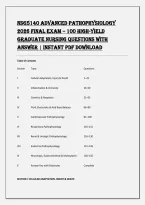
NSG5140 Advanced Pathophysiology
2026 Final Exam – 100 High-Yield
Graduate Nursing Questions with
Answer | INSTANT PDF DOWNLOAD
Table of Contents
Section Topic Questions
I Cellular Adaptation, Injury & Death 1–25
II Inflammation & Immunity 26–50
III Genetics & Neoplasia 51–65
IV Fluid, Electrolyte & Acid-Base Balance 66–80
V Cardiovascular Pathophysiology 81–100
VI Respiratory Pathophysiology 101–115
VII Renal & Urologic Pathophysiology 116–130
VIII Endocrine Pathophysiology 131–145
IX Neurologic, Gastrointestinal & Multisystem 146–150
X Answer Key with Rationales Complete
SECTION I: CELLULAR ADAPTATION, INJURY & DEATH
,🟢 Question 1. A 58-year-old male with chronic hypertension develops concentric left ventricular
hypertrophy. Which cellular adaptation is most characteristic?
A. Hyperplasia
B. Hypertrophy
C. Metaplasia
D. Dysplasia
🔴🔴 Correct Answer: B – Hypertrophy
Rationale: Increased workload causes enlargement of existing cardiac myocytes without an increase in
cell number, which is defined as hypertrophy. Cardiac myocytes are terminally differentiated and
respond to increased workload primarily through hypertrophy, not hyperplasia.
🟢 Question 2. Coagulative necrosis most commonly results from which pathophysiological process?
A. Enzymatic fat digestion
B. Ischemia
C. Tuberculosis infection
D. Abscess formation
🔴🔴 Correct Answer: B – Ischemia
Rationale: Coagulative necrosis typically follows ischemic infarction in solid organs (except the brain),
preserving tissue architecture temporarily. It results from protein denaturation causing structural
preservation for a short period.
🟢 Question 3. Apoptosis is best characterized by which feature that distinguishes it from necrosis?
A. Cellular swelling
B. Membrane rupture
C. Inflammatory response
D. Programmed cell death without inflammation
🔴🔴 Correct Answer: D – Programmed cell death without inflammation
Rationale: Apoptosis is regulated cell death that avoids eliciting an inflammatory response, unlike
necrosis. It involves programmed cell death of scattered single cells with cell shrinkage and chromatin
condensation.
🟢 Question 4. Free radical injury can be reduced by which intervention?
A. Increased iron availability
B. Decreased glutathione levels
C. Antioxidants
D. Hyperoxia
,🔴🔴 Correct Answer: C – Antioxidants
Rationale: Antioxidants neutralize reactive oxygen species and reduce oxidative cellular damage. Free
radicals cause lipid peroxidation and membrane damage, which antioxidants help prevent.
🟢 Question 5. A tissue biopsy from a smoker's bronchus reveals that normal ciliated columnar epithelial
cells have been replaced by stratified squamous epithelial cells. What is this adaptive process?
A. Anaplasia
B. Dysplasia
C. Metaplasia
D. Hyperplasia
🔴🔴 Correct Answer: C – Metaplasia
Rationale: Metaplasia is the reversible replacement of one mature cell type by another mature cell type,
usually in response to chronic irritation or inflammation, like cigarette smoke.
🟢 Question 6. During ischemic cell injury, what is the primary consequence of the decline in
mitochondrial ATP production?
A. Influx of potassium into the intracellular fluid
B. Failure of the sodium-potassium pump leading to cellular swelling
C. Decreased intracellular calcium concentration
D. Immediate activation of cellular protein synthesis
🔴🔴 Correct Answer: B – Failure of the sodium-potassium pump leading to cellular swelling
Rationale: Depleted ATP causes the Na+/K+ ATPase pump to shut down. Sodium accumulates inside the
cell, creating an osmotic gradient that pulls water into the cytoplasm, resulting in acute cellular swelling.
🟢 Question 7. A patient experiences an ischemic stroke. Which type of necrosis is uniquely characteristic
of hypoxic injury to the central nervous system?
A. Coagulative necrosis
B. Liquefactive necrosis
C. Caseous necrosis
D. Fat necrosis
🔴🔴 Correct Answer: B – Liquefactive necrosis
Rationale: Liquefactive necrosis occurs primarily in the brain and central nervous system because glial
cells and neurons contain large amounts of digestive hydrolytic enzymes and lipids, transforming dead
tissue into a liquid mass.
, 🟢 Question 8. What form of necrosis is classically associated with tuberculosis infections in the lungs,
resulting in a soft, cheese-like appearance of the dead tissue?
A. Gangrenous necrosis
B. Liquefactive necrosis
C. Caseous necrosis
D. Coagulative necrosis
🔴🔴 Correct Answer: C – Caseous necrosis
Rationale: Caseous necrosis combines elements of coagulative and liquefactive necrosis. It is a hallmark
of Mycobacterium tuberculosis infection, where dead cells disintegrate but are not completely digested,
leaving a crumbly appearance.
🟢 Question 9. Breast enlargement during pregnancy due to hormonal stimulation is an example of which
type of cellular adaptation?
A. Pathologic hypertrophy
B. Pathologic hyperplasia
C. Physiologic hypertrophy
D. Physiologic hyperplasia
🔴🔴 Correct Answer: D – Physiologic hyperplasia
Rationale: Hormonal stimulation during pregnancy causes both an increase in cell size and number in
breast tissue. This is a normal, reversible physiologic response to hormonal signals.
🟢 Question 10. Which cellular adaptation is considered a premalignant change?
A. Atrophy
B. Hypertrophy
C. Metaplasia
D. Dysplasia
🔴🔴 Correct Answer: D – Dysplasia
Rationale: Dysplasia is disordered cell growth characterized by abnormal cell size, shape, and
organization. It is often reversible but can progress to carcinoma in situ if the stimulus persists.
🟢 Question 11. Which organelle is primarily responsible for ATP production and is damaged in hypoxia?
A. Golgi apparatus
B. Lysosome
C. Mitochondrion
D. Ribosome
2026 Final Exam – 100 High-Yield
Graduate Nursing Questions with
Answer | INSTANT PDF DOWNLOAD
Table of Contents
Section Topic Questions
I Cellular Adaptation, Injury & Death 1–25
II Inflammation & Immunity 26–50
III Genetics & Neoplasia 51–65
IV Fluid, Electrolyte & Acid-Base Balance 66–80
V Cardiovascular Pathophysiology 81–100
VI Respiratory Pathophysiology 101–115
VII Renal & Urologic Pathophysiology 116–130
VIII Endocrine Pathophysiology 131–145
IX Neurologic, Gastrointestinal & Multisystem 146–150
X Answer Key with Rationales Complete
SECTION I: CELLULAR ADAPTATION, INJURY & DEATH
,🟢 Question 1. A 58-year-old male with chronic hypertension develops concentric left ventricular
hypertrophy. Which cellular adaptation is most characteristic?
A. Hyperplasia
B. Hypertrophy
C. Metaplasia
D. Dysplasia
🔴🔴 Correct Answer: B – Hypertrophy
Rationale: Increased workload causes enlargement of existing cardiac myocytes without an increase in
cell number, which is defined as hypertrophy. Cardiac myocytes are terminally differentiated and
respond to increased workload primarily through hypertrophy, not hyperplasia.
🟢 Question 2. Coagulative necrosis most commonly results from which pathophysiological process?
A. Enzymatic fat digestion
B. Ischemia
C. Tuberculosis infection
D. Abscess formation
🔴🔴 Correct Answer: B – Ischemia
Rationale: Coagulative necrosis typically follows ischemic infarction in solid organs (except the brain),
preserving tissue architecture temporarily. It results from protein denaturation causing structural
preservation for a short period.
🟢 Question 3. Apoptosis is best characterized by which feature that distinguishes it from necrosis?
A. Cellular swelling
B. Membrane rupture
C. Inflammatory response
D. Programmed cell death without inflammation
🔴🔴 Correct Answer: D – Programmed cell death without inflammation
Rationale: Apoptosis is regulated cell death that avoids eliciting an inflammatory response, unlike
necrosis. It involves programmed cell death of scattered single cells with cell shrinkage and chromatin
condensation.
🟢 Question 4. Free radical injury can be reduced by which intervention?
A. Increased iron availability
B. Decreased glutathione levels
C. Antioxidants
D. Hyperoxia
,🔴🔴 Correct Answer: C – Antioxidants
Rationale: Antioxidants neutralize reactive oxygen species and reduce oxidative cellular damage. Free
radicals cause lipid peroxidation and membrane damage, which antioxidants help prevent.
🟢 Question 5. A tissue biopsy from a smoker's bronchus reveals that normal ciliated columnar epithelial
cells have been replaced by stratified squamous epithelial cells. What is this adaptive process?
A. Anaplasia
B. Dysplasia
C. Metaplasia
D. Hyperplasia
🔴🔴 Correct Answer: C – Metaplasia
Rationale: Metaplasia is the reversible replacement of one mature cell type by another mature cell type,
usually in response to chronic irritation or inflammation, like cigarette smoke.
🟢 Question 6. During ischemic cell injury, what is the primary consequence of the decline in
mitochondrial ATP production?
A. Influx of potassium into the intracellular fluid
B. Failure of the sodium-potassium pump leading to cellular swelling
C. Decreased intracellular calcium concentration
D. Immediate activation of cellular protein synthesis
🔴🔴 Correct Answer: B – Failure of the sodium-potassium pump leading to cellular swelling
Rationale: Depleted ATP causes the Na+/K+ ATPase pump to shut down. Sodium accumulates inside the
cell, creating an osmotic gradient that pulls water into the cytoplasm, resulting in acute cellular swelling.
🟢 Question 7. A patient experiences an ischemic stroke. Which type of necrosis is uniquely characteristic
of hypoxic injury to the central nervous system?
A. Coagulative necrosis
B. Liquefactive necrosis
C. Caseous necrosis
D. Fat necrosis
🔴🔴 Correct Answer: B – Liquefactive necrosis
Rationale: Liquefactive necrosis occurs primarily in the brain and central nervous system because glial
cells and neurons contain large amounts of digestive hydrolytic enzymes and lipids, transforming dead
tissue into a liquid mass.
, 🟢 Question 8. What form of necrosis is classically associated with tuberculosis infections in the lungs,
resulting in a soft, cheese-like appearance of the dead tissue?
A. Gangrenous necrosis
B. Liquefactive necrosis
C. Caseous necrosis
D. Coagulative necrosis
🔴🔴 Correct Answer: C – Caseous necrosis
Rationale: Caseous necrosis combines elements of coagulative and liquefactive necrosis. It is a hallmark
of Mycobacterium tuberculosis infection, where dead cells disintegrate but are not completely digested,
leaving a crumbly appearance.
🟢 Question 9. Breast enlargement during pregnancy due to hormonal stimulation is an example of which
type of cellular adaptation?
A. Pathologic hypertrophy
B. Pathologic hyperplasia
C. Physiologic hypertrophy
D. Physiologic hyperplasia
🔴🔴 Correct Answer: D – Physiologic hyperplasia
Rationale: Hormonal stimulation during pregnancy causes both an increase in cell size and number in
breast tissue. This is a normal, reversible physiologic response to hormonal signals.
🟢 Question 10. Which cellular adaptation is considered a premalignant change?
A. Atrophy
B. Hypertrophy
C. Metaplasia
D. Dysplasia
🔴🔴 Correct Answer: D – Dysplasia
Rationale: Dysplasia is disordered cell growth characterized by abnormal cell size, shape, and
organization. It is often reversible but can progress to carcinoma in situ if the stimulus persists.
🟢 Question 11. Which organelle is primarily responsible for ATP production and is damaged in hypoxia?
A. Golgi apparatus
B. Lysosome
C. Mitochondrion
D. Ribosome


