
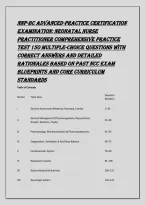
NNP-BC Advanced-Practice Certification
Examination: Neonatal Nurse
Practitioner Comprehensive Practice
Test 150 Multiple-Choice Questions with
Correct Answers and Detailed
Rationales Based on Past NCC Exam
Blueprints and Core Curriculum
Standards
Table of Contents
Question
Section Topic Area
Numbers
I General Assessment (Maternal, Neonatal, Family) 1–20
General Management (Thermoregulation, Resuscitation,
II 21–40
Growth, Nutrition, Fluids)
III Pharmacology, Pharmacokinetics & Pharmacodynamics 41–55
IV Oxygenation, Ventilation & Acid-Base Balance 56–75
V Cardiovascular System 76–90
VI Respiratory System 91–105
VII Gastrointestinal & Nutrition 106–115
VIII Neurologic System 116–125
, Question
Section Topic Area
Numbers
IX Infectious Disease & Immunology 126–135
X Hematologic & Endocrine Systems 136–145
XI Professional Issues, Ethics & Evidence-Based Practice 146–150
SECTION I: GENERAL ASSESSMENT (Maternal, Neonatal, Family)
🟢 1. A 34-week gestation infant is born to a mother with prolonged rupture of membranes (>18 hours)
and Group B Streptococcus colonization. The infant appears well at birth. According to CDC guidelines,
which of the following is the most appropriate management?
A. Observe for 48 hours without laboratory evaluation
B. Obtain blood culture and CBC, initiate empiric antibiotics
C. Administer a single dose of penicillin and discharge at 24 hours
D. Perform lumbar puncture and start ampicillin plus gentamicin
E. Provide only supportive care with frequent vital sign monitoring
🔴 Correct Answer: B
Rationale: Infants born to GBS-colonized mothers with prolonged rupture of membranes (>18 hours)
are at increased risk for early-onset sepsis. The CDC recommends a limited evaluation (blood culture and
CBC with differential) and empiric antibiotics for well-appearing infants with this risk profile. The 2019
AAP guidance recommends this approach for infants with risk factors who appear well. Observation
alone (A) is insufficient given the risk factor. A single dose of penicillin (C) is inadequate for empiric
coverage. Lumbar puncture (D) is not routinely performed on asymptomatic infants but is indicated in
symptomatic infants or when sepsis is confirmed. Supportive care alone (E) does not address infection
risk.
🟢 2. A mother with poorly controlled gestational diabetes delivers a 38-week infant weighing 4,200 g.
Which of the following complications should the NNP anticipate in the immediate newborn period?
A. Hyperglycemia and polycythemia
B. Hypoglycemia and respiratory distress
C. Hypercalcemia and hypothyroidism
D. Hyperbilirubinemia and thrombocytosis
E. Hypothermia and leukocytosis
🔴 Correct Answer: B
Rationale: Infants of diabetic mothers (IDMs) are at risk for hypoglycemia due to hyperinsulinism (from
fetal exposure to maternal glucose) and respiratory distress syndrome (due to delayed surfactant
,production). The infant of a diabetic mother is also at risk for macrosomia, birth trauma, polycythemia,
hyperbilirubinemia, and congenital anomalies (especially cardiac). Hyperglycemia (A) is not typical in
IDMs; they present with hypoglycemia. Hypercalcemia (C) is incorrect; hypocalcemia may occur.
Thrombocytosis (D) is incorrect; IDMs may have thrombocytopenia. Hypothermia (E) is a general
neonatal risk but not specific to IDMs; leukocytosis is not a classic finding.
🟢 3. A 28-week preterm infant is born via emergency cesarean section for non-reassuring fetal heart rate
tracing. At 1 minute of life, the infant has a heart rate of 80 bpm, irregular respirations, grimace, some
flexion of extremities, and blue extremities. What is the APGAR score?
A. 3
B. 4
C. 5
D. 6
E. 7
🔴 Correct Answer: B
Rationale: APGAR scoring: Heart rate <100 = 1 point (not 2, because HR must be ≥100 for 2 points);
Respiratory effort = irregular = 1 point; Muscle tone = some flexion = 1 point; Reflex irritability = grimace
= 1 point; Color = blue extremities = 1 point. Total = 1 + 1 + 1 + 1 + 1 = 5. Wait — APGAR: HR 80 = 1 point;
irregular respirations = 1 point; grimace = 1 point; some flexion = 1 point; acrocyanosis = 1 point. Total =
5. However, some scoring systems assign 0 to HR absent, 1 to HR <100, and 2 to HR ≥100. Therefore, the
correct score is 1+1+1+1+1 = 5. The answer should be C (5). Note: The APGAR score is calculated as
follows: Appearance (0-2), Pulse (0-2), Grimace (0-2), Activity (0-2), Respiration (0-2). For this infant: HR
80 = 1, irregular respirations = 1, grimace = 1, some flexion = 1, blue extremities = 1. Total = 5. Answer:
C.
🟢 4. A term infant presents at 36 hours of life with jaundice extending to the abdomen and a total serum
bilirubin of 15 mg/dL. The infant is breastfeeding well and has adequate urine output. The infant’s blood
type is A positive, and the mother’s blood type is O positive. Which of the following is the most likely
cause of the jaundice?
A. Breast milk jaundice
B. ABO hemolytic disease
C. Physiologic jaundice
D. Biliary atresia
E. Gilbert syndrome
🔴 Correct Answer: B
Rationale: ABO hemolytic disease occurs when the mother has blood type O and the infant has blood
type A or B. Maternal anti-A or anti-B IgG antibodies cross the placenta and cause hemolysis of fetal red
blood cells. This typically presents with jaundice within the first 24-48 hours, as seen here at 36 hours
with a bilirubin of 15 mg/dL. Breast milk jaundice (A) typically presents later (after the first week) and is
less severe. Physiologic jaundice (C) peaks at 3-5 days in term infants and typically does not exceed 12-
15 mg/dL. Biliary atresia (D) presents with conjugated hyperbilirubinemia and pale stools. Gilbert
, syndrome (E) is a hereditary condition that may cause mild unconjugated hyperbilirubinemia but is not
the most likely cause in this scenario.
🟢 5. A 30-week gestation infant is receiving mechanical ventilation. The NNP notes that the infant’s
mother has a history of chorioamnionitis. Which of the following laboratory findings would most
support a diagnosis of early-onset sepsis?
A. WBC of 25,000/mm³ with 40% neutrophils
B. Platelet count of 150,000/mm³
C. Immature-to-total neutrophil ratio (I:T) >0.2
D. CRP of 0.5 mg/dL
E. Glucose of 80 mg/dL
🔴 Correct Answer: C
Rationale: The immature-to-total neutrophil ratio (I:T ratio) is a sensitive marker for neonatal sepsis. An
I:T ratio >0.2 is considered abnormal and suggests neonatal sepsis. A WBC of 25,000 (A) is within the
normal range for a neonate (5,000-30,000). Platelet count of 150,000 (B) is at the lower end of normal
but not diagnostic of sepsis. CRP (C-reactive protein) of 0.5 mg/dL (D) is below the typical threshold for
sepsis (usually >1 mg/dL). Glucose of 80 mg/dL (E) is normal.
🟢 6. A newborn is noted to have a sacral dimple at the base of the spine. Which of the following findings
would warrant further imaging with ultrasound or MRI?
A. A dimple located 2 cm above the anal verge
B. A dimple within the gluteal cleft
C. A dimple with a small tuft of hair
D. A shallow dimple without discharge
E. A dimple located within the midline
🔴 Correct Answer: C
Rationale: A sacral dimple with a tuft of hair (hypertrichosis) or other cutaneous stigmata (lipoma,
hemangioma, deviated gluteal cleft) is concerning for spinal dysraphism and warrants further imaging.
Simple dimples within the gluteal cleft (B) or shallow midline dimples without other findings (D, E) are
typically benign and do not require imaging. A dimple located more than 2.5 cm above the anal verge (A)
is also concerning.
🟢 7. A 36-week infant is born to a mother who received magnesium sulfate for preeclampsia. The infant
is noted to be hypotonic with decreased deep tendon reflexes and respiratory depression. Which of the
following is the most appropriate initial management?
A. Administer naloxone 0.1 mg/kg IV
B. Provide positive pressure ventilation and supportive care
C. Administer calcium gluconate 100 mg/kg IV
D. Administer flumazenil 0.01 mg/kg IV
E. Obtain an emergency EEG
🔴 Correct Answer: C
Examination: Neonatal Nurse
Practitioner Comprehensive Practice
Test 150 Multiple-Choice Questions with
Correct Answers and Detailed
Rationales Based on Past NCC Exam
Blueprints and Core Curriculum
Standards
Table of Contents
Question
Section Topic Area
Numbers
I General Assessment (Maternal, Neonatal, Family) 1–20
General Management (Thermoregulation, Resuscitation,
II 21–40
Growth, Nutrition, Fluids)
III Pharmacology, Pharmacokinetics & Pharmacodynamics 41–55
IV Oxygenation, Ventilation & Acid-Base Balance 56–75
V Cardiovascular System 76–90
VI Respiratory System 91–105
VII Gastrointestinal & Nutrition 106–115
VIII Neurologic System 116–125
, Question
Section Topic Area
Numbers
IX Infectious Disease & Immunology 126–135
X Hematologic & Endocrine Systems 136–145
XI Professional Issues, Ethics & Evidence-Based Practice 146–150
SECTION I: GENERAL ASSESSMENT (Maternal, Neonatal, Family)
🟢 1. A 34-week gestation infant is born to a mother with prolonged rupture of membranes (>18 hours)
and Group B Streptococcus colonization. The infant appears well at birth. According to CDC guidelines,
which of the following is the most appropriate management?
A. Observe for 48 hours without laboratory evaluation
B. Obtain blood culture and CBC, initiate empiric antibiotics
C. Administer a single dose of penicillin and discharge at 24 hours
D. Perform lumbar puncture and start ampicillin plus gentamicin
E. Provide only supportive care with frequent vital sign monitoring
🔴 Correct Answer: B
Rationale: Infants born to GBS-colonized mothers with prolonged rupture of membranes (>18 hours)
are at increased risk for early-onset sepsis. The CDC recommends a limited evaluation (blood culture and
CBC with differential) and empiric antibiotics for well-appearing infants with this risk profile. The 2019
AAP guidance recommends this approach for infants with risk factors who appear well. Observation
alone (A) is insufficient given the risk factor. A single dose of penicillin (C) is inadequate for empiric
coverage. Lumbar puncture (D) is not routinely performed on asymptomatic infants but is indicated in
symptomatic infants or when sepsis is confirmed. Supportive care alone (E) does not address infection
risk.
🟢 2. A mother with poorly controlled gestational diabetes delivers a 38-week infant weighing 4,200 g.
Which of the following complications should the NNP anticipate in the immediate newborn period?
A. Hyperglycemia and polycythemia
B. Hypoglycemia and respiratory distress
C. Hypercalcemia and hypothyroidism
D. Hyperbilirubinemia and thrombocytosis
E. Hypothermia and leukocytosis
🔴 Correct Answer: B
Rationale: Infants of diabetic mothers (IDMs) are at risk for hypoglycemia due to hyperinsulinism (from
fetal exposure to maternal glucose) and respiratory distress syndrome (due to delayed surfactant
,production). The infant of a diabetic mother is also at risk for macrosomia, birth trauma, polycythemia,
hyperbilirubinemia, and congenital anomalies (especially cardiac). Hyperglycemia (A) is not typical in
IDMs; they present with hypoglycemia. Hypercalcemia (C) is incorrect; hypocalcemia may occur.
Thrombocytosis (D) is incorrect; IDMs may have thrombocytopenia. Hypothermia (E) is a general
neonatal risk but not specific to IDMs; leukocytosis is not a classic finding.
🟢 3. A 28-week preterm infant is born via emergency cesarean section for non-reassuring fetal heart rate
tracing. At 1 minute of life, the infant has a heart rate of 80 bpm, irregular respirations, grimace, some
flexion of extremities, and blue extremities. What is the APGAR score?
A. 3
B. 4
C. 5
D. 6
E. 7
🔴 Correct Answer: B
Rationale: APGAR scoring: Heart rate <100 = 1 point (not 2, because HR must be ≥100 for 2 points);
Respiratory effort = irregular = 1 point; Muscle tone = some flexion = 1 point; Reflex irritability = grimace
= 1 point; Color = blue extremities = 1 point. Total = 1 + 1 + 1 + 1 + 1 = 5. Wait — APGAR: HR 80 = 1 point;
irregular respirations = 1 point; grimace = 1 point; some flexion = 1 point; acrocyanosis = 1 point. Total =
5. However, some scoring systems assign 0 to HR absent, 1 to HR <100, and 2 to HR ≥100. Therefore, the
correct score is 1+1+1+1+1 = 5. The answer should be C (5). Note: The APGAR score is calculated as
follows: Appearance (0-2), Pulse (0-2), Grimace (0-2), Activity (0-2), Respiration (0-2). For this infant: HR
80 = 1, irregular respirations = 1, grimace = 1, some flexion = 1, blue extremities = 1. Total = 5. Answer:
C.
🟢 4. A term infant presents at 36 hours of life with jaundice extending to the abdomen and a total serum
bilirubin of 15 mg/dL. The infant is breastfeeding well and has adequate urine output. The infant’s blood
type is A positive, and the mother’s blood type is O positive. Which of the following is the most likely
cause of the jaundice?
A. Breast milk jaundice
B. ABO hemolytic disease
C. Physiologic jaundice
D. Biliary atresia
E. Gilbert syndrome
🔴 Correct Answer: B
Rationale: ABO hemolytic disease occurs when the mother has blood type O and the infant has blood
type A or B. Maternal anti-A or anti-B IgG antibodies cross the placenta and cause hemolysis of fetal red
blood cells. This typically presents with jaundice within the first 24-48 hours, as seen here at 36 hours
with a bilirubin of 15 mg/dL. Breast milk jaundice (A) typically presents later (after the first week) and is
less severe. Physiologic jaundice (C) peaks at 3-5 days in term infants and typically does not exceed 12-
15 mg/dL. Biliary atresia (D) presents with conjugated hyperbilirubinemia and pale stools. Gilbert
, syndrome (E) is a hereditary condition that may cause mild unconjugated hyperbilirubinemia but is not
the most likely cause in this scenario.
🟢 5. A 30-week gestation infant is receiving mechanical ventilation. The NNP notes that the infant’s
mother has a history of chorioamnionitis. Which of the following laboratory findings would most
support a diagnosis of early-onset sepsis?
A. WBC of 25,000/mm³ with 40% neutrophils
B. Platelet count of 150,000/mm³
C. Immature-to-total neutrophil ratio (I:T) >0.2
D. CRP of 0.5 mg/dL
E. Glucose of 80 mg/dL
🔴 Correct Answer: C
Rationale: The immature-to-total neutrophil ratio (I:T ratio) is a sensitive marker for neonatal sepsis. An
I:T ratio >0.2 is considered abnormal and suggests neonatal sepsis. A WBC of 25,000 (A) is within the
normal range for a neonate (5,000-30,000). Platelet count of 150,000 (B) is at the lower end of normal
but not diagnostic of sepsis. CRP (C-reactive protein) of 0.5 mg/dL (D) is below the typical threshold for
sepsis (usually >1 mg/dL). Glucose of 80 mg/dL (E) is normal.
🟢 6. A newborn is noted to have a sacral dimple at the base of the spine. Which of the following findings
would warrant further imaging with ultrasound or MRI?
A. A dimple located 2 cm above the anal verge
B. A dimple within the gluteal cleft
C. A dimple with a small tuft of hair
D. A shallow dimple without discharge
E. A dimple located within the midline
🔴 Correct Answer: C
Rationale: A sacral dimple with a tuft of hair (hypertrichosis) or other cutaneous stigmata (lipoma,
hemangioma, deviated gluteal cleft) is concerning for spinal dysraphism and warrants further imaging.
Simple dimples within the gluteal cleft (B) or shallow midline dimples without other findings (D, E) are
typically benign and do not require imaging. A dimple located more than 2.5 cm above the anal verge (A)
is also concerning.
🟢 7. A 36-week infant is born to a mother who received magnesium sulfate for preeclampsia. The infant
is noted to be hypotonic with decreased deep tendon reflexes and respiratory depression. Which of the
following is the most appropriate initial management?
A. Administer naloxone 0.1 mg/kg IV
B. Provide positive pressure ventilation and supportive care
C. Administer calcium gluconate 100 mg/kg IV
D. Administer flumazenil 0.01 mg/kg IV
E. Obtain an emergency EEG
🔴 Correct Answer: C


