
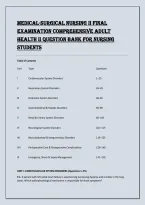
Medical-Surgical Nursing II Final
Examination Comprehensive Adult
Health II Question Bank for Nursing
Students
Table of Contents
Unit Topic Questions
I Cardiovascular System Disorders 1–25
II Respiratory System Disorders 26–45
III Endocrine System Disorders 46–65
IV Gastrointestinal & Hepatic Disorders 66–85
V Renal & Urinary System Disorders 86–100
VI Neurological System Disorders 101–115
VII Musculoskeletal & Integumentary Disorders 116–125
VIII Perioperative Care & Postoperative Complications 126–140
IX Emergency, Shock & Sepsis Management 141–150
UNIT I: CARDIOVASCULAR SYSTEM DISORDERS (Questions 1–25)
🟢 1. A patient with left-sided heart failure is experiencing worsening dyspnea and crackles in the lung
bases. Which pathophysiological mechanism is responsible for these symptoms?
,A. Increased systemic vascular resistance
B. Backup of blood into the pulmonary circulation
C. Peripheral venous congestion
D. Decreased renal perfusion causing fluid retention
🔴🔴 Answer: B
Rationale: Left-sided heart failure causes the left ventricle to fail as a pump, leading to backup of blood
into the left atrium and pulmonary veins, causing pulmonary edema and respiratory symptoms. Option
A is incorrect because increased systemic vascular resistance is more associated with hypertension and
right-sided failure. Option C describes right-sided failure manifestations. Option D is a compensatory
mechanism, not the direct cause of pulmonary symptoms.
🟢 2. A nurse is assessing a client with right-sided heart failure. Which clinical manifestation should the
nurse expect to find?
A. Orthopnea
B. Wheezing and pink frothy sputum
C. Jugular venous distention
D. Paroxysmal nocturnal dyspnea
🔴🔴 Answer: C
Rationale: Right-sided heart failure causes blood to back up into the systemic venous system, resulting
in JVD, peripheral edema, and hepatomegaly. Options A, B, and D are manifestations of left-sided heart
failure.
🟢 3. A patient with atrial fibrillation is prescribed warfarin. Which laboratory value should the nurse
monitor to evaluate therapeutic effectiveness?
A. aPTT
B. INR
C. Platelet count
D. Bleeding time
🔴🔴 Answer: B
Rationale: Warfarin therapy is monitored using the INR (International Normalized Ratio), with a
therapeutic range typically between 2.0 and 3.0 for atrial fibrillation. aPTT monitors heparin therapy.
Platelet count and bleeding time do not directly assess warfarin effectiveness.
🟢 4. A nurse is caring for a patient who develops sudden onset of chest pain radiating to the left arm,
diaphoresis, and nausea. Which action should the nurse take first?
A. Obtain a 12-lead ECG
B. Administer aspirin 325 mg chewed
,C. Assess airway, breathing, and circulation
D. Notify the healthcare provider
🔴🔴 Answer: C
Rationale: The priority nursing assessment for any patient with chest pain is to assess airway, breathing,
and circulation (ABCs). While ECG and aspirin are important, they follow the initial ABC assessment. This
aligns with NCLEX prioritization standards.
🟢 5. A patient with heart failure is prescribed furosemide. Which assessment finding indicates a
therapeutic response to the medication?
A. Weight gain of 2 kg in 24 hours
B. Decreased dyspnea and clear lung sounds
C. Jugular venous distension
D. Worsening peripheral edema
🔴🔴 Answer: B
Rationale: Decreased dyspnea and clear lung sounds indicate effective diuresis and reduced pulmonary
congestion. Weight gain, JVD, and worsening edema indicate fluid retention and worsening heart
failure.
🟢 6. A nurse is teaching a patient about lifestyle modifications for hypertension management. Which
statement by the patient indicates correct understanding?
A. "I should limit my potassium intake."
B. "I can stop taking my medication once my blood pressure is normal."
C. "I should engage in moderate exercise for at least 30 minutes most days."
D. "I should increase my sodium intake to maintain fluid balance."
🔴🔴 Answer: C
Rationale: Moderate exercise for at least 30 minutes on most days is recommended for hypertension
management. Potassium should generally be increased (unless contraindicated), medications should not
be stopped abruptly, and sodium should be restricted.
🟢 7. A patient is admitted with acute decompensated heart failure. Which position should the nurse
place the patient in to promote comfort and respiratory function?
A. Supine with legs elevated
B. High-Fowler's position
C. Trendelenburg position
D. Left lateral recumbent position
, 🔴🔴 Answer: B
Rationale: High-Fowler's position facilitates lung expansion and reduces venous return to the heart,
decreasing pulmonary congestion. Supine and Trendelenburg positions worsen respiratory distress.
🟢 8. A nurse is reviewing lab results for a patient on heparin infusion. Which value indicates a
therapeutic response?
A. INR 1.5
B. aPTT 60–80 seconds
C. Platelet count 50,000/mm³
D. Hemoglobin 10 g/dL
🔴🔴 Answer: B
Rationale: Therapeutic aPTT for heparin therapy is typically 1.5–2.5 times the control value, or
approximately 60–80 seconds. INR is used for warfarin monitoring. Low platelets may indicate HIT, and
low hemoglobin is unrelated to heparin effectiveness.
🟢 9. A patient with peripheral arterial disease (PAD) reports pain in the calf that occurs with walking and
resolves with rest. What is this symptom called?
A. Dependent rubor
B. Intermittent claudication
C. Rest pain
D. Paresthesia
🔴🔴 Answer: B
Rationale: Intermittent claudication is reproducible muscle pain that occurs with exercise and resolves
with rest, caused by inadequate arterial blood flow. Dependent rubor is a color change. Rest pain occurs
at rest and indicates severe disease.
🟢 10. A nurse is assessing a patient with deep vein thrombosis (DVT). Which finding is most concerning?
A. Unilateral calf swelling
B. Warmth and redness at the site
C. Sudden shortness of breath
D. Positive Homans' sign
🔴🔴 Answer: C
Rationale: Sudden shortness of breath may indicate pulmonary embolism, a life-threatening
complication of DVT. Unilateral swelling, warmth, and Homans' sign are common DVT findings but not
immediately life-threatening.
Examination Comprehensive Adult
Health II Question Bank for Nursing
Students
Table of Contents
Unit Topic Questions
I Cardiovascular System Disorders 1–25
II Respiratory System Disorders 26–45
III Endocrine System Disorders 46–65
IV Gastrointestinal & Hepatic Disorders 66–85
V Renal & Urinary System Disorders 86–100
VI Neurological System Disorders 101–115
VII Musculoskeletal & Integumentary Disorders 116–125
VIII Perioperative Care & Postoperative Complications 126–140
IX Emergency, Shock & Sepsis Management 141–150
UNIT I: CARDIOVASCULAR SYSTEM DISORDERS (Questions 1–25)
🟢 1. A patient with left-sided heart failure is experiencing worsening dyspnea and crackles in the lung
bases. Which pathophysiological mechanism is responsible for these symptoms?
,A. Increased systemic vascular resistance
B. Backup of blood into the pulmonary circulation
C. Peripheral venous congestion
D. Decreased renal perfusion causing fluid retention
🔴🔴 Answer: B
Rationale: Left-sided heart failure causes the left ventricle to fail as a pump, leading to backup of blood
into the left atrium and pulmonary veins, causing pulmonary edema and respiratory symptoms. Option
A is incorrect because increased systemic vascular resistance is more associated with hypertension and
right-sided failure. Option C describes right-sided failure manifestations. Option D is a compensatory
mechanism, not the direct cause of pulmonary symptoms.
🟢 2. A nurse is assessing a client with right-sided heart failure. Which clinical manifestation should the
nurse expect to find?
A. Orthopnea
B. Wheezing and pink frothy sputum
C. Jugular venous distention
D. Paroxysmal nocturnal dyspnea
🔴🔴 Answer: C
Rationale: Right-sided heart failure causes blood to back up into the systemic venous system, resulting
in JVD, peripheral edema, and hepatomegaly. Options A, B, and D are manifestations of left-sided heart
failure.
🟢 3. A patient with atrial fibrillation is prescribed warfarin. Which laboratory value should the nurse
monitor to evaluate therapeutic effectiveness?
A. aPTT
B. INR
C. Platelet count
D. Bleeding time
🔴🔴 Answer: B
Rationale: Warfarin therapy is monitored using the INR (International Normalized Ratio), with a
therapeutic range typically between 2.0 and 3.0 for atrial fibrillation. aPTT monitors heparin therapy.
Platelet count and bleeding time do not directly assess warfarin effectiveness.
🟢 4. A nurse is caring for a patient who develops sudden onset of chest pain radiating to the left arm,
diaphoresis, and nausea. Which action should the nurse take first?
A. Obtain a 12-lead ECG
B. Administer aspirin 325 mg chewed
,C. Assess airway, breathing, and circulation
D. Notify the healthcare provider
🔴🔴 Answer: C
Rationale: The priority nursing assessment for any patient with chest pain is to assess airway, breathing,
and circulation (ABCs). While ECG and aspirin are important, they follow the initial ABC assessment. This
aligns with NCLEX prioritization standards.
🟢 5. A patient with heart failure is prescribed furosemide. Which assessment finding indicates a
therapeutic response to the medication?
A. Weight gain of 2 kg in 24 hours
B. Decreased dyspnea and clear lung sounds
C. Jugular venous distension
D. Worsening peripheral edema
🔴🔴 Answer: B
Rationale: Decreased dyspnea and clear lung sounds indicate effective diuresis and reduced pulmonary
congestion. Weight gain, JVD, and worsening edema indicate fluid retention and worsening heart
failure.
🟢 6. A nurse is teaching a patient about lifestyle modifications for hypertension management. Which
statement by the patient indicates correct understanding?
A. "I should limit my potassium intake."
B. "I can stop taking my medication once my blood pressure is normal."
C. "I should engage in moderate exercise for at least 30 minutes most days."
D. "I should increase my sodium intake to maintain fluid balance."
🔴🔴 Answer: C
Rationale: Moderate exercise for at least 30 minutes on most days is recommended for hypertension
management. Potassium should generally be increased (unless contraindicated), medications should not
be stopped abruptly, and sodium should be restricted.
🟢 7. A patient is admitted with acute decompensated heart failure. Which position should the nurse
place the patient in to promote comfort and respiratory function?
A. Supine with legs elevated
B. High-Fowler's position
C. Trendelenburg position
D. Left lateral recumbent position
, 🔴🔴 Answer: B
Rationale: High-Fowler's position facilitates lung expansion and reduces venous return to the heart,
decreasing pulmonary congestion. Supine and Trendelenburg positions worsen respiratory distress.
🟢 8. A nurse is reviewing lab results for a patient on heparin infusion. Which value indicates a
therapeutic response?
A. INR 1.5
B. aPTT 60–80 seconds
C. Platelet count 50,000/mm³
D. Hemoglobin 10 g/dL
🔴🔴 Answer: B
Rationale: Therapeutic aPTT for heparin therapy is typically 1.5–2.5 times the control value, or
approximately 60–80 seconds. INR is used for warfarin monitoring. Low platelets may indicate HIT, and
low hemoglobin is unrelated to heparin effectiveness.
🟢 9. A patient with peripheral arterial disease (PAD) reports pain in the calf that occurs with walking and
resolves with rest. What is this symptom called?
A. Dependent rubor
B. Intermittent claudication
C. Rest pain
D. Paresthesia
🔴🔴 Answer: B
Rationale: Intermittent claudication is reproducible muscle pain that occurs with exercise and resolves
with rest, caused by inadequate arterial blood flow. Dependent rubor is a color change. Rest pain occurs
at rest and indicates severe disease.
🟢 10. A nurse is assessing a patient with deep vein thrombosis (DVT). Which finding is most concerning?
A. Unilateral calf swelling
B. Warmth and redness at the site
C. Sudden shortness of breath
D. Positive Homans' sign
🔴🔴 Answer: C
Rationale: Sudden shortness of breath may indicate pulmonary embolism, a life-threatening
complication of DVT. Unilateral swelling, warmth, and Homans' sign are common DVT findings but not
immediately life-threatening.


