
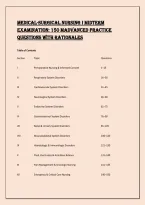
medical-Surgical Nursing I Midterm
Examination: 150 MAdvanced Practice
Questions with Rationales
Table of Contents
Section Topic Questions
I Perioperative Nursing & Informed Consent 1–15
II Respiratory System Disorders 16–30
III Cardiovascular System Disorders 31–45
IV Neurological System Disorders 46–60
V Endocrine System Disorders 61–75
VI Gastrointestinal System Disorders 76–90
VII Renal & Urinary System Disorders 91–105
VIII Musculoskeletal System Disorders 106–120
IX Hematologic & Immunologic Disorders 121–130
X Fluid, Electrolyte & Acid-Base Balance 131–140
XI Pain Management & Oncologic Nursing 141–145
XII Emergency & Critical Care Nursing 146–150
,Section I: Perioperative Nursing & Informed Consent
🟢 1. A nurse is preparing a patient for surgery. Which of the following is the primary responsibility of the
nurse regarding informed consent?
A. Explaining the risks and benefits of the procedure
B. Obtaining the surgical consent from the patient
C. Witnessing the patient’s signature on the consent form
D. Deciding if the patient is competent to sign
🔴🔴 Correct Answer: C
Rationale: The surgeon is responsible for explaining the procedure and obtaining consent; the nurse’s
role is to witness the patient signing the form and ensuring they are doing so voluntarily.
🟢 2. A postoperative patient is being monitored for atelectasis. Which assessment finding should the
nurse prioritize?
A. Increased temperature to 101°F
B. Decreased breath sounds at the bases
C. Productive cough with yellow sputum
D. Sharp chest pain on inspiration
🔴🔴 Correct Answer: B
Rationale: Atelectasis is the collapse of alveoli, commonly evidenced by decreased or absent breath
sounds in the lower lobes due to shallow breathing post-surgery.
🟢 3. A patient is 12 hours postoperative following abdominal surgery. Which nursing intervention most
effectively prevents deep vein thrombosis (DVT)?
A. Administering prophylactic antibiotics
B. Teaching the patient to cough and deep breathe
C. Massaging the calves every 4 hours
D. Early ambulation and leg exercises
🔴🔴 Correct Answer: D
Rationale: Early ambulation is the most effective way to promote venous return and prevent the
formation of clots in the lower extremities.
🟢 4. During a blood transfusion, the patient complains of chills and lower back pain. What is the priority
nursing action?
A. Stop the transfusion immediately
B. Administer Benadryl immediately
,C. Slow down the infusion rate
D. Check the patient’s temperature
🔴🔴 Correct Answer: A
Rationale: Chills and lower back pain are signs of a hemolytic reaction. The first priority is to stop the
transfusion immediately.
🟢 5. A nurse is caring for a client who is 24 hours postoperative following an abdominal hysterectomy.
The client reports sudden chest pain and dyspnea. The nurse notes an oxygen saturation of 88% on
room air. Which action should the nurse take first?
A. Administer the prescribed PRN morphine sulfate injection.
B. Initiate oxygen therapy via nasal cannula at 2 to 4 L/min.
C. Obtain a 12-lead electrocardiogram (ECG).
D. Elevate the head of the bed to 45 degrees.
🔴🔴 Correct Answer: D
Rationale: Elevating the head of the bed immediately maximizes chest expansion, improves
diaphragmatic excursion, and optimizes gas exchange for a client experiencing acute dyspnea and
suspected pulmonary embolism. This independent nursing action requires no physician order and
addresses immediate physiological stability. While initiating oxygen (Option B) is highly critical, physical
repositioning takes immediate priority to ease the work of breathing.
🟢 6. The nurse is caring for a patient post-thyroidectomy. The presence of Trousseau’s sign indicates:
A. Hypercalcemia
B. Hypocalcemia
C. Hypokalemia
D. Hypermagnesemia
🔴🔴 Correct Answer: B
Rationale: Accidental removal or damage to parathyroid glands during thyroidectomy leads to
hypocalcemia, evidenced by neuromuscular irritability (Trousseau’s or Chvostek’s signs).
🟢 7. The primary purpose of using a water-seal drainage system after thoracic surgery is to:
A. Measure volume of drainage
B. Re-expand the lung and prevent air from returning to the pleural space
C. Provide a sterile environment for pleural fluids
D. Prevent infection of the surgical site
🔴🔴 Correct Answer: B
Rationale: The water seal acts as a one-way valve, allowing air and fluid to escape the pleural space but
preventing atmospheric air from re-entering, allowing lung re-expansion.
, 🟢 8. A nurse is caring for a client who is post-operative following a total hip arthroplasty. Which of the
following actions should the nurse take to prevent dislocation?
A. Place a pillow between the client’s legs when turning.
B. Keep the client’s hip flexed at 90 degrees.
C. Encourage the client to cross their legs when sitting.
D. Avoid using an abduction pillow.
🔴🔴 Correct Answer: A
Rationale: Placing a pillow between the legs (abduction pillow) prevents adduction and dislocation of
the new hip prosthesis.
🟢 9. A client scheduled for a barium swallow should:
A. Starve for 8 hours before the procedure
B. Starve for 6 hours before the procedure
C. Starve for 4 hours before the procedure
D. Starve for 2 hours before the procedure
🔴🔴 Correct Answer: A
Rationale: Patients scheduled for barium swallow should be NPO for 8 hours to ensure an empty
stomach for accurate visualization.
🟢 10. The nurse is monitoring a client following a lung resection. Which finding should the nurse report
immediately?
A. Chest tube drainage of 50 mL/hr
B. Oxygen saturation of 94% on 2 L nasal cannula
C. Tracheal deviation to the unaffected side
D. Incisional pain rated 4/10
🔴🔴 Correct Answer: C
Rationale: Tracheal deviation to the unaffected side is a sign of tension pneumothorax, a life-
threatening complication requiring immediate intervention.
🟢 11. A nurse is preparing a patient for surgery. Which of the following is the primary responsibility of
the nurse regarding informed consent?
A. Explaining the risks and benefits of the procedure
B. Obtaining the surgical consent from the patient
C. Witnessing the patient’s signature on the consent form
D. Deciding if the patient is competent to sign
Examination: 150 MAdvanced Practice
Questions with Rationales
Table of Contents
Section Topic Questions
I Perioperative Nursing & Informed Consent 1–15
II Respiratory System Disorders 16–30
III Cardiovascular System Disorders 31–45
IV Neurological System Disorders 46–60
V Endocrine System Disorders 61–75
VI Gastrointestinal System Disorders 76–90
VII Renal & Urinary System Disorders 91–105
VIII Musculoskeletal System Disorders 106–120
IX Hematologic & Immunologic Disorders 121–130
X Fluid, Electrolyte & Acid-Base Balance 131–140
XI Pain Management & Oncologic Nursing 141–145
XII Emergency & Critical Care Nursing 146–150
,Section I: Perioperative Nursing & Informed Consent
🟢 1. A nurse is preparing a patient for surgery. Which of the following is the primary responsibility of the
nurse regarding informed consent?
A. Explaining the risks and benefits of the procedure
B. Obtaining the surgical consent from the patient
C. Witnessing the patient’s signature on the consent form
D. Deciding if the patient is competent to sign
🔴🔴 Correct Answer: C
Rationale: The surgeon is responsible for explaining the procedure and obtaining consent; the nurse’s
role is to witness the patient signing the form and ensuring they are doing so voluntarily.
🟢 2. A postoperative patient is being monitored for atelectasis. Which assessment finding should the
nurse prioritize?
A. Increased temperature to 101°F
B. Decreased breath sounds at the bases
C. Productive cough with yellow sputum
D. Sharp chest pain on inspiration
🔴🔴 Correct Answer: B
Rationale: Atelectasis is the collapse of alveoli, commonly evidenced by decreased or absent breath
sounds in the lower lobes due to shallow breathing post-surgery.
🟢 3. A patient is 12 hours postoperative following abdominal surgery. Which nursing intervention most
effectively prevents deep vein thrombosis (DVT)?
A. Administering prophylactic antibiotics
B. Teaching the patient to cough and deep breathe
C. Massaging the calves every 4 hours
D. Early ambulation and leg exercises
🔴🔴 Correct Answer: D
Rationale: Early ambulation is the most effective way to promote venous return and prevent the
formation of clots in the lower extremities.
🟢 4. During a blood transfusion, the patient complains of chills and lower back pain. What is the priority
nursing action?
A. Stop the transfusion immediately
B. Administer Benadryl immediately
,C. Slow down the infusion rate
D. Check the patient’s temperature
🔴🔴 Correct Answer: A
Rationale: Chills and lower back pain are signs of a hemolytic reaction. The first priority is to stop the
transfusion immediately.
🟢 5. A nurse is caring for a client who is 24 hours postoperative following an abdominal hysterectomy.
The client reports sudden chest pain and dyspnea. The nurse notes an oxygen saturation of 88% on
room air. Which action should the nurse take first?
A. Administer the prescribed PRN morphine sulfate injection.
B. Initiate oxygen therapy via nasal cannula at 2 to 4 L/min.
C. Obtain a 12-lead electrocardiogram (ECG).
D. Elevate the head of the bed to 45 degrees.
🔴🔴 Correct Answer: D
Rationale: Elevating the head of the bed immediately maximizes chest expansion, improves
diaphragmatic excursion, and optimizes gas exchange for a client experiencing acute dyspnea and
suspected pulmonary embolism. This independent nursing action requires no physician order and
addresses immediate physiological stability. While initiating oxygen (Option B) is highly critical, physical
repositioning takes immediate priority to ease the work of breathing.
🟢 6. The nurse is caring for a patient post-thyroidectomy. The presence of Trousseau’s sign indicates:
A. Hypercalcemia
B. Hypocalcemia
C. Hypokalemia
D. Hypermagnesemia
🔴🔴 Correct Answer: B
Rationale: Accidental removal or damage to parathyroid glands during thyroidectomy leads to
hypocalcemia, evidenced by neuromuscular irritability (Trousseau’s or Chvostek’s signs).
🟢 7. The primary purpose of using a water-seal drainage system after thoracic surgery is to:
A. Measure volume of drainage
B. Re-expand the lung and prevent air from returning to the pleural space
C. Provide a sterile environment for pleural fluids
D. Prevent infection of the surgical site
🔴🔴 Correct Answer: B
Rationale: The water seal acts as a one-way valve, allowing air and fluid to escape the pleural space but
preventing atmospheric air from re-entering, allowing lung re-expansion.
, 🟢 8. A nurse is caring for a client who is post-operative following a total hip arthroplasty. Which of the
following actions should the nurse take to prevent dislocation?
A. Place a pillow between the client’s legs when turning.
B. Keep the client’s hip flexed at 90 degrees.
C. Encourage the client to cross their legs when sitting.
D. Avoid using an abduction pillow.
🔴🔴 Correct Answer: A
Rationale: Placing a pillow between the legs (abduction pillow) prevents adduction and dislocation of
the new hip prosthesis.
🟢 9. A client scheduled for a barium swallow should:
A. Starve for 8 hours before the procedure
B. Starve for 6 hours before the procedure
C. Starve for 4 hours before the procedure
D. Starve for 2 hours before the procedure
🔴🔴 Correct Answer: A
Rationale: Patients scheduled for barium swallow should be NPO for 8 hours to ensure an empty
stomach for accurate visualization.
🟢 10. The nurse is monitoring a client following a lung resection. Which finding should the nurse report
immediately?
A. Chest tube drainage of 50 mL/hr
B. Oxygen saturation of 94% on 2 L nasal cannula
C. Tracheal deviation to the unaffected side
D. Incisional pain rated 4/10
🔴🔴 Correct Answer: C
Rationale: Tracheal deviation to the unaffected side is a sign of tension pneumothorax, a life-
threatening complication requiring immediate intervention.
🟢 11. A nurse is preparing a patient for surgery. Which of the following is the primary responsibility of
the nurse regarding informed consent?
A. Explaining the risks and benefits of the procedure
B. Obtaining the surgical consent from the patient
C. Witnessing the patient’s signature on the consent form
D. Deciding if the patient is competent to sign


