
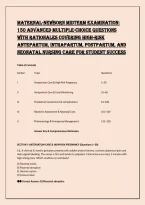
Maternal-Newborn Midterm Examination:
150 Advanced Multiple-Choice Questions
with Rationales Covering High-Risk
Antepartum, Intrapartum, Postpartum, and
Neonatal Nursing Care for Student Success
Table of Contents
Section Topic Questions
I Antepartum Care & High-Risk Pregnancy 1–30
II Intrapartum Care & Fetal Monitoring 31–60
III Postpartum Assessment & Complications 61–100
IV Newborn Assessment & Neonatal Care 101–130
V Pharmacology & Emergency Management 131–150
Answer Key & Comprehensive Rationales
SECTION I: ANTEPARTUM CARE & HIGH-RISK PREGNANCY (Questions 1–30)
🟢 1. A client at 33 weeks' gestation presents with sudden onset of severe, constant abdominal pain and
dark vaginal bleeding. The uterus is firm and tender to palpation. Contractions are every 2 minutes with
high resting tone. Which condition is most likely?
A) Placenta previa
B) Placental abruption
C) Uterine rupture
D) Preterm labor
🔴🔴 Correct Answer: B) Placental abruption
,Rationale: The classic signs of placental abruption (abruptio placentae) are painful, dark red bleeding,
uterine hypertonicity, and a rigid, tender uterus. Placenta previa typically presents with painless, bright
red bleeding and a soft uterus. Uterine rupture causes sudden tearing pain, cessation of contractions,
and fetal bradycardia. Preterm labor has rhythmic contractions without a rigid uterus.
🟢 2. A client at 38 weeks gestation presents with a blood pressure of 150/95 mmHg and proteinuria (2+).
She denies headache or visual changes. Which diagnosis is most likely?
A) Gestational hypertension
B) Preeclampsia without severe features
C) Chronic hypertension
D) Eclampsia
🔴🔴 Correct Answer: B) Preeclampsia without severe features
Rationale: New hypertension after 20 weeks with proteinuria defines preeclampsia. No severe features
are present (BP <160/110, normal platelets/LFTs). Gestational hypertension lacks proteinuria. Chronic
hypertension predates pregnancy. Eclampsia involves seizures.
🟢 3. A client at 32 weeks gestation reports painless, bright red vaginal bleeding. Which condition is most
likely?
A) Abruptio placentae
B) Placenta previa
C) Vasa previa
D) Labor
🔴🔴 Correct Answer: B) Placenta previa
Rationale: Painless bright red vaginal bleeding in the third trimester is the hallmark of placenta previa.
Abruptio placentae presents with painful bleeding and a rigid uterus. Vasa previa involves fetal vessel
rupture. Labor typically presents with contractions and bloody show.
🟢 4. A nurse is assessing a client with severe preeclampsia receiving magnesium sulfate infusion. The
nurse notes respiratory rate 8 breaths/min, absent deep tendon reflexes, and serum magnesium
pending. What is the priority nursing action?
A) Continue the infusion and reassess in 30 minutes
B) Discontinue the magnesium sulfate infusion immediately
C) Administer oxygen and reposition the client
D) Prepare for emergent cesarean delivery
🔴🔴 Correct Answer: B) Discontinue the magnesium sulfate infusion immediately
,Rationale: Respiratory rate <12 breaths/min and absent deep tendon reflexes indicate magnesium
sulfate toxicity. The priority is to discontinue the infusion immediately and prepare to administer the
antidote, calcium gluconate. Continuing the infusion could lead to respiratory arrest.
🟢 5. A woman at 24 weeks' gestation with a history of a previous preterm birth at 30 weeks is at highest
risk for which complication?
A) Gestational diabetes
B) Recurrent preterm labor
C) Placenta previa
D) Preeclampsia
🔴🔴 Correct Answer: B) Recurrent preterm labor
Rationale: A history of prior preterm birth is the strongest risk factor for recurrent preterm labor. These
clients may be candidates for progesterone supplementation and cervical length monitoring. Gestational
diabetes, placenta previa, and preeclampsia have different risk profiles.
🟢 6. A client at 28 weeks gestation is diagnosed with gestational diabetes. Which instruction should the
nurse include in the teaching plan?
A) "You should eliminate all carbohydrates from your diet."
B) "Monitor your blood glucose levels before breakfast and 1–2 hours after each meal."
C) "You will need to take insulin for the remainder of your pregnancy."
D) "You can resume your pre-pregnancy diet after delivery."
🔴🔴 Correct Answer: B) "Monitor your blood glucose levels before breakfast and 1–2 hours after each
meal."
Rationale: Blood glucose monitoring in gestational diabetes typically includes fasting levels and
postprandial checks. Carbohydrates should be distributed throughout the day, not eliminated. Not all
clients with GDM require insulin; many are managed with diet and exercise alone.
🟢 7. A nurse is reviewing the medical record of a pregnant client at 30 weeks gestation. Which finding is
most concerning for the development of preeclampsia?
A) Blood pressure 118/72 mmHg
B) 1+ proteinuria and BP 138/88 mmHg
C) Blood pressure 145/92 mmHg with proteinuria 2+
D) Mild ankle edema
🔴🔴 Correct Answer: C) Blood pressure 145/92 mmHg with proteinuria 2+
Rationale: Hypertension (≥140/90 mmHg) with proteinuria (≥2+) after 20 weeks gestation is diagnostic
for preeclampsia. Mild ankle edema is common in normal pregnancy. A BP of 138/88 is elevated but
, does not meet the threshold for hypertension. The combination of BP ≥140/90 and significant
proteinuria requires immediate attention.
🟢 8. A client at 36 weeks gestation with placenta previa is admitted with painless vaginal bleeding.
Which nursing intervention is contraindicated?
A) Assessing fetal heart tones
B) Performing a sterile vaginal examination
C) Monitoring maternal vital signs
D) Administering IV fluids as prescribed
🔴🔴 Correct Answer: B) Performing a sterile vaginal examination
Rationale: Vaginal examination is absolutely contraindicated in placenta previa because it may disrupt
the placenta and cause severe hemorrhage. Fetal monitoring, vital signs, and IV fluid administration are
appropriate interventions.
🟢 9. A nurse is providing education to a pregnant client about warning signs that require immediate
medical attention. Which statement by the client indicates understanding?
A) "I should report any clear vaginal discharge."
B) "I should report a severe headache or visual changes immediately."
C) "I should expect occasional contractions in the third trimester."
D) "I should report mild ankle swelling."
🔴🔴 Correct Answer: B) "I should report a severe headache or visual changes immediately."
Rationale: Severe headache and visual changes are warning signs of preeclampsia and require
immediate evaluation. Clear vaginal discharge and mild ankle swelling are normal in pregnancy.
Occasional contractions may be Braxton Hicks, but regular contractions before 37 weeks should be
reported.
🟢 10. A client at 26 weeks gestation is diagnosed with gestational diabetes. Which finding indicates that
dietary management alone is insufficient?
A) Fasting blood glucose of 92 mg/dL
B) 1-hour postprandial glucose of 130 mg/dL
C) Fasting blood glucose of 110 mg/dL
D) 2-hour postprandial glucose of 115 mg/dL
🔴🔴 Correct Answer: C) Fasting blood glucose of 110 mg/dL
Rationale: Target fasting glucose in gestational diabetes is typically <95 mg/dL. A fasting glucose of 110
mg/dL indicates that dietary management alone is insufficient and pharmacologic therapy (insulin)
should be initiated. Postprandial targets are generally <140 mg/dL at 1 hour and <120 mg/dL at 2 hours.
150 Advanced Multiple-Choice Questions
with Rationales Covering High-Risk
Antepartum, Intrapartum, Postpartum, and
Neonatal Nursing Care for Student Success
Table of Contents
Section Topic Questions
I Antepartum Care & High-Risk Pregnancy 1–30
II Intrapartum Care & Fetal Monitoring 31–60
III Postpartum Assessment & Complications 61–100
IV Newborn Assessment & Neonatal Care 101–130
V Pharmacology & Emergency Management 131–150
Answer Key & Comprehensive Rationales
SECTION I: ANTEPARTUM CARE & HIGH-RISK PREGNANCY (Questions 1–30)
🟢 1. A client at 33 weeks' gestation presents with sudden onset of severe, constant abdominal pain and
dark vaginal bleeding. The uterus is firm and tender to palpation. Contractions are every 2 minutes with
high resting tone. Which condition is most likely?
A) Placenta previa
B) Placental abruption
C) Uterine rupture
D) Preterm labor
🔴🔴 Correct Answer: B) Placental abruption
,Rationale: The classic signs of placental abruption (abruptio placentae) are painful, dark red bleeding,
uterine hypertonicity, and a rigid, tender uterus. Placenta previa typically presents with painless, bright
red bleeding and a soft uterus. Uterine rupture causes sudden tearing pain, cessation of contractions,
and fetal bradycardia. Preterm labor has rhythmic contractions without a rigid uterus.
🟢 2. A client at 38 weeks gestation presents with a blood pressure of 150/95 mmHg and proteinuria (2+).
She denies headache or visual changes. Which diagnosis is most likely?
A) Gestational hypertension
B) Preeclampsia without severe features
C) Chronic hypertension
D) Eclampsia
🔴🔴 Correct Answer: B) Preeclampsia without severe features
Rationale: New hypertension after 20 weeks with proteinuria defines preeclampsia. No severe features
are present (BP <160/110, normal platelets/LFTs). Gestational hypertension lacks proteinuria. Chronic
hypertension predates pregnancy. Eclampsia involves seizures.
🟢 3. A client at 32 weeks gestation reports painless, bright red vaginal bleeding. Which condition is most
likely?
A) Abruptio placentae
B) Placenta previa
C) Vasa previa
D) Labor
🔴🔴 Correct Answer: B) Placenta previa
Rationale: Painless bright red vaginal bleeding in the third trimester is the hallmark of placenta previa.
Abruptio placentae presents with painful bleeding and a rigid uterus. Vasa previa involves fetal vessel
rupture. Labor typically presents with contractions and bloody show.
🟢 4. A nurse is assessing a client with severe preeclampsia receiving magnesium sulfate infusion. The
nurse notes respiratory rate 8 breaths/min, absent deep tendon reflexes, and serum magnesium
pending. What is the priority nursing action?
A) Continue the infusion and reassess in 30 minutes
B) Discontinue the magnesium sulfate infusion immediately
C) Administer oxygen and reposition the client
D) Prepare for emergent cesarean delivery
🔴🔴 Correct Answer: B) Discontinue the magnesium sulfate infusion immediately
,Rationale: Respiratory rate <12 breaths/min and absent deep tendon reflexes indicate magnesium
sulfate toxicity. The priority is to discontinue the infusion immediately and prepare to administer the
antidote, calcium gluconate. Continuing the infusion could lead to respiratory arrest.
🟢 5. A woman at 24 weeks' gestation with a history of a previous preterm birth at 30 weeks is at highest
risk for which complication?
A) Gestational diabetes
B) Recurrent preterm labor
C) Placenta previa
D) Preeclampsia
🔴🔴 Correct Answer: B) Recurrent preterm labor
Rationale: A history of prior preterm birth is the strongest risk factor for recurrent preterm labor. These
clients may be candidates for progesterone supplementation and cervical length monitoring. Gestational
diabetes, placenta previa, and preeclampsia have different risk profiles.
🟢 6. A client at 28 weeks gestation is diagnosed with gestational diabetes. Which instruction should the
nurse include in the teaching plan?
A) "You should eliminate all carbohydrates from your diet."
B) "Monitor your blood glucose levels before breakfast and 1–2 hours after each meal."
C) "You will need to take insulin for the remainder of your pregnancy."
D) "You can resume your pre-pregnancy diet after delivery."
🔴🔴 Correct Answer: B) "Monitor your blood glucose levels before breakfast and 1–2 hours after each
meal."
Rationale: Blood glucose monitoring in gestational diabetes typically includes fasting levels and
postprandial checks. Carbohydrates should be distributed throughout the day, not eliminated. Not all
clients with GDM require insulin; many are managed with diet and exercise alone.
🟢 7. A nurse is reviewing the medical record of a pregnant client at 30 weeks gestation. Which finding is
most concerning for the development of preeclampsia?
A) Blood pressure 118/72 mmHg
B) 1+ proteinuria and BP 138/88 mmHg
C) Blood pressure 145/92 mmHg with proteinuria 2+
D) Mild ankle edema
🔴🔴 Correct Answer: C) Blood pressure 145/92 mmHg with proteinuria 2+
Rationale: Hypertension (≥140/90 mmHg) with proteinuria (≥2+) after 20 weeks gestation is diagnostic
for preeclampsia. Mild ankle edema is common in normal pregnancy. A BP of 138/88 is elevated but
, does not meet the threshold for hypertension. The combination of BP ≥140/90 and significant
proteinuria requires immediate attention.
🟢 8. A client at 36 weeks gestation with placenta previa is admitted with painless vaginal bleeding.
Which nursing intervention is contraindicated?
A) Assessing fetal heart tones
B) Performing a sterile vaginal examination
C) Monitoring maternal vital signs
D) Administering IV fluids as prescribed
🔴🔴 Correct Answer: B) Performing a sterile vaginal examination
Rationale: Vaginal examination is absolutely contraindicated in placenta previa because it may disrupt
the placenta and cause severe hemorrhage. Fetal monitoring, vital signs, and IV fluid administration are
appropriate interventions.
🟢 9. A nurse is providing education to a pregnant client about warning signs that require immediate
medical attention. Which statement by the client indicates understanding?
A) "I should report any clear vaginal discharge."
B) "I should report a severe headache or visual changes immediately."
C) "I should expect occasional contractions in the third trimester."
D) "I should report mild ankle swelling."
🔴🔴 Correct Answer: B) "I should report a severe headache or visual changes immediately."
Rationale: Severe headache and visual changes are warning signs of preeclampsia and require
immediate evaluation. Clear vaginal discharge and mild ankle swelling are normal in pregnancy.
Occasional contractions may be Braxton Hicks, but regular contractions before 37 weeks should be
reported.
🟢 10. A client at 26 weeks gestation is diagnosed with gestational diabetes. Which finding indicates that
dietary management alone is insufficient?
A) Fasting blood glucose of 92 mg/dL
B) 1-hour postprandial glucose of 130 mg/dL
C) Fasting blood glucose of 110 mg/dL
D) 2-hour postprandial glucose of 115 mg/dL
🔴🔴 Correct Answer: C) Fasting blood glucose of 110 mg/dL
Rationale: Target fasting glucose in gestational diabetes is typically <95 mg/dL. A fasting glucose of 110
mg/dL indicates that dietary management alone is insufficient and pharmacologic therapy (insulin)
should be initiated. Postprandial targets are generally <140 mg/dL at 1 hour and <120 mg/dL at 2 hours.


