
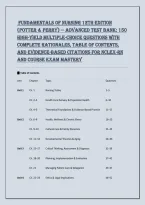
Fundamentals of Nursing 12th Edition
(Potter & Perry) — Advanced Test Bank: 150
High-Yield Multiple-Choice Questions with
Complete Rationales, Table of Contents,
and Evidence-Based Citations for NCLEX-RN
and Course Exam Mastery
📋 Table of Contents
Unit Chapter Topic Questions
Unit 1 Ch. 1 Nursing Today 1–5
Ch. 2–3 Health Care Delivery & Population Health 6–10
Ch. 4–5 Theoretical Foundations & Evidence-Based Practice 11–15
Unit 2 Ch. 6–8 Health, Wellness & Chronic Illness 16–20
Ch. 9–10 Cultural Care & Family Dynamics 21–25
Ch. 11–14 Developmental Theories & Aging 26–30
Unit 3 Ch. 15–17 Critical Thinking, Assessment & Diagnosis 31–36
Ch. 18–20 Planning, Implementation & Evaluation 37–42
Ch. 21 Managing Patient Care & Delegation 43–47
Unit 4 Ch. 22–23 Ethics & Legal Implications 48–52
,Unit Chapter Topic Questions
Ch. 24–25 Communication & Patient Education 53–58
Ch. 26 Informatics & Documentation 59–62
Unit 5 Ch. 27 Patient Safety & Quality 63–68
Ch. 28 Infection Prevention & Control 69–75
Ch. 29 Vital Signs 76–82
Ch. 30 Health Assessment & Physical Examination 83–87
Ch. 31 Medication Administration 88–96
Ch. 32 Complementary & Integrative Therapies 97–100
Unit 6 Ch. 33–37 Psychosocial Basis for Practice 101–110
Unit 7 Ch. 38–40 Activity, Immobility & Hygiene 111–118
Ch. 41–43 Oxygenation, Fluids & Sleep 119–126
Ch. 44–45 Pain Management & Nutrition 127–134
Ch. 46–47 Urinary & Bowel Elimination 135–140
Ch. 48–50 Skin Integrity, Sensory & Perioperative Care 141–150
UNIT 1: NURSING AND THE HEALTH CARE ENVIRONMENT
Chapter 1: Nursing Today
,🟢 Question 1. A nurse is explaining the history of nursing to a group of nursing students. Which
individual is credited with establishing the first nursing school based on Nightingale's principles?
A) Clara Barton
B) Florence Nightingale
C) Dorothea Dix
D) Lillian Wald
Correct Answer: 🔴🔴 B) Florence Nightingale
Rationale: Florence Nightingale established the first nursing school based on her principles at St.
Thomas' Hospital in London in 1860. She is considered the founder of modern nursing and established
the foundation for nursing education and practice. Clara Barton founded the American Red Cross.
Dorothea Dix was an advocate for the mentally ill. Lillian Wald founded public health nursing and the
Henry Street Settlement.
🟢 Question 2. A nurse is reviewing the ANA Code of Ethics for Nurses with a new graduate. Which
statement best describes the purpose of this code?
A) To provide a legal framework for nursing practice
B) To establish the standards of care for nursing
C) To serve as a guide for ethical decision-making in nursing
D) To define the scope of nursing practice
Correct Answer: 🔴🔴 C) To serve as a guide for ethical decision-making in nursing
Rationale: The ANA Code of Ethics for Nurses serves as a guide for ethical decision-making in nursing. It
provides a framework for nurses to make ethical decisions and to advocate for their patients. The code
is not a legal document, although it can be used in legal proceedings. Standards of care and the scope of
nursing practice are defined by other regulatory and professional bodies.
🟢 Question 3. An experienced medical-surgical nurse chooses to transition to obstetrics. According to
Benner's model, which level of proficiency is the nurse upon initial transition to the obstetrical floor?
A) Novice
B) Proficient
C) Competent
D) Advanced beginner
Correct Answer: 🔴🔴 A) Novice
Rationale: According to Benner's model, a novice nurse is any nurse entering a situation with no
previous level of experience—even an experienced nurse entering a new specialty area. A proficient
nurse (B) perceives clinical situations as a whole and anticipates outcomes. A competent nurse (C)
understands organization and specific care required. An advanced beginner (D) has some observational
experience.
, 🟢 Question 4. A nurse is caring for a patient with end-stage lung disease. The patient wants to go home
on oxygen and be comfortable. The family wants the patient to have a new surgical procedure. The
nurse explains the risks and benefits of the surgery to the family and discusses the patient's wishes with
the family. The nurse is acting as the patient's:
A) Educator
B) Advocate
C) Caregiver
D) Case manager
Correct Answer: 🔴🔴 B) Advocate
Rationale: An advocate protects the patient's human and legal right to make choices about his or her
care. An advocate may also provide additional information to help a patient decide whether or not to
accept a treatment or find an interpreter to help family members communicate their concerns.
🟢 Question 5. Which action is most consistent with the nursing code of ethics?
A) Reporting a colleague for suspected substance abuse to the appropriate authority
B) Sharing a patient's personal health information with family without consent
C) Refusing to care for an assigned patient due to a busy schedule
D) Accepting a gift of cash from a grateful patient
Correct Answer: 🔴🔴 A) Reporting a colleague for suspected substance abuse to the appropriate
authority
Rationale: Reporting impaired colleagues protects patient safety and aligns with ethical duties. Sharing
PHI without consent violates confidentiality. Refusing assignment without appropriate reason may be
abandonment. Accepting cash gifts can create a conflict of interest and violates professional boundaries.
Chapters 2–3: Health Care Delivery & Population Health
🟢 Question 6. A patient is being discharged after a stroke and needs skilled nursing care, physical
therapy, and speech therapy at home. Which level of care is most appropriate?
A) Primary care
B) Restorative care
C) Tertiary care
D) Palliative care
Correct Answer: 🔴🔴 B) Restorative care
Rationale: Restorative care includes home health, rehabilitation, and skilled nursing services designed to
help patients regain maximum function after an acute event. Primary care is preventive, tertiary is
specialized inpatient, and palliative focuses on comfort.
(Potter & Perry) — Advanced Test Bank: 150
High-Yield Multiple-Choice Questions with
Complete Rationales, Table of Contents,
and Evidence-Based Citations for NCLEX-RN
and Course Exam Mastery
📋 Table of Contents
Unit Chapter Topic Questions
Unit 1 Ch. 1 Nursing Today 1–5
Ch. 2–3 Health Care Delivery & Population Health 6–10
Ch. 4–5 Theoretical Foundations & Evidence-Based Practice 11–15
Unit 2 Ch. 6–8 Health, Wellness & Chronic Illness 16–20
Ch. 9–10 Cultural Care & Family Dynamics 21–25
Ch. 11–14 Developmental Theories & Aging 26–30
Unit 3 Ch. 15–17 Critical Thinking, Assessment & Diagnosis 31–36
Ch. 18–20 Planning, Implementation & Evaluation 37–42
Ch. 21 Managing Patient Care & Delegation 43–47
Unit 4 Ch. 22–23 Ethics & Legal Implications 48–52
,Unit Chapter Topic Questions
Ch. 24–25 Communication & Patient Education 53–58
Ch. 26 Informatics & Documentation 59–62
Unit 5 Ch. 27 Patient Safety & Quality 63–68
Ch. 28 Infection Prevention & Control 69–75
Ch. 29 Vital Signs 76–82
Ch. 30 Health Assessment & Physical Examination 83–87
Ch. 31 Medication Administration 88–96
Ch. 32 Complementary & Integrative Therapies 97–100
Unit 6 Ch. 33–37 Psychosocial Basis for Practice 101–110
Unit 7 Ch. 38–40 Activity, Immobility & Hygiene 111–118
Ch. 41–43 Oxygenation, Fluids & Sleep 119–126
Ch. 44–45 Pain Management & Nutrition 127–134
Ch. 46–47 Urinary & Bowel Elimination 135–140
Ch. 48–50 Skin Integrity, Sensory & Perioperative Care 141–150
UNIT 1: NURSING AND THE HEALTH CARE ENVIRONMENT
Chapter 1: Nursing Today
,🟢 Question 1. A nurse is explaining the history of nursing to a group of nursing students. Which
individual is credited with establishing the first nursing school based on Nightingale's principles?
A) Clara Barton
B) Florence Nightingale
C) Dorothea Dix
D) Lillian Wald
Correct Answer: 🔴🔴 B) Florence Nightingale
Rationale: Florence Nightingale established the first nursing school based on her principles at St.
Thomas' Hospital in London in 1860. She is considered the founder of modern nursing and established
the foundation for nursing education and practice. Clara Barton founded the American Red Cross.
Dorothea Dix was an advocate for the mentally ill. Lillian Wald founded public health nursing and the
Henry Street Settlement.
🟢 Question 2. A nurse is reviewing the ANA Code of Ethics for Nurses with a new graduate. Which
statement best describes the purpose of this code?
A) To provide a legal framework for nursing practice
B) To establish the standards of care for nursing
C) To serve as a guide for ethical decision-making in nursing
D) To define the scope of nursing practice
Correct Answer: 🔴🔴 C) To serve as a guide for ethical decision-making in nursing
Rationale: The ANA Code of Ethics for Nurses serves as a guide for ethical decision-making in nursing. It
provides a framework for nurses to make ethical decisions and to advocate for their patients. The code
is not a legal document, although it can be used in legal proceedings. Standards of care and the scope of
nursing practice are defined by other regulatory and professional bodies.
🟢 Question 3. An experienced medical-surgical nurse chooses to transition to obstetrics. According to
Benner's model, which level of proficiency is the nurse upon initial transition to the obstetrical floor?
A) Novice
B) Proficient
C) Competent
D) Advanced beginner
Correct Answer: 🔴🔴 A) Novice
Rationale: According to Benner's model, a novice nurse is any nurse entering a situation with no
previous level of experience—even an experienced nurse entering a new specialty area. A proficient
nurse (B) perceives clinical situations as a whole and anticipates outcomes. A competent nurse (C)
understands organization and specific care required. An advanced beginner (D) has some observational
experience.
, 🟢 Question 4. A nurse is caring for a patient with end-stage lung disease. The patient wants to go home
on oxygen and be comfortable. The family wants the patient to have a new surgical procedure. The
nurse explains the risks and benefits of the surgery to the family and discusses the patient's wishes with
the family. The nurse is acting as the patient's:
A) Educator
B) Advocate
C) Caregiver
D) Case manager
Correct Answer: 🔴🔴 B) Advocate
Rationale: An advocate protects the patient's human and legal right to make choices about his or her
care. An advocate may also provide additional information to help a patient decide whether or not to
accept a treatment or find an interpreter to help family members communicate their concerns.
🟢 Question 5. Which action is most consistent with the nursing code of ethics?
A) Reporting a colleague for suspected substance abuse to the appropriate authority
B) Sharing a patient's personal health information with family without consent
C) Refusing to care for an assigned patient due to a busy schedule
D) Accepting a gift of cash from a grateful patient
Correct Answer: 🔴🔴 A) Reporting a colleague for suspected substance abuse to the appropriate
authority
Rationale: Reporting impaired colleagues protects patient safety and aligns with ethical duties. Sharing
PHI without consent violates confidentiality. Refusing assignment without appropriate reason may be
abandonment. Accepting cash gifts can create a conflict of interest and violates professional boundaries.
Chapters 2–3: Health Care Delivery & Population Health
🟢 Question 6. A patient is being discharged after a stroke and needs skilled nursing care, physical
therapy, and speech therapy at home. Which level of care is most appropriate?
A) Primary care
B) Restorative care
C) Tertiary care
D) Palliative care
Correct Answer: 🔴🔴 B) Restorative care
Rationale: Restorative care includes home health, rehabilitation, and skilled nursing services designed to
help patients regain maximum function after an acute event. Primary care is preventive, tertiary is
specialized inpatient, and palliative focuses on comfort.


