
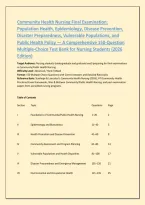
Community Health Nursing Final Examination:
Population Health, Epidemiology, Disease Prevention,
Disaster Preparedness, Vulnerable Populations, and
Public Health Policy — A Comprehensive 150-Question
Multiple-Choice Test Bank for Nursing Students (2026
Edition)
Target Audience: Nursing students (undergraduate and graduate level) preparing for final examinations
in Community/Public Health Nursing
Difficulty Level: Advanced / Hard / Mixed
Format: 150 Multiple-Choice Questions with Correct Answers and Detailed Rationales
Reference Basis: Stanhope & Lancaster's Community Health Nursing (2026), ATI Community Health
Proctored Exam frameworks, Nies & McEwen Community/Public Health Nursing, and past examination
papers from accredited nursing programs.
Table of Contents
Section Topic Questions Page
I Foundations of Community/Public Health Nursing 1–20 2
II Epidemiology and Biostatistics 21–40 5
III Health Promotion and Disease Prevention 41–60 9
IV Community Assessment and Program Planning 61–80 13
V Vulnerable Populations and Health Disparities 81–100 17
VI Disaster Preparedness and Emergency Management 101–120 21
VII Environmental and Occupational Health 121–135 25
,Section Topic Questions Page
VIII Public Health Policy, Ethics, and Legal Issues 136–150 28
SECTION I: FOUNDATIONS OF COMMUNITY/PUBLIC HEALTH NURSING (Questions 1–20)
🟢 Question 1
A community health nurse is planning an immunization clinic in a rural village. Which action should the
nurse take FIRST?
A. Arrange for vaccine storage equipment
B. Notify community leaders of clinic date
C. Develop an outreach and education plan
🔴🔴 D. Conduct a community needs assessment
Rationale: The nursing process always begins with assessment. A needs assessment identifies
population-specific barriers, baseline knowledge, and gaps before planning or implementation. This
ensures the clinic addresses the actual needs of the community rather than assumptions.
🟢 Question 2
Which of the following best describes community-based nursing?
A. A practice in which care is provided for individuals and families
B. Providing care with a focus on the community as a whole
C. A value system in which all clients receive optimal care
🔴🔴 D. A practice in which care is provided for individuals and families where they live, work, and attend
school
Rationale: Community-based nursing focuses on illness care for individuals and families in community
settings, whereas community-oriented nursing focuses on populations and systems-level interventions.
🟢 Question 3
According to the ANA Code of Ethics, what responsibility does the nurse have beyond giving excellent
care to patients?
A. Accept longer work schedules to ensure professional care is always available
🔴🔴 B. Engage in activities that promote health and prevent illness
C. Provide free care to all clients without regard for reimbursement
D. Act as a patient advocate in all health care settings
,Rationale: Community health nursing extends beyond individual care to include health promotion and
disease prevention at the population level. The ANA Code of Ethics emphasizes the nurse's responsibility
to promote health and prevent illness in the communities they serve.
🟢 Question 4
A nursing student is learning about the primary goal of community health nursing. Which statement best
describes this goal?
A. To provide direct bedside care to acutely ill patients in hospital settings
🔴🔴 B. To enhance the capacity of individuals, families, and communities to achieve their full health
potential
C. To administer immunizations exclusively to pediatric populations
D. To conduct research on genetic markers for chronic diseases
Rationale: The primary goal of community health nursing is to promote and preserve the health of
populations by integrating community involvement and enhancing the capacity of communities to
achieve optimal health.
🟢 Question 5
A nurse is working with a case manager for a client in an HMO. The nurse should identify that an HMO
provides which payment structure?
A. The client is participating in a fee-for-service insurance program
🔴🔴 B. The provider is paid a fixed sum for the client on a monthly or yearly basis
C. The client pays the insurer a percentage of total costs for each service
D. The provider bills the client directly for a predetermined percentage
Rationale: In an HMO, the provider is paid a fixed sum (capitation) for each client on a monthly or yearly
basis, regardless of services used. Fee-for-service reimburses providers for each service rendered.
🟢 Question 6
A community health nurse is preparing a windshield survey. Which would the nurse observe?
A. Health insurance claims data
🔴🔴 B. Housing conditions and community resources
C. Individual patient medical histories
D. Hospital readmission rates
Rationale: A windshield survey involves driving through a community to observe housing, schools, parks,
transportation, and safety—a visual assessment tool. It provides observational data about the physical
environment and available community resources.
, 🟢 Question 7
Which of the following best describes community-oriented nursing?
A. A practice in which care is provided for individuals and families in their homes
🔴🔴 B. A practice focused on the health of populations and the systems that affect population health
C. A practice limited to providing direct care in community clinics
D. A practice that focuses exclusively on health education
Rationale: Community-oriented nursing focuses on improving collective health through education,
promotion, disease prevention, and surveillance at the population and systems level.
🟢 Question 8
A community health nurse is implementing a tertiary prevention strategy. Which of the following
activities best exemplifies this level of prevention?
A. Administering influenza vaccinations at a senior center
B. Teaching a parenting class on infant nutrition
🔴🔴 C. Leading a support group for stroke survivors to improve their functional abilities
D. Conducting a home safety assessment for fall risks
Rationale: Tertiary prevention focuses on rehabilitation and minimizing complications from an existing
disease or condition. Leading a support group for stroke survivors to improve their functional abilities is
a tertiary prevention activity.
🟢 Question 9
What is the primary difference between community-oriented nursing and community-based nursing?
A. Community-oriented nursing focuses on individuals, whereas community-based nursing focuses on
populations
🔴🔴 B. Community-oriented nursing focuses on populations, whereas community-based nursing focuses
on individuals and families
C. Both focus exclusively on hospital care
D. Community-based nursing is a newer model than community-oriented nursing
Rationale: Community-oriented nursing focuses on populations and systems-level interventions, while
community-based nursing provides illness care for individuals and families in community settings.
🟢 Question 10
Which statement best describes the goal of public health nursing?
🔴🔴 A. Promoting and preserving the health of populations by integrating community involvement
B. Providing direct bedside care to acutely ill patients
C. Administering immunizations exclusively to pediatric populations
D. Conducting research on genetic markers for chronic diseases
Population Health, Epidemiology, Disease Prevention,
Disaster Preparedness, Vulnerable Populations, and
Public Health Policy — A Comprehensive 150-Question
Multiple-Choice Test Bank for Nursing Students (2026
Edition)
Target Audience: Nursing students (undergraduate and graduate level) preparing for final examinations
in Community/Public Health Nursing
Difficulty Level: Advanced / Hard / Mixed
Format: 150 Multiple-Choice Questions with Correct Answers and Detailed Rationales
Reference Basis: Stanhope & Lancaster's Community Health Nursing (2026), ATI Community Health
Proctored Exam frameworks, Nies & McEwen Community/Public Health Nursing, and past examination
papers from accredited nursing programs.
Table of Contents
Section Topic Questions Page
I Foundations of Community/Public Health Nursing 1–20 2
II Epidemiology and Biostatistics 21–40 5
III Health Promotion and Disease Prevention 41–60 9
IV Community Assessment and Program Planning 61–80 13
V Vulnerable Populations and Health Disparities 81–100 17
VI Disaster Preparedness and Emergency Management 101–120 21
VII Environmental and Occupational Health 121–135 25
,Section Topic Questions Page
VIII Public Health Policy, Ethics, and Legal Issues 136–150 28
SECTION I: FOUNDATIONS OF COMMUNITY/PUBLIC HEALTH NURSING (Questions 1–20)
🟢 Question 1
A community health nurse is planning an immunization clinic in a rural village. Which action should the
nurse take FIRST?
A. Arrange for vaccine storage equipment
B. Notify community leaders of clinic date
C. Develop an outreach and education plan
🔴🔴 D. Conduct a community needs assessment
Rationale: The nursing process always begins with assessment. A needs assessment identifies
population-specific barriers, baseline knowledge, and gaps before planning or implementation. This
ensures the clinic addresses the actual needs of the community rather than assumptions.
🟢 Question 2
Which of the following best describes community-based nursing?
A. A practice in which care is provided for individuals and families
B. Providing care with a focus on the community as a whole
C. A value system in which all clients receive optimal care
🔴🔴 D. A practice in which care is provided for individuals and families where they live, work, and attend
school
Rationale: Community-based nursing focuses on illness care for individuals and families in community
settings, whereas community-oriented nursing focuses on populations and systems-level interventions.
🟢 Question 3
According to the ANA Code of Ethics, what responsibility does the nurse have beyond giving excellent
care to patients?
A. Accept longer work schedules to ensure professional care is always available
🔴🔴 B. Engage in activities that promote health and prevent illness
C. Provide free care to all clients without regard for reimbursement
D. Act as a patient advocate in all health care settings
,Rationale: Community health nursing extends beyond individual care to include health promotion and
disease prevention at the population level. The ANA Code of Ethics emphasizes the nurse's responsibility
to promote health and prevent illness in the communities they serve.
🟢 Question 4
A nursing student is learning about the primary goal of community health nursing. Which statement best
describes this goal?
A. To provide direct bedside care to acutely ill patients in hospital settings
🔴🔴 B. To enhance the capacity of individuals, families, and communities to achieve their full health
potential
C. To administer immunizations exclusively to pediatric populations
D. To conduct research on genetic markers for chronic diseases
Rationale: The primary goal of community health nursing is to promote and preserve the health of
populations by integrating community involvement and enhancing the capacity of communities to
achieve optimal health.
🟢 Question 5
A nurse is working with a case manager for a client in an HMO. The nurse should identify that an HMO
provides which payment structure?
A. The client is participating in a fee-for-service insurance program
🔴🔴 B. The provider is paid a fixed sum for the client on a monthly or yearly basis
C. The client pays the insurer a percentage of total costs for each service
D. The provider bills the client directly for a predetermined percentage
Rationale: In an HMO, the provider is paid a fixed sum (capitation) for each client on a monthly or yearly
basis, regardless of services used. Fee-for-service reimburses providers for each service rendered.
🟢 Question 6
A community health nurse is preparing a windshield survey. Which would the nurse observe?
A. Health insurance claims data
🔴🔴 B. Housing conditions and community resources
C. Individual patient medical histories
D. Hospital readmission rates
Rationale: A windshield survey involves driving through a community to observe housing, schools, parks,
transportation, and safety—a visual assessment tool. It provides observational data about the physical
environment and available community resources.
, 🟢 Question 7
Which of the following best describes community-oriented nursing?
A. A practice in which care is provided for individuals and families in their homes
🔴🔴 B. A practice focused on the health of populations and the systems that affect population health
C. A practice limited to providing direct care in community clinics
D. A practice that focuses exclusively on health education
Rationale: Community-oriented nursing focuses on improving collective health through education,
promotion, disease prevention, and surveillance at the population and systems level.
🟢 Question 8
A community health nurse is implementing a tertiary prevention strategy. Which of the following
activities best exemplifies this level of prevention?
A. Administering influenza vaccinations at a senior center
B. Teaching a parenting class on infant nutrition
🔴🔴 C. Leading a support group for stroke survivors to improve their functional abilities
D. Conducting a home safety assessment for fall risks
Rationale: Tertiary prevention focuses on rehabilitation and minimizing complications from an existing
disease or condition. Leading a support group for stroke survivors to improve their functional abilities is
a tertiary prevention activity.
🟢 Question 9
What is the primary difference between community-oriented nursing and community-based nursing?
A. Community-oriented nursing focuses on individuals, whereas community-based nursing focuses on
populations
🔴🔴 B. Community-oriented nursing focuses on populations, whereas community-based nursing focuses
on individuals and families
C. Both focus exclusively on hospital care
D. Community-based nursing is a newer model than community-oriented nursing
Rationale: Community-oriented nursing focuses on populations and systems-level interventions, while
community-based nursing provides illness care for individuals and families in community settings.
🟢 Question 10
Which statement best describes the goal of public health nursing?
🔴🔴 A. Promoting and preserving the health of populations by integrating community involvement
B. Providing direct bedside care to acutely ill patients
C. Administering immunizations exclusively to pediatric populations
D. Conducting research on genetic markers for chronic diseases


