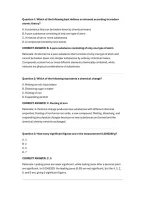
Question 1: Which of the following best defines an element according to modern
atomic theory?
A. A substance that can be broken down by chemical means
B. A pure substance consisting of only one type of atom
C. A mixture of two or more substances
D. A compound formed by ionic bonds
CORRECT ANSWER: B. A pure substance consisting of only one type of atom
Rationale: An element is a pure substance that consists of only one type of atom and
cannot be broken down into simpler substances by ordinary chemical means.
Compounds contain two or more di erent elements chemically combined, while
mixtures are physical combinations of substances.
Question 2: Which of the following represents a chemical change?
A. Melting ice into liquid water
B. Dissolving sugar in water
C. Rusting of iron
D. Evaporating alcohol
CORRECT ANSWER: C. Rusting of iron
Rationale: A chemical change produces new substances with di erent chemical
properties. Rusting of iron forms iron oxide, a new compound. Melting, dissolving, and
evaporating are physical changes because no new substances are formed and the
chemical identity remains unchanged.
Question 3: How many significant figures are in the measurement 0.0045200 g?
A. 3
B. 4
C. 5
D. 7
CORRECT ANSWER: C. 5
Rationale: Leading zeros are never significant, while trailing zeros after a decimal point
are significant. In 0.0045200, the leading zeros (0.00) are not significant, but the 4, 5, 2,
0, and 0 are, giving 5 significant figures.
,Question 4: Which of the following is the correct electron configuration for a
neutral chlorine atom (Z = 17)?
A. 1s² 2s² 2p⁶ 3s² 3p⁵
B. 1s² 2s² 2p⁶ 3s² 3p⁶
C. 1s² 2s² 2p⁵ 3s² 3p⁶
D. 1s² 2s² 2p⁶ 3s² 3p⁴
CORRECT ANSWER: A. 1s² 2s² 2p⁶ 3s² 3p⁵
Rationale: Chlorine has 17 electrons. Filling orbitals in order of increasing energy: 1s²
(2), 2s² (4), 2p⁶ (10), 3s² (12), 3p⁵ (17). Option B represents argon, and the others do not
total 17 electrons.
Question 5: What is the molar mass of calcium phosphate, Ca₃(PO₄)₂?
A. 215.21 g/mol
B. 310.18 g/mol
C. 279.21 g/mol
D. 340.30 g/mol
CORRECT ANSWER: B. 310.18 g/mol
Rationale: Ca₃(PO₄)₂ contains 3 Ca (40.08 × 3 = 120.24), 2 P (30.97 × 2 = 61.94), and 8 O
(16.00 × 8 = 128.00). The sum is 120.24 + 61.94 + 128.00 = 310.18 g/mol.
Question 6: Which of the following statements is a correct interpretation of the law
of conservation of mass?
A. Mass is always lost during a chemical reaction
B. The total mass of reactants equals the total mass of products in a closed system
C. Mass can be created in nuclear reactions
D. The mass of products is always greater than the mass of reactants
CORRECT ANSWER: B. The total mass of reactants equals the total mass of
products in a closed system
Rationale: The law of conservation of mass states that matter cannot be created or
destroyed in a chemical reaction. In a closed system, the total mass of the reactants
equals the total mass of the products. Mass changes in nuclear reactions are governed
by E=mc².
Question 7: How many moles of atoms are present in 3.01 × 10²³ atoms of helium?
,A. 0.25 mol
B. 0.50 mol
C. 1.00 mol
D. 2.00 mol
CORRECT ANSWER: B. 0.50 mol
Rationale: Using Avogadro's number (6.022 × 10²³ atoms/mol): moles = (3.01 × 10²³) ÷
(6.022 × 10²³) = 0.50 mol. This calculation converts the number of particles to moles.
Question 8: Which of the following is the correct name for the compound N₂O₅?
A. Dinitrogen pentoxide
B. Nitrogen pentoxide
C. Dinitrogen oxide
D. Nitrogen(V) oxide
CORRECT ANSWER: A. Dinitrogen pentoxide
Rationale: For binary covalent compounds, prefixes indicate the number of atoms: "di-"
for 2 nitrogen atoms and "penta-" for 5 oxygen atoms. The correct IUPAC name is
dinitrogen pentoxide. Option B omits the prefix for nitrogen.
Question 9: Which of the following is an example of a homogeneous mixture?
A. Sand and water
B. Salt water
C. Oil and water
D. Granite rock
CORRECT ANSWER: B. Salt water
Rationale: A homogeneous mixture has uniform composition throughout. Salt water is
homogeneous because the dissolved salt is evenly distributed. Sand and water, oil and
water, and granite are heterogeneous mixtures with visible distinct phases.
Question 10: What is the correct formula for aluminum sulfate?
A. AlSO₄
B. Al₂(SO₄)₃
C. Al₃(SO₄)₂
D. Al(SO₄)₂
, CORRECT ANSWER: B. Al₂(SO₄)₃
Rationale: Aluminum forms a 3+ cation (Al³⁺) and sulfate is a 2- anion (SO₄²⁻). To
balance charges, the least common multiple is 6, requiring 2 Al³⁺ and 3 SO₄²⁻, giving
Al₂(SO₄)₃.
Question 11: Which quantum number describes the orientation of an orbital in
space?
A. Principal quantum number (n)
B. Angular momentum quantum number (l)
C. Magnetic quantum number (mₗ)
D. Spin quantum number (mₛ)
CORRECT ANSWER: C. Magnetic quantum number (mₗ)
Rationale: The magnetic quantum number (mₗ) describes the orientation of an orbital in
space relative to an applied magnetic field. The principal quantum number describes
the energy level, the angular momentum quantum number describes orbital shape, and
the spin quantum number describes electron spin.
Question 12: How many valence electrons does a neutral sulfur atom have?
A. 2
B. 4
C. 6
D. 8
CORRECT ANSWER: C. 6
Rationale: Sulfur has the electron configuration 1s² 2s² 2p⁶ 3s² 3p⁴. The valence
electrons are in the outermost shell (n=3): 3s² 3p⁴ = 6 valence electrons. Sulfur is in
Group 16 (VIA) of the periodic table.
Question 13: Which of the following bonds is most polar?
A. H–H
B. C–H
C. O–H
D. N–H
CORRECT ANSWER: C. O–H
atomic theory?
A. A substance that can be broken down by chemical means
B. A pure substance consisting of only one type of atom
C. A mixture of two or more substances
D. A compound formed by ionic bonds
CORRECT ANSWER: B. A pure substance consisting of only one type of atom
Rationale: An element is a pure substance that consists of only one type of atom and
cannot be broken down into simpler substances by ordinary chemical means.
Compounds contain two or more di erent elements chemically combined, while
mixtures are physical combinations of substances.
Question 2: Which of the following represents a chemical change?
A. Melting ice into liquid water
B. Dissolving sugar in water
C. Rusting of iron
D. Evaporating alcohol
CORRECT ANSWER: C. Rusting of iron
Rationale: A chemical change produces new substances with di erent chemical
properties. Rusting of iron forms iron oxide, a new compound. Melting, dissolving, and
evaporating are physical changes because no new substances are formed and the
chemical identity remains unchanged.
Question 3: How many significant figures are in the measurement 0.0045200 g?
A. 3
B. 4
C. 5
D. 7
CORRECT ANSWER: C. 5
Rationale: Leading zeros are never significant, while trailing zeros after a decimal point
are significant. In 0.0045200, the leading zeros (0.00) are not significant, but the 4, 5, 2,
0, and 0 are, giving 5 significant figures.
,Question 4: Which of the following is the correct electron configuration for a
neutral chlorine atom (Z = 17)?
A. 1s² 2s² 2p⁶ 3s² 3p⁵
B. 1s² 2s² 2p⁶ 3s² 3p⁶
C. 1s² 2s² 2p⁵ 3s² 3p⁶
D. 1s² 2s² 2p⁶ 3s² 3p⁴
CORRECT ANSWER: A. 1s² 2s² 2p⁶ 3s² 3p⁵
Rationale: Chlorine has 17 electrons. Filling orbitals in order of increasing energy: 1s²
(2), 2s² (4), 2p⁶ (10), 3s² (12), 3p⁵ (17). Option B represents argon, and the others do not
total 17 electrons.
Question 5: What is the molar mass of calcium phosphate, Ca₃(PO₄)₂?
A. 215.21 g/mol
B. 310.18 g/mol
C. 279.21 g/mol
D. 340.30 g/mol
CORRECT ANSWER: B. 310.18 g/mol
Rationale: Ca₃(PO₄)₂ contains 3 Ca (40.08 × 3 = 120.24), 2 P (30.97 × 2 = 61.94), and 8 O
(16.00 × 8 = 128.00). The sum is 120.24 + 61.94 + 128.00 = 310.18 g/mol.
Question 6: Which of the following statements is a correct interpretation of the law
of conservation of mass?
A. Mass is always lost during a chemical reaction
B. The total mass of reactants equals the total mass of products in a closed system
C. Mass can be created in nuclear reactions
D. The mass of products is always greater than the mass of reactants
CORRECT ANSWER: B. The total mass of reactants equals the total mass of
products in a closed system
Rationale: The law of conservation of mass states that matter cannot be created or
destroyed in a chemical reaction. In a closed system, the total mass of the reactants
equals the total mass of the products. Mass changes in nuclear reactions are governed
by E=mc².
Question 7: How many moles of atoms are present in 3.01 × 10²³ atoms of helium?
,A. 0.25 mol
B. 0.50 mol
C. 1.00 mol
D. 2.00 mol
CORRECT ANSWER: B. 0.50 mol
Rationale: Using Avogadro's number (6.022 × 10²³ atoms/mol): moles = (3.01 × 10²³) ÷
(6.022 × 10²³) = 0.50 mol. This calculation converts the number of particles to moles.
Question 8: Which of the following is the correct name for the compound N₂O₅?
A. Dinitrogen pentoxide
B. Nitrogen pentoxide
C. Dinitrogen oxide
D. Nitrogen(V) oxide
CORRECT ANSWER: A. Dinitrogen pentoxide
Rationale: For binary covalent compounds, prefixes indicate the number of atoms: "di-"
for 2 nitrogen atoms and "penta-" for 5 oxygen atoms. The correct IUPAC name is
dinitrogen pentoxide. Option B omits the prefix for nitrogen.
Question 9: Which of the following is an example of a homogeneous mixture?
A. Sand and water
B. Salt water
C. Oil and water
D. Granite rock
CORRECT ANSWER: B. Salt water
Rationale: A homogeneous mixture has uniform composition throughout. Salt water is
homogeneous because the dissolved salt is evenly distributed. Sand and water, oil and
water, and granite are heterogeneous mixtures with visible distinct phases.
Question 10: What is the correct formula for aluminum sulfate?
A. AlSO₄
B. Al₂(SO₄)₃
C. Al₃(SO₄)₂
D. Al(SO₄)₂
, CORRECT ANSWER: B. Al₂(SO₄)₃
Rationale: Aluminum forms a 3+ cation (Al³⁺) and sulfate is a 2- anion (SO₄²⁻). To
balance charges, the least common multiple is 6, requiring 2 Al³⁺ and 3 SO₄²⁻, giving
Al₂(SO₄)₃.
Question 11: Which quantum number describes the orientation of an orbital in
space?
A. Principal quantum number (n)
B. Angular momentum quantum number (l)
C. Magnetic quantum number (mₗ)
D. Spin quantum number (mₛ)
CORRECT ANSWER: C. Magnetic quantum number (mₗ)
Rationale: The magnetic quantum number (mₗ) describes the orientation of an orbital in
space relative to an applied magnetic field. The principal quantum number describes
the energy level, the angular momentum quantum number describes orbital shape, and
the spin quantum number describes electron spin.
Question 12: How many valence electrons does a neutral sulfur atom have?
A. 2
B. 4
C. 6
D. 8
CORRECT ANSWER: C. 6
Rationale: Sulfur has the electron configuration 1s² 2s² 2p⁶ 3s² 3p⁴. The valence
electrons are in the outermost shell (n=3): 3s² 3p⁴ = 6 valence electrons. Sulfur is in
Group 16 (VIA) of the periodic table.
Question 13: Which of the following bonds is most polar?
A. H–H
B. C–H
C. O–H
D. N–H
CORRECT ANSWER: C. O–H