
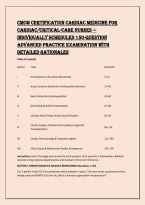
CMC® Certification Cardiac Medicine for
Cardiac/Critical-Care Nurses —
Individually Scheduled 150-Question
Advanced Practice Examination with
Detailed Rationales
Table of Contents
Section Topic Questions
I Hemodynamics & Invasive Monitoring 1–20
II Acute Coronary Syndromes & Myocardial Infarction 21–40
III Heart Failure & Cardiomyopathies 41–60
IV Dysrhythmias & ECG Interpretation 61–80
V Valvular Heart Disease & Structural Disorders 81–95
Cardiac Surgery, Mechanical Circulatory Support &
VI 96–110
Transplantation
VII Cardiac Pharmacology & Vasoactive Agents 111–130
VIII Shock States & Multisystem Cardiac Emergencies 131–150
Instructions: Select the single best answer for each question. Each question is followed by a detailed
rationale citing evidence-based practice and standard critical care references.
SECTION I: HEMODYNAMICS & INVASIVE MONITORING (Questions 1–20)
🟢 1. A patient in the ICU has a pulmonary artery catheter in place. The nurse notes a pulmonary artery
wedge pressure (PAWP) of 18 mm Hg. What is the most appropriate interpretation?
,A. Normal left ventricular filling pressure
B. Elevated left ventricular filling pressure
C. Decreased right ventricular preload
D. Elevated right ventricular afterload
🔴🔴 Correct Answer: B. PAWP reflects left ventricular end-diastolic pressure (LVEDP). Normal PAWP is
4–12 mm Hg. A PAWP of 18 mm Hg indicates elevated left ventricular filling pressure, consistent with
left-sided heart failure or fluid overload. Options C and D relate to right-sided parameters measured by
CVP or right ventricular pressures.
🟢 2. A patient with septic shock has a cardiac output (CO) of 8 L/min and a systemic vascular resistance
(SVR) of 400 dynes/sec/cm⁵. Which hemodynamic profile best describes this patient?
A. High CO, high SVR (hypertensive shock)
B. High CO, low SVR (distributive shock)
C. Low CO, high SVR (cardiogenic shock)
D. Low CO, low SVR (obstructive shock)
🔴🔴 Correct Answer: B. Septic shock is a classic distributive shock characterized by high CO due to
vasodilation and low SVR. Normal CO is 4–8 L/min; normal SVR is 800–1200 dynes/sec/cm⁵. This profile
is often referred to as "warm shock."
🟢 3. A patient in cardiogenic shock has the following hemodynamic readings: CO 2.8 L/min, cardiac index
(CI) 1.5 L/min/m², PAWP 26 mm Hg, SVR 1800 dynes/sec/cm⁵. Which intervention would the nurse
anticipate?
A. Rapid volume resuscitation with crystalloids
B. Initiation of dobutamine infusion
C. Administration of norepinephrine as first-line therapy
D. Diuresis with furosemide alone
🔴🔴 Correct Answer: B. This profile demonstrates low CO, low CI, elevated PAWP, and elevated SVR —
classic cardiogenic shock. Inotropic support (dobutamine) improves contractility and cardiac output.
Volume resuscitation is contraindicated with elevated filling pressures; norepinephrine is used for
vasodilation-associated shock.
🟢 4. Which of the following hemodynamic parameters are correctly matched with their normal values?
A. Central Venous Pressure (CVP): 2–6 mm Hg
B. Pulmonary Artery Wedge Pressure (PAWP): 8–12 mm Hg
C. Cardiac Index (CI): 2.5–4.0 L/min/m²
D. Systemic Vascular Resistance (SVR): 800–1200 dynes/sec/cm⁵
,🔴🔴 Correct Answer: C. The normal CI is 2.5–4.0 L/min/m². Normal CVP is 2–8 mm Hg, normal PAWP is
4–12 mm Hg, and normal SVR is 800–1200 dynes/sec/cm⁵.
🟢 5. During hemodynamic monitoring, the nurse notes that the patient's CVP is 14 mm Hg and PAWP is 6
mm Hg. This discrepancy most likely indicates:
A. Left ventricular failure
B. Right ventricular failure
C. Pulmonary hypertension
D. Cardiac tamponade
🔴🔴 Correct Answer: B. An elevated CVP with a normal PAWP suggests isolated right ventricular
dysfunction or elevated right-sided pressures. Left ventricular failure would elevate PAWP. Pulmonary
hypertension would elevate PA pressures but not necessarily CVP in isolation.
🟢 6. A patient with an intra-arterial catheter for blood pressure monitoring has a dampened waveform
and a systolic pressure reading that is 20 mm Hg lower than the cuff pressure. The most likely cause is:
A. Catheter whip or artifact
B. Overdamped system from air bubbles or clot
C. Underdamped system from excessive tubing length
D. Normal physiologic variation
🔴🔴 Correct Answer: B. A dampened waveform with falsely low systolic readings indicates an
overdamped system, commonly caused by air bubbles, blood clots, or kinks in the tubing. This requires
assessment and correction of the monitoring system.
🟢 7. The nurse is assessing a patient with a pulmonary artery catheter. The PAWP tracing shows large "v"
waves. This finding is most consistent with:
A. Mitral stenosis
B. Mitral regurgitation
C. Aortic stenosis
D. Tricuspid regurgitation
🔴🔴 Correct Answer: B. Large "v" waves in the PAWP tracing indicate mitral regurgitation. The "v" wave
represents atrial filling against a regurgitant jet during ventricular systole. Mitral stenosis produces
prominent "a" waves.
🟢 8. A patient has a cardiac output of 4.2 L/min and a heart rate of 110 beats/min. What is the calculated
stroke volume?
, A. 28 mL/beat
B. 38 mL/beat
C. 42 mL/beat
D. 48 mL/beat
🔴🔴 Correct Answer: B. Stroke volume = Cardiac output ÷ Heart rate = 4200 mL/min ÷ 110 beats/min ≈
38 mL/beat. Normal stroke volume is 60–100 mL/beat; this patient has reduced stroke volume.
🟢 9. The nurse is monitoring a patient with a pulmonary artery catheter. The PAWP is measured at end-
expiration. Why is this timing important?
A. End-expiration reflects the highest intrathoracic pressure
B. End-expiration minimizes the effect of intrathoracic pressure on readings
C. End-expiration coincides with peak ventricular contraction
D. End-expiration is when the pulmonary artery valve is open
🔴🔴 Correct Answer: B. Measuring PAWP at end-expiration minimizes the influence of intrathoracic
pressure variations on the reading. Positive pressure ventilation can falsely elevate readings if measured
at other points in the respiratory cycle.
🟢 10. A patient with acute decompensated heart failure has the following hemodynamic profile: CI 1.9
L/min/m², PAWP 24 mm Hg, SVR 1600 dynes/sec/cm⁵, BP 88/52 mm Hg. Which classification best
describes this patient?
A. Warm and wet
B. Cold and wet
C. Warm and dry
D. Cold and dry
🔴🔴 Correct Answer: B. "Cold and wet" describes low cardiac index (cold) with elevated filling pressures
(wet). This patient requires inotropic support and possibly vasodilators. "Warm and wet" would have
normal/high CI with elevated PAWP.
🟢 11. Which of the following is a contraindication to pulmonary artery catheter insertion?
A. Need for cardiac output monitoring
B. Presence of a right ventricular assist device
C. Severe coagulopathy
D. Suspected cardiogenic shock
🔴🔴 Correct Answer: C. Severe coagulopathy is a relative contraindication to PA catheter insertion due
to bleeding risk. Other contraindications include right-sided endocarditis and mechanical
tricuspid/pulmonary valves.
Cardiac/Critical-Care Nurses —
Individually Scheduled 150-Question
Advanced Practice Examination with
Detailed Rationales
Table of Contents
Section Topic Questions
I Hemodynamics & Invasive Monitoring 1–20
II Acute Coronary Syndromes & Myocardial Infarction 21–40
III Heart Failure & Cardiomyopathies 41–60
IV Dysrhythmias & ECG Interpretation 61–80
V Valvular Heart Disease & Structural Disorders 81–95
Cardiac Surgery, Mechanical Circulatory Support &
VI 96–110
Transplantation
VII Cardiac Pharmacology & Vasoactive Agents 111–130
VIII Shock States & Multisystem Cardiac Emergencies 131–150
Instructions: Select the single best answer for each question. Each question is followed by a detailed
rationale citing evidence-based practice and standard critical care references.
SECTION I: HEMODYNAMICS & INVASIVE MONITORING (Questions 1–20)
🟢 1. A patient in the ICU has a pulmonary artery catheter in place. The nurse notes a pulmonary artery
wedge pressure (PAWP) of 18 mm Hg. What is the most appropriate interpretation?
,A. Normal left ventricular filling pressure
B. Elevated left ventricular filling pressure
C. Decreased right ventricular preload
D. Elevated right ventricular afterload
🔴🔴 Correct Answer: B. PAWP reflects left ventricular end-diastolic pressure (LVEDP). Normal PAWP is
4–12 mm Hg. A PAWP of 18 mm Hg indicates elevated left ventricular filling pressure, consistent with
left-sided heart failure or fluid overload. Options C and D relate to right-sided parameters measured by
CVP or right ventricular pressures.
🟢 2. A patient with septic shock has a cardiac output (CO) of 8 L/min and a systemic vascular resistance
(SVR) of 400 dynes/sec/cm⁵. Which hemodynamic profile best describes this patient?
A. High CO, high SVR (hypertensive shock)
B. High CO, low SVR (distributive shock)
C. Low CO, high SVR (cardiogenic shock)
D. Low CO, low SVR (obstructive shock)
🔴🔴 Correct Answer: B. Septic shock is a classic distributive shock characterized by high CO due to
vasodilation and low SVR. Normal CO is 4–8 L/min; normal SVR is 800–1200 dynes/sec/cm⁵. This profile
is often referred to as "warm shock."
🟢 3. A patient in cardiogenic shock has the following hemodynamic readings: CO 2.8 L/min, cardiac index
(CI) 1.5 L/min/m², PAWP 26 mm Hg, SVR 1800 dynes/sec/cm⁵. Which intervention would the nurse
anticipate?
A. Rapid volume resuscitation with crystalloids
B. Initiation of dobutamine infusion
C. Administration of norepinephrine as first-line therapy
D. Diuresis with furosemide alone
🔴🔴 Correct Answer: B. This profile demonstrates low CO, low CI, elevated PAWP, and elevated SVR —
classic cardiogenic shock. Inotropic support (dobutamine) improves contractility and cardiac output.
Volume resuscitation is contraindicated with elevated filling pressures; norepinephrine is used for
vasodilation-associated shock.
🟢 4. Which of the following hemodynamic parameters are correctly matched with their normal values?
A. Central Venous Pressure (CVP): 2–6 mm Hg
B. Pulmonary Artery Wedge Pressure (PAWP): 8–12 mm Hg
C. Cardiac Index (CI): 2.5–4.0 L/min/m²
D. Systemic Vascular Resistance (SVR): 800–1200 dynes/sec/cm⁵
,🔴🔴 Correct Answer: C. The normal CI is 2.5–4.0 L/min/m². Normal CVP is 2–8 mm Hg, normal PAWP is
4–12 mm Hg, and normal SVR is 800–1200 dynes/sec/cm⁵.
🟢 5. During hemodynamic monitoring, the nurse notes that the patient's CVP is 14 mm Hg and PAWP is 6
mm Hg. This discrepancy most likely indicates:
A. Left ventricular failure
B. Right ventricular failure
C. Pulmonary hypertension
D. Cardiac tamponade
🔴🔴 Correct Answer: B. An elevated CVP with a normal PAWP suggests isolated right ventricular
dysfunction or elevated right-sided pressures. Left ventricular failure would elevate PAWP. Pulmonary
hypertension would elevate PA pressures but not necessarily CVP in isolation.
🟢 6. A patient with an intra-arterial catheter for blood pressure monitoring has a dampened waveform
and a systolic pressure reading that is 20 mm Hg lower than the cuff pressure. The most likely cause is:
A. Catheter whip or artifact
B. Overdamped system from air bubbles or clot
C. Underdamped system from excessive tubing length
D. Normal physiologic variation
🔴🔴 Correct Answer: B. A dampened waveform with falsely low systolic readings indicates an
overdamped system, commonly caused by air bubbles, blood clots, or kinks in the tubing. This requires
assessment and correction of the monitoring system.
🟢 7. The nurse is assessing a patient with a pulmonary artery catheter. The PAWP tracing shows large "v"
waves. This finding is most consistent with:
A. Mitral stenosis
B. Mitral regurgitation
C. Aortic stenosis
D. Tricuspid regurgitation
🔴🔴 Correct Answer: B. Large "v" waves in the PAWP tracing indicate mitral regurgitation. The "v" wave
represents atrial filling against a regurgitant jet during ventricular systole. Mitral stenosis produces
prominent "a" waves.
🟢 8. A patient has a cardiac output of 4.2 L/min and a heart rate of 110 beats/min. What is the calculated
stroke volume?
, A. 28 mL/beat
B. 38 mL/beat
C. 42 mL/beat
D. 48 mL/beat
🔴🔴 Correct Answer: B. Stroke volume = Cardiac output ÷ Heart rate = 4200 mL/min ÷ 110 beats/min ≈
38 mL/beat. Normal stroke volume is 60–100 mL/beat; this patient has reduced stroke volume.
🟢 9. The nurse is monitoring a patient with a pulmonary artery catheter. The PAWP is measured at end-
expiration. Why is this timing important?
A. End-expiration reflects the highest intrathoracic pressure
B. End-expiration minimizes the effect of intrathoracic pressure on readings
C. End-expiration coincides with peak ventricular contraction
D. End-expiration is when the pulmonary artery valve is open
🔴🔴 Correct Answer: B. Measuring PAWP at end-expiration minimizes the influence of intrathoracic
pressure variations on the reading. Positive pressure ventilation can falsely elevate readings if measured
at other points in the respiratory cycle.
🟢 10. A patient with acute decompensated heart failure has the following hemodynamic profile: CI 1.9
L/min/m², PAWP 24 mm Hg, SVR 1600 dynes/sec/cm⁵, BP 88/52 mm Hg. Which classification best
describes this patient?
A. Warm and wet
B. Cold and wet
C. Warm and dry
D. Cold and dry
🔴🔴 Correct Answer: B. "Cold and wet" describes low cardiac index (cold) with elevated filling pressures
(wet). This patient requires inotropic support and possibly vasodilators. "Warm and wet" would have
normal/high CI with elevated PAWP.
🟢 11. Which of the following is a contraindication to pulmonary artery catheter insertion?
A. Need for cardiac output monitoring
B. Presence of a right ventricular assist device
C. Severe coagulopathy
D. Suspected cardiogenic shock
🔴🔴 Correct Answer: C. Severe coagulopathy is a relative contraindication to PA catheter insertion due
to bleeding risk. Other contraindications include right-sided endocarditis and mechanical
tricuspid/pulmonary valves.


