
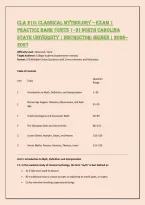
CLA 210: Classical Mythology – Exam 1
Practice Bank (Units 1–3) North Carolina
State University | Instructor: Heinen | 2026–
2027
Difficulty Level: Advanced / Hard
Target Audience: College students (sophomores–seniors)
Format: 150 Multiple-Choice Questions with Correct Answers and Rationales
Table of Contents
Question
Unit Topic
Range
1 Introduction to Myth, Definition, and Interpretation 1–30
Bronze Age Aegean: Minoans, Mycenaeans, and Dark
1 31–55
Age
1 Greek Cosmogony and Succession Myth 56–85
2 The Olympian Gods and Divine Order 86–115
2 Lesser Deities, Nymphs, Satyrs, and Heroes 116–130
3 Heroic Myths: Perseus, Heracles, Theseus, Jason 131–150
Unit 1: Introduction to Myth, Definition, and Interpretation
🟢 1. In the academic study of classical mythology, the term "myth" is best defined as:
A) A false story used to deceive
B) A traditional story a culture accepts as explaining its world, gods, or origins
C) Any narrative involving supernatural beings
, D) A story with a single, identifiable author
🔴🔴 Correct Answer: B
Rationale: In classical studies, "myth" does not carry the popular connotation of falsehood. It refers to a
traditional, anonymous narrative that a culture uses to explain its gods, origins, values, or the workings
of the world. This definition aligns with the course syllabus and standard handbooks (e.g., Lopez-Ruiz,
Gods, Heroes, and Monsters, Introduction).
🟢 2. How do scholars typically distinguish a "legend" from a "myth"?
A) Legends are always false; myths are always true
B) Legends are attached to a specific historical time, place, or person; myths are not necessarily
tied to history
C) Legends only involve animals; myths only involve gods
D) There is no meaningful distinction
🔴🔴 Correct Answer: B
Rationale: Legends are traditional stories loosely anchored to a real person, place, or historical event
(e.g., the Trojan War), whereas myths are not required to have any historical anchor. This distinction is
standard in classical mythology courses.
🟢 3. An "etiological" myth primarily:
A) Explains the cause or origin of a custom, name, or natural phenomenon
B) Describes a hero's death in battle
C) Was invented by Freud
D) Has no connection to real-life rituals
🔴🔴 Correct Answer: A
Rationale: "Etiological" derives from the Greek aitia ("cause"). These myths explain why something
exists or came to be—such as why a plant grows a certain way or why a ritual is performed.
🟢 4. The psychoanalytic approach to myth (Freud/Jung) focuses on:
A) Astronomical calendars
B) Myths as expressions of unconscious desires, fears, or universal archetypes
C) The economic history of Bronze Age Greece
D) Precise historical dating of events
,🔴🔴 Correct Answer: B
Rationale: Psychological approaches read myths as symbolic expressions of the human unconscious—
Freud emphasized repressed desires (e.g., the Oedipus complex), while Jung emphasized shared
archetypes across cultures.
🟢 5. The "ritual" theory of myth (associated with the Cambridge Ritualists) argues that:
A) Myths came first; rituals were invented to commemorate them
B) Many myths originated as the spoken explanation accompanying a religious ritual
C) Myths and rituals are entirely unrelated phenomena
D) Only Roman myths have ritual origins
🔴🔴 Correct Answer: B
Rationale: The Cambridge Ritualists (e.g., Jane Harrison) argued that myth and ritual are closely linked,
with myth often serving as the narrative accompaniment to ritual practice.
🟢 6. A "folktale" is best characterized by:
A) A focus on the origin of the cosmos
B) An emphasis on entertainment, often featuring ordinary people and a moral or clever
resolution
C) Exclusive focus on the gods' genealogy
D) Being restricted to religious ritual use
🔴🔴 Correct Answer: B
Rationale: Folktales are told primarily for entertainment or moral instruction and usually involve
ordinary or lightly fantastic characters, distinguishing them from myths and legends.
🟢 7. Which of the following is an example of an etiological myth?
A) The story of Zeus overthrowing Cronus
B) The myth of Arachne explaining why spiders weave webs
C) The Iliad's account of the Trojan War
D) The Odyssey's account of Odysseus's journey
🔴🔴 Correct Answer: B
Rationale: The myth of Arachne (Ovid, Metamorphoses 6) explains the origin of spiders and weaving—a
classic etiological narrative.
, 🟢 8. The structuralist approach to myth (Lévi-Strauss) emphasizes:
A) Binary oppositions and underlying logical structures
B) The historical accuracy of myths
C) The psychological symbolism of dreams
D) The economic basis of ancient societies
🔴🔴 Correct Answer: A
Rationale: Claude Lévi-Strauss argued that myths are structured around binary oppositions (e.g.,
raw/cooked, nature/culture) that reflect universal human thought patterns.
🟢 9. A "charter myth" is one that:
A) Justifies or validates a social institution, ritual, or political order
B) Is written on a charter document
C) Has no cultural function
D) Is always about a hero's journey
🔴🔴 Correct Answer: A
Rationale: Charter myths serve to legitimize social structures, such as the divine right of kings or the
authority of a priesthood.
🟢 10. In the classical tradition, myth is often transmitted through:
A) Only written texts
B) Only oral tradition
C) A combination of oral tradition, literature, art, and ritual
D) Only philosophical treatises
🔴🔴 Correct Answer: C
Rationale: Myth was transmitted through multiple media: oral performance (e.g., epic recitation),
literature (Homer, Hesiod, tragedians), visual art (vase painting, sculpture), and ritual practice.
🟢 11. The term "mythopoeia" refers to:
A) The study of myth
B) The creation or making of myth
Practice Bank (Units 1–3) North Carolina
State University | Instructor: Heinen | 2026–
2027
Difficulty Level: Advanced / Hard
Target Audience: College students (sophomores–seniors)
Format: 150 Multiple-Choice Questions with Correct Answers and Rationales
Table of Contents
Question
Unit Topic
Range
1 Introduction to Myth, Definition, and Interpretation 1–30
Bronze Age Aegean: Minoans, Mycenaeans, and Dark
1 31–55
Age
1 Greek Cosmogony and Succession Myth 56–85
2 The Olympian Gods and Divine Order 86–115
2 Lesser Deities, Nymphs, Satyrs, and Heroes 116–130
3 Heroic Myths: Perseus, Heracles, Theseus, Jason 131–150
Unit 1: Introduction to Myth, Definition, and Interpretation
🟢 1. In the academic study of classical mythology, the term "myth" is best defined as:
A) A false story used to deceive
B) A traditional story a culture accepts as explaining its world, gods, or origins
C) Any narrative involving supernatural beings
, D) A story with a single, identifiable author
🔴🔴 Correct Answer: B
Rationale: In classical studies, "myth" does not carry the popular connotation of falsehood. It refers to a
traditional, anonymous narrative that a culture uses to explain its gods, origins, values, or the workings
of the world. This definition aligns with the course syllabus and standard handbooks (e.g., Lopez-Ruiz,
Gods, Heroes, and Monsters, Introduction).
🟢 2. How do scholars typically distinguish a "legend" from a "myth"?
A) Legends are always false; myths are always true
B) Legends are attached to a specific historical time, place, or person; myths are not necessarily
tied to history
C) Legends only involve animals; myths only involve gods
D) There is no meaningful distinction
🔴🔴 Correct Answer: B
Rationale: Legends are traditional stories loosely anchored to a real person, place, or historical event
(e.g., the Trojan War), whereas myths are not required to have any historical anchor. This distinction is
standard in classical mythology courses.
🟢 3. An "etiological" myth primarily:
A) Explains the cause or origin of a custom, name, or natural phenomenon
B) Describes a hero's death in battle
C) Was invented by Freud
D) Has no connection to real-life rituals
🔴🔴 Correct Answer: A
Rationale: "Etiological" derives from the Greek aitia ("cause"). These myths explain why something
exists or came to be—such as why a plant grows a certain way or why a ritual is performed.
🟢 4. The psychoanalytic approach to myth (Freud/Jung) focuses on:
A) Astronomical calendars
B) Myths as expressions of unconscious desires, fears, or universal archetypes
C) The economic history of Bronze Age Greece
D) Precise historical dating of events
,🔴🔴 Correct Answer: B
Rationale: Psychological approaches read myths as symbolic expressions of the human unconscious—
Freud emphasized repressed desires (e.g., the Oedipus complex), while Jung emphasized shared
archetypes across cultures.
🟢 5. The "ritual" theory of myth (associated with the Cambridge Ritualists) argues that:
A) Myths came first; rituals were invented to commemorate them
B) Many myths originated as the spoken explanation accompanying a religious ritual
C) Myths and rituals are entirely unrelated phenomena
D) Only Roman myths have ritual origins
🔴🔴 Correct Answer: B
Rationale: The Cambridge Ritualists (e.g., Jane Harrison) argued that myth and ritual are closely linked,
with myth often serving as the narrative accompaniment to ritual practice.
🟢 6. A "folktale" is best characterized by:
A) A focus on the origin of the cosmos
B) An emphasis on entertainment, often featuring ordinary people and a moral or clever
resolution
C) Exclusive focus on the gods' genealogy
D) Being restricted to religious ritual use
🔴🔴 Correct Answer: B
Rationale: Folktales are told primarily for entertainment or moral instruction and usually involve
ordinary or lightly fantastic characters, distinguishing them from myths and legends.
🟢 7. Which of the following is an example of an etiological myth?
A) The story of Zeus overthrowing Cronus
B) The myth of Arachne explaining why spiders weave webs
C) The Iliad's account of the Trojan War
D) The Odyssey's account of Odysseus's journey
🔴🔴 Correct Answer: B
Rationale: The myth of Arachne (Ovid, Metamorphoses 6) explains the origin of spiders and weaving—a
classic etiological narrative.
, 🟢 8. The structuralist approach to myth (Lévi-Strauss) emphasizes:
A) Binary oppositions and underlying logical structures
B) The historical accuracy of myths
C) The psychological symbolism of dreams
D) The economic basis of ancient societies
🔴🔴 Correct Answer: A
Rationale: Claude Lévi-Strauss argued that myths are structured around binary oppositions (e.g.,
raw/cooked, nature/culture) that reflect universal human thought patterns.
🟢 9. A "charter myth" is one that:
A) Justifies or validates a social institution, ritual, or political order
B) Is written on a charter document
C) Has no cultural function
D) Is always about a hero's journey
🔴🔴 Correct Answer: A
Rationale: Charter myths serve to legitimize social structures, such as the divine right of kings or the
authority of a priesthood.
🟢 10. In the classical tradition, myth is often transmitted through:
A) Only written texts
B) Only oral tradition
C) A combination of oral tradition, literature, art, and ritual
D) Only philosophical treatises
🔴🔴 Correct Answer: C
Rationale: Myth was transmitted through multiple media: oral performance (e.g., epic recitation),
literature (Homer, Hesiod, tragedians), visual art (vase painting, sculpture), and ritual practice.
🟢 11. The term "mythopoeia" refers to:
A) The study of myth
B) The creation or making of myth


