
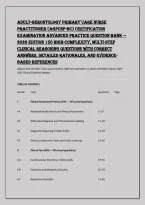
Adult-Gerontology Primary Care Nurse
Practitioner (AGPCNP-BC) Certification
Examination Advanced Practice Question Bank —
2026 Edition 150 High-Complexity, Multi-Step
Clinical Reasoning Questions with Correct
Answers, Detailed Rationales, and Evidence-
Based References
Aligned with the ANCC Test Content Outline (Effective September 13, 2023) and Reflecting the 2025–
2026 Clinical Guideline Updates
TABLE OF CONTENTS
Section Topic Questions Page
I Patient Assessment Process (24% — 36 scored questions)
I-A Advanced Health History and Physical Assessment 1–10
I-B Differential Diagnosis and Clinical Decision-Making 11–20
I-C Diagnostic Reasoning in Older Adults 21–30
I-D Geriatric Assessment Tools and Frailty Screening 31–36
II Plan of Care (60% — 90 scored questions)
II-A Cardiovascular Disorders in Older Adults 37–55
II-B Endocrine and Metabolic Disorders 56–70
II-C Respiratory Disorders 71–82
,Section Topic Questions Page
II-D Geriatric Syndromes and Frailty 83–95
II-E Pharmacology and Polypharmacy 96–110
II-F Musculoskeletal and Rheumatologic Disorders 111–120
II-G Neurologic and Psychiatric Disorders 121–132
II-H Renal, Genitourinary, and Fluid/Electrolyte Disorders 133–142
II-I Infectious Disease and Immunization 143–148
III Professional Practice (16% — 24 scored questions)
III-A Ethics, Legal, and Scope of Practice 149–150
SECTION I: PATIENT ASSESSMENT PROCESS
I-A. Advanced Health History and Physical Assessment
🟢 Question 1. A 78-year-old woman presents to the primary care clinic accompanied by her daughter,
who reports that the patient has become increasingly "forgetful" over the past 6 months. The patient
scored 22/30 on the Mini-Mental State Examination (MMSE). Which of the following is the most
appropriate next step in the assessment of this patient's cognitive decline?
A. Diagnose Alzheimer's disease based on the MMSE score alone
B. Order a CBC, comprehensive metabolic panel, TSH, and vitamin B12 level to rule out reversible causes
C. Initiate donepezil 5 mg daily immediately
D. Refer for neuropsychological testing without further laboratory workup
🔴 Correct Answer: B. The initial evaluation of cognitive decline in an older adult must include laboratory
studies to identify reversible causes, including thyroid dysfunction, vitamin B12 deficiency, metabolic
derangements, and anemia. The MMSE alone cannot establish a diagnosis of Alzheimer's disease.
Initiating cholinesterase inhibitors before ruling out reversible causes is inappropriate.
Neuropsychological testing may be pursued after basic workup, but laboratory screening is the essential
first step. Reference: Codina Leik, M.T. (2024). Adult-Gerontology Nurse Practitioner Certification
Intensive Review, 4th ed. Springer Publishing. Chapter 18: Neurologic Disorders.
,🟢 Question 2. A 72-year-old man with a history of hypertension and type 2 diabetes presents for a
routine visit. He reports no chest pain or dyspnea. His blood pressure is 158/88 mm Hg, and his heart
rate is 92 beats/min and irregularly irregular. An ECG confirms atrial fibrillation. Which of the following
assessment findings is most critical to obtain at this visit?
A. Serum potassium level
B. Thyroid-stimulating hormone (TSH) level
C. Hemoglobin A1C
D. Serum creatinine
🔴 Correct Answer: B. New-onset atrial fibrillation in an older adult warrants evaluation for underlying
causes, particularly hyperthyroidism, which is a common and reversible precipitant. While renal function
and electrolytes are relevant, TSH assessment is essential in the initial workup of new AF. The 2023
ACC/AHA/ACCP/HRS guideline for the diagnosis and management of atrial fibrillation emphasizes
evaluation for reversible causes including thyroid disease. Reference: Joglar, J.A., et al. (2024). 2023
ACC/AHA/ACCP/HRS Guideline for the Diagnosis and Management of Atrial Fibrillation. Circulation,
149(1), e1–e156.
🟢 Question 3. An 80-year-old woman is brought to the clinic by her son, who notes that she has had a
10-lb unintentional weight loss over 3 months and appears "weak and tired." Physical examination
reveals temporal wasting, reduced grip strength, and slow gait. Which of the following screening tools is
most appropriate to assess this patient's nutritional and functional status?
A. Mini-Cog
B. Mini Nutritional Assessment (MNA)
C. PHQ-9
D. CAGE questionnaire
🔴 Correct Answer: B. The Mini Nutritional Assessment (MNA) is specifically validated for older adults
and assesses nutritional status, including weight loss, BMI, mobility, and dietary intake. Given the
presentation of unintentional weight loss and physical signs of malnutrition (temporal wasting,
weakness), the MNA is the most appropriate tool. The Mini-Cog assesses cognition; PHQ-9 screens for
depression; CAGE screens for alcohol use. Reference: Winland-Brown, J.E., et al. (2023). Family Practice
and Adult-Gerontology Primary Care Nurse Practitioner Certification Examination, 5th ed. F.A. Davis.
Chapter 3: Health Promotion.
🟢 Question 4. A 68-year-old man with a 40-pack-year smoking history presents for an annual wellness
visit. He has no current respiratory complaints. According to the 2021 USPSTF recommendation, which
of the following is the most appropriate screening for lung cancer in this patient?
A. Annual chest X-ray
B. Low-dose computed tomography (LDCT) annually
, C. Sputum cytology every 2 years
D. No screening is indicated because he is asymptomatic
🔴 Correct Answer: B. The USPSTF recommends annual screening for lung cancer with low-dose
computed tomography (LDCT) in adults aged 50 to 80 years who have a 20-pack-year smoking history
and currently smoke or have quit within the past 15 years. This patient meets criteria (68 years old, 40
pack-years). Chest X-ray and sputum cytology are not recommended screening modalities. Reference: US
Preventive Services Task Force. (2021). Screening for Lung Cancer: US Preventive Services Task Force
Recommendation Statement. JAMA, 325(10), 962–970.
🟢 Question 5. A 75-year-old woman presents with a 2-week history of progressive dyspnea on exertion,
orthopnea, and bilateral lower extremity edema. On examination, jugular venous pressure is elevated,
and auscultation reveals an S3 gallop. Which of the following is the most important initial diagnostic
test?
A. Chest X-ray
B. ECG
C. Transthoracic echocardiogram
D. Serum BNP or NT-proBNP
🔴 Correct Answer: C. While BNP and chest X-ray are useful initial tests, transthoracic echocardiogram is
the most important diagnostic test to evaluate cardiac structure and function, determine ejection
fraction, and identify the underlying cause of heart failure (e.g., HFrEF vs. HFpEF, valvular disease). The
2022 AHA/ACC/HFSA guideline for the management of heart failure states that echocardiography is the
single most useful diagnostic test in the evaluation of patients with HF. Reference: Heidenreich, P.A., et
al. (2022). 2022 AHA/ACC/HFSA Guideline for the Management of Heart Failure. Circulation, 145(18),
e895–e1032.
🟢 Question 6. A 70-year-old man with a history of COPD presents with increased sputum production,
worsening dyspnea, and a change in sputum color from clear to purulent over the past 3 days. He is
afebrile with stable vital signs. According to GOLD 2025 criteria, which of the following best
characterizes this patient's acute exacerbation?
A. Mild exacerbation
B. Moderate exacerbation
C. Severe exacerbation
D. Very severe exacerbation
🔴 Correct Answer: B. GOLD 2025 classifies acute exacerbations of COPD based on the need for
treatment: mild (treated with short-acting bronchodilators only), moderate (treated with short-acting
bronchodilators plus antibiotics and/or oral corticosteroids), and severe (requires emergency
department visit or hospitalization). This patient has increased sputum purulence and dyspnea, which
warrants antibiotics and/or corticosteroids, making this a moderate exacerbation. Reference: Global
Practitioner (AGPCNP-BC) Certification
Examination Advanced Practice Question Bank —
2026 Edition 150 High-Complexity, Multi-Step
Clinical Reasoning Questions with Correct
Answers, Detailed Rationales, and Evidence-
Based References
Aligned with the ANCC Test Content Outline (Effective September 13, 2023) and Reflecting the 2025–
2026 Clinical Guideline Updates
TABLE OF CONTENTS
Section Topic Questions Page
I Patient Assessment Process (24% — 36 scored questions)
I-A Advanced Health History and Physical Assessment 1–10
I-B Differential Diagnosis and Clinical Decision-Making 11–20
I-C Diagnostic Reasoning in Older Adults 21–30
I-D Geriatric Assessment Tools and Frailty Screening 31–36
II Plan of Care (60% — 90 scored questions)
II-A Cardiovascular Disorders in Older Adults 37–55
II-B Endocrine and Metabolic Disorders 56–70
II-C Respiratory Disorders 71–82
,Section Topic Questions Page
II-D Geriatric Syndromes and Frailty 83–95
II-E Pharmacology and Polypharmacy 96–110
II-F Musculoskeletal and Rheumatologic Disorders 111–120
II-G Neurologic and Psychiatric Disorders 121–132
II-H Renal, Genitourinary, and Fluid/Electrolyte Disorders 133–142
II-I Infectious Disease and Immunization 143–148
III Professional Practice (16% — 24 scored questions)
III-A Ethics, Legal, and Scope of Practice 149–150
SECTION I: PATIENT ASSESSMENT PROCESS
I-A. Advanced Health History and Physical Assessment
🟢 Question 1. A 78-year-old woman presents to the primary care clinic accompanied by her daughter,
who reports that the patient has become increasingly "forgetful" over the past 6 months. The patient
scored 22/30 on the Mini-Mental State Examination (MMSE). Which of the following is the most
appropriate next step in the assessment of this patient's cognitive decline?
A. Diagnose Alzheimer's disease based on the MMSE score alone
B. Order a CBC, comprehensive metabolic panel, TSH, and vitamin B12 level to rule out reversible causes
C. Initiate donepezil 5 mg daily immediately
D. Refer for neuropsychological testing without further laboratory workup
🔴 Correct Answer: B. The initial evaluation of cognitive decline in an older adult must include laboratory
studies to identify reversible causes, including thyroid dysfunction, vitamin B12 deficiency, metabolic
derangements, and anemia. The MMSE alone cannot establish a diagnosis of Alzheimer's disease.
Initiating cholinesterase inhibitors before ruling out reversible causes is inappropriate.
Neuropsychological testing may be pursued after basic workup, but laboratory screening is the essential
first step. Reference: Codina Leik, M.T. (2024). Adult-Gerontology Nurse Practitioner Certification
Intensive Review, 4th ed. Springer Publishing. Chapter 18: Neurologic Disorders.
,🟢 Question 2. A 72-year-old man with a history of hypertension and type 2 diabetes presents for a
routine visit. He reports no chest pain or dyspnea. His blood pressure is 158/88 mm Hg, and his heart
rate is 92 beats/min and irregularly irregular. An ECG confirms atrial fibrillation. Which of the following
assessment findings is most critical to obtain at this visit?
A. Serum potassium level
B. Thyroid-stimulating hormone (TSH) level
C. Hemoglobin A1C
D. Serum creatinine
🔴 Correct Answer: B. New-onset atrial fibrillation in an older adult warrants evaluation for underlying
causes, particularly hyperthyroidism, which is a common and reversible precipitant. While renal function
and electrolytes are relevant, TSH assessment is essential in the initial workup of new AF. The 2023
ACC/AHA/ACCP/HRS guideline for the diagnosis and management of atrial fibrillation emphasizes
evaluation for reversible causes including thyroid disease. Reference: Joglar, J.A., et al. (2024). 2023
ACC/AHA/ACCP/HRS Guideline for the Diagnosis and Management of Atrial Fibrillation. Circulation,
149(1), e1–e156.
🟢 Question 3. An 80-year-old woman is brought to the clinic by her son, who notes that she has had a
10-lb unintentional weight loss over 3 months and appears "weak and tired." Physical examination
reveals temporal wasting, reduced grip strength, and slow gait. Which of the following screening tools is
most appropriate to assess this patient's nutritional and functional status?
A. Mini-Cog
B. Mini Nutritional Assessment (MNA)
C. PHQ-9
D. CAGE questionnaire
🔴 Correct Answer: B. The Mini Nutritional Assessment (MNA) is specifically validated for older adults
and assesses nutritional status, including weight loss, BMI, mobility, and dietary intake. Given the
presentation of unintentional weight loss and physical signs of malnutrition (temporal wasting,
weakness), the MNA is the most appropriate tool. The Mini-Cog assesses cognition; PHQ-9 screens for
depression; CAGE screens for alcohol use. Reference: Winland-Brown, J.E., et al. (2023). Family Practice
and Adult-Gerontology Primary Care Nurse Practitioner Certification Examination, 5th ed. F.A. Davis.
Chapter 3: Health Promotion.
🟢 Question 4. A 68-year-old man with a 40-pack-year smoking history presents for an annual wellness
visit. He has no current respiratory complaints. According to the 2021 USPSTF recommendation, which
of the following is the most appropriate screening for lung cancer in this patient?
A. Annual chest X-ray
B. Low-dose computed tomography (LDCT) annually
, C. Sputum cytology every 2 years
D. No screening is indicated because he is asymptomatic
🔴 Correct Answer: B. The USPSTF recommends annual screening for lung cancer with low-dose
computed tomography (LDCT) in adults aged 50 to 80 years who have a 20-pack-year smoking history
and currently smoke or have quit within the past 15 years. This patient meets criteria (68 years old, 40
pack-years). Chest X-ray and sputum cytology are not recommended screening modalities. Reference: US
Preventive Services Task Force. (2021). Screening for Lung Cancer: US Preventive Services Task Force
Recommendation Statement. JAMA, 325(10), 962–970.
🟢 Question 5. A 75-year-old woman presents with a 2-week history of progressive dyspnea on exertion,
orthopnea, and bilateral lower extremity edema. On examination, jugular venous pressure is elevated,
and auscultation reveals an S3 gallop. Which of the following is the most important initial diagnostic
test?
A. Chest X-ray
B. ECG
C. Transthoracic echocardiogram
D. Serum BNP or NT-proBNP
🔴 Correct Answer: C. While BNP and chest X-ray are useful initial tests, transthoracic echocardiogram is
the most important diagnostic test to evaluate cardiac structure and function, determine ejection
fraction, and identify the underlying cause of heart failure (e.g., HFrEF vs. HFpEF, valvular disease). The
2022 AHA/ACC/HFSA guideline for the management of heart failure states that echocardiography is the
single most useful diagnostic test in the evaluation of patients with HF. Reference: Heidenreich, P.A., et
al. (2022). 2022 AHA/ACC/HFSA Guideline for the Management of Heart Failure. Circulation, 145(18),
e895–e1032.
🟢 Question 6. A 70-year-old man with a history of COPD presents with increased sputum production,
worsening dyspnea, and a change in sputum color from clear to purulent over the past 3 days. He is
afebrile with stable vital signs. According to GOLD 2025 criteria, which of the following best
characterizes this patient's acute exacerbation?
A. Mild exacerbation
B. Moderate exacerbation
C. Severe exacerbation
D. Very severe exacerbation
🔴 Correct Answer: B. GOLD 2025 classifies acute exacerbations of COPD based on the need for
treatment: mild (treated with short-acting bronchodilators only), moderate (treated with short-acting
bronchodilators plus antibiotics and/or oral corticosteroids), and severe (requires emergency
department visit or hospitalization). This patient has increased sputum purulence and dyspnea, which
warrants antibiotics and/or corticosteroids, making this a moderate exacerbation. Reference: Global


