
FRUIT STEM
SEED TYPES
• Simple → Mango • Ascending part of axis bearing
• Feature of flowering plants. • After fertilisation, ovules develop branches, leaves, flowers, fruits.
• Compound → lamina dividived Pinnately
• Fruit is mature / ripened ovary into seeds. • Devlops from plumule of seed
• Compound → Neem, palmately
(develops after fertilization) • Seed has seed coat & embryo. • Bears nodes & internodes
• Compound → Silk, Cotton
• Fruit wall → Pericarp • Embryo has radicle, embryonal axis • Has buds – terminal & auxillary.
• Pericarp divided into outer epicarp & cotyledons.
& inner endocarp & middle mesocarp • One cotyledon – Monocot seeds
• Drupe → fruit of coconut & mango (Wheat, Maize) PHYLLOTAXY
• Parthenocarpic fruits that develop • Two cotyledons – Dicot seeds (Gram • Alternate – leaf at each node in
without fertilisation of ovary & Pea). alternate manner ROOT
• Opposite – leaf at each node in opposite
• Elongation of Radicle in plans forms
manner
primary root. Lateral roots from
• Whorled – More than 2 leaves at a node
primary root form secondary.
& form a whorl.
• Tertiary roots.
FAMILIES
• FABACEAE – also called papilionoidae
(sub family of Leguminosae). Pulses, Oil.
• FLORAL FORMULA– %♀K (5) C 1+2+(2)A(a)+1 G1 ROOT SYSTEMS
• SOLANACEAE– “Potato family” tomato,
brinjal, potato, chilli. • Primary roots & its branches form
• FLORAL FORMULA– ⊕♀K(5) C(5) A(5) G(2) Tap root system .e.g mustard
• LILIACEAE– “Lily family” (Tulips) • Roots coming from base of the stem
Characteristic family of Monocots. form fibrous root system. E.g wheat
• Formal formula– Br⊕♀ P(3+3) A 3+3 G (3) • Roots arising from other than radicle
→ adventitious roots. E.g Grass etc.
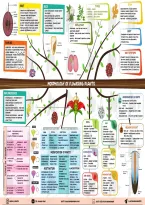
MORPHOLOGY OF FLOWERING PLANTS
INFLORESCENCE
• Inflorescence – Arrangement of MODIFICATION OF ROOTS
flowers on floral axis. • Strong Roots Turnip carrot
• Floral meristem is modified shoot • Prop roots → Banyan tree (hanging
apical meristem roots)
• Racemose inflorescence – main axis • Stilt roots → Palm (support)
grows; flowers in acropetal manner • Pneumatophores → Mangroves (for oxygen
(soybean) / respiration)
• Cymose inflorescence – main axis • Nodulated Roots → Pea (for nitrogen fixation)
terminates flowers in basipetal
order (Tulip)
AERIAL
LEAF
• Stem tendril for • Lateral,
climbing – cucumber flattened
REGIONS OF ROOT
• Flower – reproductive unit of • Stem thorn for protection structure on stem • Root cap → protects the apex of Root.
Calyx Corolla Androecium Gynoecium
angiosperms. → Citrus that develops at node. • Region of meristematic activity →
• Flower arranged on thalamus • Outermost • Next to Calyx • Inner to Corolla • Innermost whorl • Phylloclade – for grow new cells.
• 3 main parts → leaf
whorl • Petals • Stamens • Carpel/ Pistil photosynthesis – opuntia • Region of elongation → lengthening of root
base, Petiole, lamina
• Sepals • Brightly • Male Reproductive • Female • Cladode – leaf–like • Region of maturation → cells
On the basis • Hypogynous – Overy • Performs photosynthesis
• Green coloured Part Reproductive part structure – Asparagus differentiates & mature
of position of highest • Protect the • Attract insects • Stamen has another • Corpel has stigma,
ovary w.r.t • Perigynous – all flower for pellination & filament style & ovary
TYPES OF FLOWER
all whorls whorls same level.
VENATION
• Epigynous – Overy MODIFICATION OF PARTS UNDERGROUND
inferior • Arrangement
• Gamosepalous • Gamopetalous • Stamens united as • Carpels fused • Bulb → Onion of veins
On the basis • Bracteate (Sepals united) (petals united) one bundle (syncarpous) (storage) • Reticulate → network
of Bracts • Ebracteate • Polysepalous • Polypetalous (Monadelphous) • Carpels free • Rhizome →ginger (storage) of veins
(Sepals free) (petals free) • Two bundle – (Apocarpous) • Corm → Colocasia • Parallel → Veins are
Presence of • Bisexual (both present) • Tuber → Potato (stroge) parallel
(Diadelphous)
stamen &
carpel
• Unisexual (only one) AESTIVATION • More than two pLACENTATION
• Arrangement of sepals or bundles • Arrangement of
petals in a floral bud (polyadelphous) ovules in ovary MODIFICATIONS
On the basis of • Actinomorphic (radial • Epipetalous - SUB–AERIAL
• Valvate – no overlapping of • Marginal – pea • Tendril → Pea
symmetry symmetry) Stamen fused with
whorls. • Axile – China Rose • Offset → pistia,
• Zygomorphic (Bilateral petal • Spine → opuntia
• Twisted – overlapping occurs • Parietal – Mustard Eicchornia
symmetry) • Epiphyllous – • Stolon → Strawberry • Flesh leaves → Onion
• Imbricate – Overlapping present • Free central – • Succulent → Aloe
but not in particular direction stamen attached prime rose • Runner → Oxalis
On the basis of • Trimerous • Sucker → Chrysanthemum • Phyllode → Acacia
• Vexillary – One large petal to perianth • Basal – Sunflower
no. of floral • Tetramerous banana (Vegetative • Insectivorous → Venus –
appendages • Pentamerous overlaps other Marigold Propagation) fly trap.
anand_mani16 DR. Anand Mani https://www.anandmani.com/ https://discord.io/anandmani t.me/anandmani001
SEED TYPES
• Simple → Mango • Ascending part of axis bearing
• Feature of flowering plants. • After fertilisation, ovules develop branches, leaves, flowers, fruits.
• Compound → lamina dividived Pinnately
• Fruit is mature / ripened ovary into seeds. • Devlops from plumule of seed
• Compound → Neem, palmately
(develops after fertilization) • Seed has seed coat & embryo. • Bears nodes & internodes
• Compound → Silk, Cotton
• Fruit wall → Pericarp • Embryo has radicle, embryonal axis • Has buds – terminal & auxillary.
• Pericarp divided into outer epicarp & cotyledons.
& inner endocarp & middle mesocarp • One cotyledon – Monocot seeds
• Drupe → fruit of coconut & mango (Wheat, Maize) PHYLLOTAXY
• Parthenocarpic fruits that develop • Two cotyledons – Dicot seeds (Gram • Alternate – leaf at each node in
without fertilisation of ovary & Pea). alternate manner ROOT
• Opposite – leaf at each node in opposite
• Elongation of Radicle in plans forms
manner
primary root. Lateral roots from
• Whorled – More than 2 leaves at a node
primary root form secondary.
& form a whorl.
• Tertiary roots.
FAMILIES
• FABACEAE – also called papilionoidae
(sub family of Leguminosae). Pulses, Oil.
• FLORAL FORMULA– %♀K (5) C 1+2+(2)A(a)+1 G1 ROOT SYSTEMS
• SOLANACEAE– “Potato family” tomato,
brinjal, potato, chilli. • Primary roots & its branches form
• FLORAL FORMULA– ⊕♀K(5) C(5) A(5) G(2) Tap root system .e.g mustard
• LILIACEAE– “Lily family” (Tulips) • Roots coming from base of the stem
Characteristic family of Monocots. form fibrous root system. E.g wheat
• Formal formula– Br⊕♀ P(3+3) A 3+3 G (3) • Roots arising from other than radicle
→ adventitious roots. E.g Grass etc.
MORPHOLOGY OF FLOWERING PLANTS
INFLORESCENCE
• Inflorescence – Arrangement of MODIFICATION OF ROOTS
flowers on floral axis. • Strong Roots Turnip carrot
• Floral meristem is modified shoot • Prop roots → Banyan tree (hanging
apical meristem roots)
• Racemose inflorescence – main axis • Stilt roots → Palm (support)
grows; flowers in acropetal manner • Pneumatophores → Mangroves (for oxygen
(soybean) / respiration)
• Cymose inflorescence – main axis • Nodulated Roots → Pea (for nitrogen fixation)
terminates flowers in basipetal
order (Tulip)
AERIAL
LEAF
• Stem tendril for • Lateral,
climbing – cucumber flattened
REGIONS OF ROOT
• Flower – reproductive unit of • Stem thorn for protection structure on stem • Root cap → protects the apex of Root.
Calyx Corolla Androecium Gynoecium
angiosperms. → Citrus that develops at node. • Region of meristematic activity →
• Flower arranged on thalamus • Outermost • Next to Calyx • Inner to Corolla • Innermost whorl • Phylloclade – for grow new cells.
• 3 main parts → leaf
whorl • Petals • Stamens • Carpel/ Pistil photosynthesis – opuntia • Region of elongation → lengthening of root
base, Petiole, lamina
• Sepals • Brightly • Male Reproductive • Female • Cladode – leaf–like • Region of maturation → cells
On the basis • Hypogynous – Overy • Performs photosynthesis
• Green coloured Part Reproductive part structure – Asparagus differentiates & mature
of position of highest • Protect the • Attract insects • Stamen has another • Corpel has stigma,
ovary w.r.t • Perigynous – all flower for pellination & filament style & ovary
TYPES OF FLOWER
all whorls whorls same level.
VENATION
• Epigynous – Overy MODIFICATION OF PARTS UNDERGROUND
inferior • Arrangement
• Gamosepalous • Gamopetalous • Stamens united as • Carpels fused • Bulb → Onion of veins
On the basis • Bracteate (Sepals united) (petals united) one bundle (syncarpous) (storage) • Reticulate → network
of Bracts • Ebracteate • Polysepalous • Polypetalous (Monadelphous) • Carpels free • Rhizome →ginger (storage) of veins
(Sepals free) (petals free) • Two bundle – (Apocarpous) • Corm → Colocasia • Parallel → Veins are
Presence of • Bisexual (both present) • Tuber → Potato (stroge) parallel
(Diadelphous)
stamen &
carpel
• Unisexual (only one) AESTIVATION • More than two pLACENTATION
• Arrangement of sepals or bundles • Arrangement of
petals in a floral bud (polyadelphous) ovules in ovary MODIFICATIONS
On the basis of • Actinomorphic (radial • Epipetalous - SUB–AERIAL
• Valvate – no overlapping of • Marginal – pea • Tendril → Pea
symmetry symmetry) Stamen fused with
whorls. • Axile – China Rose • Offset → pistia,
• Zygomorphic (Bilateral petal • Spine → opuntia
• Twisted – overlapping occurs • Parietal – Mustard Eicchornia
symmetry) • Epiphyllous – • Stolon → Strawberry • Flesh leaves → Onion
• Imbricate – Overlapping present • Free central – • Succulent → Aloe
but not in particular direction stamen attached prime rose • Runner → Oxalis
On the basis of • Trimerous • Sucker → Chrysanthemum • Phyllode → Acacia
• Vexillary – One large petal to perianth • Basal – Sunflower
no. of floral • Tetramerous banana (Vegetative • Insectivorous → Venus –
appendages • Pentamerous overlaps other Marigold Propagation) fly trap.
anand_mani16 DR. Anand Mani https://www.anandmani.com/ https://discord.io/anandmani t.me/anandmani001


