
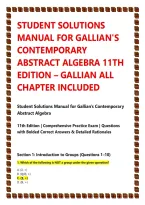
STUDENT SOLUTIONS
MANUAL FOR GALLIAN'S
CONTEMPORARY
ABSTRACT ALGEBRA 11TH
EDITION – GALLIAN ALL
CHAPTER INCLUDED
Student Solutions Manual for Gallian's Contemporary
Abstract Algebra
11th Edition | Comprehensive Practice Exam | Questions
with Bolded Correct Answers & Detailed Rationales
Section 1: Introduction to Groups (Questions 1–10)
1. Which of the following is NOT a group under the given operation?
A. (ℤ, +)
B. (ℚ{0}, ×)
C. (ℤ, ×)
D. (ℝ, +)
,Rationale: (ℤ, ×) is not a group because most integers lack multiplicative inverses (e.g.,
2 has no integer inverse). The other three are standard groups.
2. In a group G, the equation ax = b has how many solutions for x?
A. 0
B. 1
C. 2
D. Infinitely many
Rationale: In a group, ax = b has the unique solution x = a⁻¹b. This is a fundamental
property of groups.
3. Which of the following is the identity element in (ℝ{0}, ×)?
A. 0
B. 1
C. −1
D. ∞
Rationale: The multiplicative identity is 1, since a × 1 = 1 × a = a for all a.
4. What is the inverse of 3 in (ℤ₇, +)?
A. 3
B. 4
C. 5
D. 6
Rationale: In (ℤ₇, +), the inverse of 3 is 4 because 3 + 4 = 7 ≡ 0 (mod 7).
5. The group D₄ has how many elements?
A. 4
B. 6
C. 8
D. 12
Rationale: D₄ (dihedral group of order 8) represents the symmetries of a square and has
8 elements: 4 rotations and 4 reflections.
6. Which property is NOT required for a set with a binary operation to be a group?
,A. Associativity
B. Identity element
C. Inverses
D. Commutativity
Rationale: Commutativity is not required. Groups that satisfy commutativity are called
abelian groups, but non-abelian groups are still groups.
7. In the group ℤ₁₂, what is the order of the element 8?
A. 2
B. 3
C. 4
D. 6
Rationale: The order of 8 in ℤ₁₂ is the smallest positive k such that 8k ≡ 0 (mod 12). 8·3
= 24 ≡ 0, so the order is 3.
8. Which of the following is the Cayley table for (ℤ₃, +)?
A.
+ 0 1 2
0 0 1 2
1 1 2 0
2 2 0 1
B. The table for (ℤ₃, ×)
C. The table for (ℤ₂, +)
D. The table for (ℤ₄, +)
Rationale: The Cayley table for (ℤ₃, +) shows addition modulo 3.
9. In a group, (ab)⁻¹ equals:
A. a⁻¹b⁻¹
B. b⁻¹a⁻¹
, C. ab
D. ba
Rationale: The inverse of a product reverses the order: (ab)⁻¹ = b⁻¹a⁻¹.
10. Which of the following sets forms a group under multiplication?
A. ℤ
B. ℚ{0}
C. ℤ{0}
D. ℕ
Rationale: ℚ{0} is closed under multiplication, has identity 1, and every nonzero rational
has a multiplicative inverse. ℤ{0} fails because inverses are not integers.
Section 2: Groups (Questions 11–20)
11. In a group G, if a² = e for all a ∈ G, then G is:
A. Cyclic
B. Abelian
C. Trivial
D. Infinite
Rationale: If a² = e for all a, then ab = (ab)⁻¹ = b⁻¹a⁻¹ = ba, so G is abelian.
12. The center of a group G, Z(G), is:
A. The set of all elements
B. The set of elements that commute with every element of G
C. The set of elements with order 2
D. The set of generators
Rationale: Z(G) = {z ∈ G | zg = gz for all g ∈ G}.
13. In the group S₃, how many elements have order 2?
A. 1
B. 2
MANUAL FOR GALLIAN'S
CONTEMPORARY
ABSTRACT ALGEBRA 11TH
EDITION – GALLIAN ALL
CHAPTER INCLUDED
Student Solutions Manual for Gallian's Contemporary
Abstract Algebra
11th Edition | Comprehensive Practice Exam | Questions
with Bolded Correct Answers & Detailed Rationales
Section 1: Introduction to Groups (Questions 1–10)
1. Which of the following is NOT a group under the given operation?
A. (ℤ, +)
B. (ℚ{0}, ×)
C. (ℤ, ×)
D. (ℝ, +)
,Rationale: (ℤ, ×) is not a group because most integers lack multiplicative inverses (e.g.,
2 has no integer inverse). The other three are standard groups.
2. In a group G, the equation ax = b has how many solutions for x?
A. 0
B. 1
C. 2
D. Infinitely many
Rationale: In a group, ax = b has the unique solution x = a⁻¹b. This is a fundamental
property of groups.
3. Which of the following is the identity element in (ℝ{0}, ×)?
A. 0
B. 1
C. −1
D. ∞
Rationale: The multiplicative identity is 1, since a × 1 = 1 × a = a for all a.
4. What is the inverse of 3 in (ℤ₇, +)?
A. 3
B. 4
C. 5
D. 6
Rationale: In (ℤ₇, +), the inverse of 3 is 4 because 3 + 4 = 7 ≡ 0 (mod 7).
5. The group D₄ has how many elements?
A. 4
B. 6
C. 8
D. 12
Rationale: D₄ (dihedral group of order 8) represents the symmetries of a square and has
8 elements: 4 rotations and 4 reflections.
6. Which property is NOT required for a set with a binary operation to be a group?
,A. Associativity
B. Identity element
C. Inverses
D. Commutativity
Rationale: Commutativity is not required. Groups that satisfy commutativity are called
abelian groups, but non-abelian groups are still groups.
7. In the group ℤ₁₂, what is the order of the element 8?
A. 2
B. 3
C. 4
D. 6
Rationale: The order of 8 in ℤ₁₂ is the smallest positive k such that 8k ≡ 0 (mod 12). 8·3
= 24 ≡ 0, so the order is 3.
8. Which of the following is the Cayley table for (ℤ₃, +)?
A.
+ 0 1 2
0 0 1 2
1 1 2 0
2 2 0 1
B. The table for (ℤ₃, ×)
C. The table for (ℤ₂, +)
D. The table for (ℤ₄, +)
Rationale: The Cayley table for (ℤ₃, +) shows addition modulo 3.
9. In a group, (ab)⁻¹ equals:
A. a⁻¹b⁻¹
B. b⁻¹a⁻¹
, C. ab
D. ba
Rationale: The inverse of a product reverses the order: (ab)⁻¹ = b⁻¹a⁻¹.
10. Which of the following sets forms a group under multiplication?
A. ℤ
B. ℚ{0}
C. ℤ{0}
D. ℕ
Rationale: ℚ{0} is closed under multiplication, has identity 1, and every nonzero rational
has a multiplicative inverse. ℤ{0} fails because inverses are not integers.
Section 2: Groups (Questions 11–20)
11. In a group G, if a² = e for all a ∈ G, then G is:
A. Cyclic
B. Abelian
C. Trivial
D. Infinite
Rationale: If a² = e for all a, then ab = (ab)⁻¹ = b⁻¹a⁻¹ = ba, so G is abelian.
12. The center of a group G, Z(G), is:
A. The set of all elements
B. The set of elements that commute with every element of G
C. The set of elements with order 2
D. The set of generators
Rationale: Z(G) = {z ∈ G | zg = gz for all g ∈ G}.
13. In the group S₃, how many elements have order 2?
A. 1
B. 2


