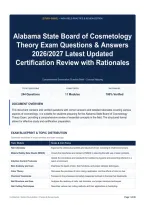
[STUDY GUIDE] • HIGH-YIELD PRACTICE & REVIEW EDITION
Alabama State Board of Cosmetology
Theory Exam Questions & Answers
2026/2027 Latest Updated
Certification Review with Rationales
Comprehensive Examination Question Bank • Concept Mapping
TOTAL QUESTIONS EXAM TOPICS RATIONALES
244 Questions 11 Modules 100% Verified
DOCUMENT OVERVIEW
This document contains 244 verified questions with correct answers and detailed rationales covering various
aspects of cosmetology. It is suitable for students preparing for the Alabama State Board of Cosmetology
Theory Exam, providing a comprehensive review of essential concepts in the field. The structured format
allows for effective study and certification preparation.
EXAM BLUEPRINT & TOPIC DISTRIBUTION
Systematic breakdown of subject domains and exam coverage.
Topic Module Scope & Core Focus
Hair Chemistry Explores the chemical properties and structure of hair, including its treatment and care.
Material Safety Data Sheets (MSDS) Covers the importance and content of MSDS in ensuring the safe use of salon products.
Details the procedures and standards for maintaining hygiene and preventing infection in a
Infection Control Protocols salon environment.
Skin Anatomy and Care Examines the layers of skin, their functions, and proper skincare techniques.
Color Theory Discusses the principles of color mixing, application, and the effects of color on hair.
Chemical Treatments Focuses on the processes and safety measures involved in chemical hair treatments.
Nail Structure and Care Analyzes the anatomy of nails, nail disorders, and proper manicure techniques.
Hair Cutting Techniques Describes various hair cutting methods and their applications in hairstyling.
Confidential • Student Study Edition • Practice & Review Guide Page 1 of 66
,STUDENT STUDY & MASTERY EDITION PRACTICE & REVIEW GUIDE
Disinfection and Sterilization Covers methods for disinfecting tools and ensuring a safe salon environment.
Highlights the importance of effective communication and consultation in cosmetology
Client Consultation services.
Regulatory Compliance Details the laws and regulations governing cosmetology practice and salon operations.
Total Exam Coverage 11 Integrated Topic Modules • 244 Examination Questions
Confidential • Student Study Edition • Practice & Review Guide Page 2 of 66
,STUDENT STUDY & MASTERY EDITION PRACTICE & REVIEW GUIDE
QUESTION 1
When performing a basic permanent wrap, the hair should be divided into how many
sections?
Answer: Nine.
Rationale: Dividing hair into nine sections during a basic permanent wrap allows for even distribution of the perm solution
and consistent curl formation, ensuring optimal results. This method adheres to the principles of sectioning in chemical hair
treatments, promoting uniformity and control throughout the process.
QUESTION 2
In which of the following areas would you start a relaxer retouch application?
Answer: Area most resistant.
Rationale: Applying relaxer to the most resistant area first ensures even processing, as this section requires more time to
achieve the desired result due to its greater resistance to chemical alteration. This approach adheres to the principle of
effective product application, maximizing the relaxer's efficacy while minimizing the risk of over-processing.
QUESTION 3
Which of the following does the stylist look for during a scalp analysis for chemical
procedures?
Answer: Abrasions on the scalp.
Rationale: A scalp analysis assesses for abrasions to prevent chemical irritation or burns during procedures, as
compromised skin can lead to adverse reactions. Identifying these surface injuries is crucial for ensuring client safety and
the efficacy of chemical treatments.
QUESTION 4
When using a chemical relaxer, it changes the shape of the hair by breaking down
which of the following?
Answer: Disulfide bonds.
Rationale: Chemical relaxers alter hair structure by breaking disulfide bonds, which are responsible for the hair's natural
curl pattern. This process allows the hair to be reshaped into a straighter form, demonstrating the principle of chemical
alteration of protein structures.
Confidential • Student Study Edition • Practice & Review Guide Page 3 of 66
, STUDENT STUDY & MASTERY EDITION PRACTICE & REVIEW GUIDE
QUESTION 5
When using relaxers incorrectly, which of the following could happen?
Answer: The hair melts.
Rationale: Excessive heat or prolonged exposure to relaxer chemicals can lead to the breakdown of the hair's protein
structure, resulting in severe damage and melting. Understanding the chemical interaction between relaxers and hair fibers
is critical for safe application and maintenance of hair integrity.
QUESTION 6
All of the following are reasons to perform a strand test EXCEPT
Answer: To determine the best type of shampoo.
Rationale: Strand tests evaluate hair's condition and chemical resilience, primarily guiding decisions about processing
methods and timing rather than shampoo selection. The underlying principle emphasizes assessing hair integrity to ensure
safe and effective chemical treatments.
QUESTION 7
When analyzing the hair before a chemical relaxer, it is necessary to evaluate the hair
for all of the following EXCEPT
Answer: Color.
Rationale: Assessing hair before a chemical relaxer involves evaluating its texture, porosity, and elasticity to determine its
suitability for chemical processes; color does not impact the hair's structural integrity or responsiveness to relaxers.
Understanding these characteristics helps prevent damage and ensures optimal results during the chemical treatment.
QUESTION 8
Which of the following is the main ingredient in true acid and acid balanced waving
lotions?
Answer: Glyceryl monothioglycolate.
Rationale: Glyceryl monothioglycolate serves as the primary reducing agent in true acid and acid balanced waving lotions,
facilitating the permanent alteration of the hair's disulfide bonds through a controlled pH environment. This allows for
effective hair restructuring while minimizing damage compared to alkaline alternatives.
Confidential • Student Study Edition • Practice & Review Guide Page 4 of 66
Alabama State Board of Cosmetology
Theory Exam Questions & Answers
2026/2027 Latest Updated
Certification Review with Rationales
Comprehensive Examination Question Bank • Concept Mapping
TOTAL QUESTIONS EXAM TOPICS RATIONALES
244 Questions 11 Modules 100% Verified
DOCUMENT OVERVIEW
This document contains 244 verified questions with correct answers and detailed rationales covering various
aspects of cosmetology. It is suitable for students preparing for the Alabama State Board of Cosmetology
Theory Exam, providing a comprehensive review of essential concepts in the field. The structured format
allows for effective study and certification preparation.
EXAM BLUEPRINT & TOPIC DISTRIBUTION
Systematic breakdown of subject domains and exam coverage.
Topic Module Scope & Core Focus
Hair Chemistry Explores the chemical properties and structure of hair, including its treatment and care.
Material Safety Data Sheets (MSDS) Covers the importance and content of MSDS in ensuring the safe use of salon products.
Details the procedures and standards for maintaining hygiene and preventing infection in a
Infection Control Protocols salon environment.
Skin Anatomy and Care Examines the layers of skin, their functions, and proper skincare techniques.
Color Theory Discusses the principles of color mixing, application, and the effects of color on hair.
Chemical Treatments Focuses on the processes and safety measures involved in chemical hair treatments.
Nail Structure and Care Analyzes the anatomy of nails, nail disorders, and proper manicure techniques.
Hair Cutting Techniques Describes various hair cutting methods and their applications in hairstyling.
Confidential • Student Study Edition • Practice & Review Guide Page 1 of 66
,STUDENT STUDY & MASTERY EDITION PRACTICE & REVIEW GUIDE
Disinfection and Sterilization Covers methods for disinfecting tools and ensuring a safe salon environment.
Highlights the importance of effective communication and consultation in cosmetology
Client Consultation services.
Regulatory Compliance Details the laws and regulations governing cosmetology practice and salon operations.
Total Exam Coverage 11 Integrated Topic Modules • 244 Examination Questions
Confidential • Student Study Edition • Practice & Review Guide Page 2 of 66
,STUDENT STUDY & MASTERY EDITION PRACTICE & REVIEW GUIDE
QUESTION 1
When performing a basic permanent wrap, the hair should be divided into how many
sections?
Answer: Nine.
Rationale: Dividing hair into nine sections during a basic permanent wrap allows for even distribution of the perm solution
and consistent curl formation, ensuring optimal results. This method adheres to the principles of sectioning in chemical hair
treatments, promoting uniformity and control throughout the process.
QUESTION 2
In which of the following areas would you start a relaxer retouch application?
Answer: Area most resistant.
Rationale: Applying relaxer to the most resistant area first ensures even processing, as this section requires more time to
achieve the desired result due to its greater resistance to chemical alteration. This approach adheres to the principle of
effective product application, maximizing the relaxer's efficacy while minimizing the risk of over-processing.
QUESTION 3
Which of the following does the stylist look for during a scalp analysis for chemical
procedures?
Answer: Abrasions on the scalp.
Rationale: A scalp analysis assesses for abrasions to prevent chemical irritation or burns during procedures, as
compromised skin can lead to adverse reactions. Identifying these surface injuries is crucial for ensuring client safety and
the efficacy of chemical treatments.
QUESTION 4
When using a chemical relaxer, it changes the shape of the hair by breaking down
which of the following?
Answer: Disulfide bonds.
Rationale: Chemical relaxers alter hair structure by breaking disulfide bonds, which are responsible for the hair's natural
curl pattern. This process allows the hair to be reshaped into a straighter form, demonstrating the principle of chemical
alteration of protein structures.
Confidential • Student Study Edition • Practice & Review Guide Page 3 of 66
, STUDENT STUDY & MASTERY EDITION PRACTICE & REVIEW GUIDE
QUESTION 5
When using relaxers incorrectly, which of the following could happen?
Answer: The hair melts.
Rationale: Excessive heat or prolonged exposure to relaxer chemicals can lead to the breakdown of the hair's protein
structure, resulting in severe damage and melting. Understanding the chemical interaction between relaxers and hair fibers
is critical for safe application and maintenance of hair integrity.
QUESTION 6
All of the following are reasons to perform a strand test EXCEPT
Answer: To determine the best type of shampoo.
Rationale: Strand tests evaluate hair's condition and chemical resilience, primarily guiding decisions about processing
methods and timing rather than shampoo selection. The underlying principle emphasizes assessing hair integrity to ensure
safe and effective chemical treatments.
QUESTION 7
When analyzing the hair before a chemical relaxer, it is necessary to evaluate the hair
for all of the following EXCEPT
Answer: Color.
Rationale: Assessing hair before a chemical relaxer involves evaluating its texture, porosity, and elasticity to determine its
suitability for chemical processes; color does not impact the hair's structural integrity or responsiveness to relaxers.
Understanding these characteristics helps prevent damage and ensures optimal results during the chemical treatment.
QUESTION 8
Which of the following is the main ingredient in true acid and acid balanced waving
lotions?
Answer: Glyceryl monothioglycolate.
Rationale: Glyceryl monothioglycolate serves as the primary reducing agent in true acid and acid balanced waving lotions,
facilitating the permanent alteration of the hair's disulfide bonds through a controlled pH environment. This allows for
effective hair restructuring while minimizing damage compared to alkaline alternatives.
Confidential • Student Study Edition • Practice & Review Guide Page 4 of 66