[STUDY GUIDE] • HIGH-YIELD PRACTICE & REVIEW EDITION
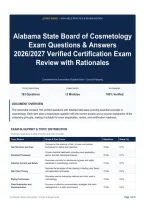
Alabama State Board of Cosmetology
Exam Questions & Answers
2026/2027 Verified Certification Exam
Review with Rationales
Comprehensive Examination Question Bank • Concept Mapping
TOTAL QUESTIONS EXAM TOPICS RATIONALES
183 Questions 12 Modules 100% Verified
DOCUMENT OVERVIEW
This document contains 183 verified questions with detailed rationales covering essential concepts in
cosmetology. Each item pairs a board-style question with the correct answer and a concise explanation of the
underlying principle, making it suitable for exam preparation, review, and certification readiness.
EXAM BLUEPRINT & TOPIC DISTRIBUTION
Systematic breakdown of subject domains and exam coverage.
Topic Module Scope & Core Focus Questions Share (%)
Focuses on the anatomy of hair, its care, and various
Hair Structure and Care techniques for styling and treatment. 16 Qs 8.7%
Covers chemical treatments, including color application,
Chemical Processes perms, and hair relaxing techniques. 16 Qs 8.7%
Examines protocols for maintaining hygiene and safety
Infection Control and Safety standards in cosmetology practices. 16 Qs 8.7%
Explores the principles of hair coloring, including color theory
Hair Color Theory and application techniques. 15 Qs 8.2%
Discusses various hairstyling methods and tools used in
Styling Techniques cosmetology. 15 Qs 8.2%
Client Interaction and Focuses on effective communication strategies and client
Communication management in a salon environment. 15 Qs 8.2%
Confidential • Student Study Edition • Practice & Review Guide Page 1 of 51
,STUDENT STUDY & MASTERY EDITION PRACTICE & REVIEW GUIDE
Examines techniques to modify hair texture and the impact on
Texture and Styling Adjustments styling. 15 Qs 8.2%
Legal and Ethical Covers the Good Samaritan Law and other legal aspects
Considerations relevant to cosmetology practices. 15 Qs 8.2%
Professional Standards and Discusses standards of professional conduct, including client
Practices services and business practices. 15 Qs 8.2%
Covers techniques and considerations for facials and nail care
Facial and Nail Services services. 15 Qs 8.2%
Physiology and Anatomy Examines the anatomical and physiological knowledge
Related to Cosmetology necessary for effective cosmetology practice. 15 Qs 8.2%
Focuses on the tools and equipment used in cosmetology
Equipment and Tools services and their proper usage. 15 Qs 8.2%
Total Exam Coverage 12 Integrated Topic Modules 183 Qs 100.0%
Confidential • Student Study Edition • Practice & Review Guide Page 2 of 51
,STUDENT STUDY & MASTERY EDITION PRACTICE & REVIEW GUIDE
TOPIC 1: HAIR STRUCTURE AND CARE
16 Questions • 8.7% of Exam • Focuses on the anatomy of hair, its care, and various techniques for styling and treatment.
QUESTION 1
Long, slow wave would be an example of:
Answer: Slow speed texture pattern.
Rationale: A long, slow wave indicates a texture pattern characterized by low frequency and gradual changes, reflecting a
slow speed of variation in amplitude. This principle is fundamental in understanding how auditory and visual stimuli can be
interpreted based on their frequency and speed.
QUESTION 2
Hair additions are designed to be attached:
Answer: To the base of the clients hair.
Rationale: Attaching hair additions to the base of the client's hair ensures a secure, natural blend that maintains the integrity
of the existing hair and allows for movement. This method minimizes stress on the natural hair while providing a seamless
appearance.
QUESTION 3
Base control is also:
Answer: The amount of volume within a hairstyle.
Rationale: Base control refers to the volume created at the base of a hairstyle, influencing the lift and shape by determining
how hair is positioned and secured. Mastery of base control techniques allows hairstylists to achieve desired styles through
strategic manipulation of hair volume and direction.
Confidential • Student Study Edition • Practice & Review Guide Page 3 of 51
, STUDENT STUDY & MASTERY EDITION PRACTICE & REVIEW GUIDE
QUESTION 4
Mild relaxer
Answer: Safer to use on fine, color treated hair.
Rationale: A mild relaxer is formulated with lower alkaline content, making it less damaging and more suitable for fine,
color-treated hair, which is typically more fragile and prone to breakage. This gentler approach preserves the hair's integrity
while achieving desired texture changes.
QUESTION 5
Team approach example
Answer: Offering guests water while they wait.
Rationale: Providing water to guests while they wait exemplifies a team approach by promoting collaboration and
enhancing the guest experience, demonstrating how coordinated efforts can improve service delivery in hospitality settings.
This practice underscores the principle of customer-centered care, where every team member contributes to client
satisfaction.
QUESTION 6
Connect strategies:
Answer: Using clients name, introducing self, giving client helpful direction.
Rationale: Utilizing a client's name, self-introduction, and providing clear guidance fosters therapeutic communication,
enhancing rapport and trust. This approach aligns with the principles of client-centered care, which prioritize respectful and
effective interactions in healthcare settings.
QUESTION 7
Normal dry hair stretches
Answer: 20% Of its length.
Rationale: Normal dry hair can stretch up to 20% of its length due to the structural properties of keratin, which allows for
elasticity without permanent deformation. Understanding this elasticity is important for evaluating hair health and preventing
damage during styling or treatments.
Confidential • Student Study Edition • Practice & Review Guide Page 4 of 51
Alabama State Board of Cosmetology
Exam Questions & Answers
2026/2027 Verified Certification Exam
Review with Rationales
Comprehensive Examination Question Bank • Concept Mapping
TOTAL QUESTIONS EXAM TOPICS RATIONALES
183 Questions 12 Modules 100% Verified
DOCUMENT OVERVIEW
This document contains 183 verified questions with detailed rationales covering essential concepts in
cosmetology. Each item pairs a board-style question with the correct answer and a concise explanation of the
underlying principle, making it suitable for exam preparation, review, and certification readiness.
EXAM BLUEPRINT & TOPIC DISTRIBUTION
Systematic breakdown of subject domains and exam coverage.
Topic Module Scope & Core Focus Questions Share (%)
Focuses on the anatomy of hair, its care, and various
Hair Structure and Care techniques for styling and treatment. 16 Qs 8.7%
Covers chemical treatments, including color application,
Chemical Processes perms, and hair relaxing techniques. 16 Qs 8.7%
Examines protocols for maintaining hygiene and safety
Infection Control and Safety standards in cosmetology practices. 16 Qs 8.7%
Explores the principles of hair coloring, including color theory
Hair Color Theory and application techniques. 15 Qs 8.2%
Discusses various hairstyling methods and tools used in
Styling Techniques cosmetology. 15 Qs 8.2%
Client Interaction and Focuses on effective communication strategies and client
Communication management in a salon environment. 15 Qs 8.2%
Confidential • Student Study Edition • Practice & Review Guide Page 1 of 51
,STUDENT STUDY & MASTERY EDITION PRACTICE & REVIEW GUIDE
Examines techniques to modify hair texture and the impact on
Texture and Styling Adjustments styling. 15 Qs 8.2%
Legal and Ethical Covers the Good Samaritan Law and other legal aspects
Considerations relevant to cosmetology practices. 15 Qs 8.2%
Professional Standards and Discusses standards of professional conduct, including client
Practices services and business practices. 15 Qs 8.2%
Covers techniques and considerations for facials and nail care
Facial and Nail Services services. 15 Qs 8.2%
Physiology and Anatomy Examines the anatomical and physiological knowledge
Related to Cosmetology necessary for effective cosmetology practice. 15 Qs 8.2%
Focuses on the tools and equipment used in cosmetology
Equipment and Tools services and their proper usage. 15 Qs 8.2%
Total Exam Coverage 12 Integrated Topic Modules 183 Qs 100.0%
Confidential • Student Study Edition • Practice & Review Guide Page 2 of 51
,STUDENT STUDY & MASTERY EDITION PRACTICE & REVIEW GUIDE
TOPIC 1: HAIR STRUCTURE AND CARE
16 Questions • 8.7% of Exam • Focuses on the anatomy of hair, its care, and various techniques for styling and treatment.
QUESTION 1
Long, slow wave would be an example of:
Answer: Slow speed texture pattern.
Rationale: A long, slow wave indicates a texture pattern characterized by low frequency and gradual changes, reflecting a
slow speed of variation in amplitude. This principle is fundamental in understanding how auditory and visual stimuli can be
interpreted based on their frequency and speed.
QUESTION 2
Hair additions are designed to be attached:
Answer: To the base of the clients hair.
Rationale: Attaching hair additions to the base of the client's hair ensures a secure, natural blend that maintains the integrity
of the existing hair and allows for movement. This method minimizes stress on the natural hair while providing a seamless
appearance.
QUESTION 3
Base control is also:
Answer: The amount of volume within a hairstyle.
Rationale: Base control refers to the volume created at the base of a hairstyle, influencing the lift and shape by determining
how hair is positioned and secured. Mastery of base control techniques allows hairstylists to achieve desired styles through
strategic manipulation of hair volume and direction.
Confidential • Student Study Edition • Practice & Review Guide Page 3 of 51
, STUDENT STUDY & MASTERY EDITION PRACTICE & REVIEW GUIDE
QUESTION 4
Mild relaxer
Answer: Safer to use on fine, color treated hair.
Rationale: A mild relaxer is formulated with lower alkaline content, making it less damaging and more suitable for fine,
color-treated hair, which is typically more fragile and prone to breakage. This gentler approach preserves the hair's integrity
while achieving desired texture changes.
QUESTION 5
Team approach example
Answer: Offering guests water while they wait.
Rationale: Providing water to guests while they wait exemplifies a team approach by promoting collaboration and
enhancing the guest experience, demonstrating how coordinated efforts can improve service delivery in hospitality settings.
This practice underscores the principle of customer-centered care, where every team member contributes to client
satisfaction.
QUESTION 6
Connect strategies:
Answer: Using clients name, introducing self, giving client helpful direction.
Rationale: Utilizing a client's name, self-introduction, and providing clear guidance fosters therapeutic communication,
enhancing rapport and trust. This approach aligns with the principles of client-centered care, which prioritize respectful and
effective interactions in healthcare settings.
QUESTION 7
Normal dry hair stretches
Answer: 20% Of its length.
Rationale: Normal dry hair can stretch up to 20% of its length due to the structural properties of keratin, which allows for
elasticity without permanent deformation. Understanding this elasticity is important for evaluating hair health and preventing
damage during styling or treatments.
Confidential • Student Study Edition • Practice & Review Guide Page 4 of 51