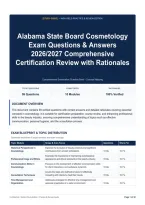
[STUDY GUIDE] • HIGH-YIELD PRACTICE & REVIEW EDITION
Alabama State Board Cosmetology
Exam Questions & Answers
2026/2027 Comprehensive
Certification Review with Rationales
Comprehensive Examination Question Bank • Concept Mapping
TOTAL QUESTIONS EXAM TOPICS RATIONALES
99 Questions 10 Modules 100% Verified
DOCUMENT OVERVIEW
This document contains 99 verified questions with correct answers and detailed rationales covering essential
concepts in cosmetology. It is suitable for certification preparation, course review, and enhancing professional
skills in the beauty industry, ensuring comprehensive understanding of topics such as effective
communication, personal hygiene, and the consultation process.
EXAM BLUEPRINT & TOPIC DISTRIBUTION
Systematic breakdown of subject domains and exam coverage.
Topic Module Scope & Core Focus Questions Share (%)
Historical Perspectives in Explores the evolution of beauty practices and significant
Cosmetology contributions from ancient civilizations. 10 Qs 10.1%
Examines the importance of maintaining a professional
Professional Image and Ethics appearance and ethical standards in the beauty industry. 10 Qs 10.1%
Communication Skills in Focuses on the development of effective communication skills
Cosmetology for client interactions and workplace dynamics. 10 Qs 10.1%
Covers the steps and methods involved in effectively
Consultation Techniques consulting with clients to meet their needs. 10 Qs 10.1%
Time Management and Addresses strategies for effective time management and
Organization personal organization in a salon environment. 10 Qs 10.1%
Confidential • Student Study Edition • Practice & Review Guide Page 1 of 32
,STUDENT STUDY & MASTERY EDITION PRACTICE & REVIEW GUIDE
Personal Hygiene and Emphasizes the significance of personal hygiene and
Maintenance maintaining cleanliness in professional settings. 10 Qs 10.1%
Examines the principles of ergonomics to promote safety and
Ergonomics in Cosmetology comfort in the workplace. 10 Qs 10.1%
Life Skills and Professional Explores the development of life skills that contribute to
Growth personal and professional success. 10 Qs 10.1%
Cosmetic Innovations and Highlights significant innovations in cosmetic products and
Trends techniques throughout history. 10 Qs 10.1%
Focuses on building lasting relationships with clients to
Client Relationships and Loyalty enhance loyalty and satisfaction. 9 Qs 9.1%
Total Exam Coverage 10 Integrated Topic Modules 99 Qs 100.0%
Confidential • Student Study Edition • Practice & Review Guide Page 2 of 32
,STUDENT STUDY & MASTERY EDITION PRACTICE & REVIEW GUIDE
TOPIC 1: HISTORICAL PERSPECTIVES IN COSMETOLOGY
10 Questions • 10.1% of Exam • Explores the evolution of beauty practices and significant contributions from ancient civilizations.
QUESTION 1
African civilization had a variety of hairstyles that were used as a symbol of tribal
traditions and conveyed a message of age, marital status, _____, and rank
Answer: Power.
Rationale: Hairstyles in African civilization served as visual markers of social hierarchy and authority, reflecting not only
personal identity but also communal values and status within tribal structures. Power dynamics were often expressed
through intricate styles, indicating an individual's position and influence within the community.
QUESTION 2
Which of the following civilizations was the first to infuse essential oils from leaves,
bark, and blossoms of plants for use as perfumes and purification?
Answer: Egyptians.
Rationale: Egyptians pioneered the extraction and use of essential oils from various plant parts, establishing practices that
linked aromatic substances to religious rituals and personal care, thus laying the foundation for modern perfumery and
aromatherapy. Their advanced techniques in distillation and infusion highlighted their sophisticated understanding of natural
resources for both spiritual and hygienic purposes.
QUESTION 3
The Ancient ______ were the first to cultivate beauty in an extravagant fashion.
Answer: Egyptians.
Rationale: Ancient Egyptians emphasized aesthetics through elaborate art, cosmetics, and personal adornment, reflecting
their cultural values and beliefs in beauty as a divine attribute. This cultivation of beauty was intricately linked to their
religious practices and social status, showcasing the intersection of art and identity in their civilization.
Confidential • Student Study Edition • Practice & Review Guide Page 3 of 32
, STUDENT STUDY & MASTERY EDITION PRACTICE & REVIEW GUIDE
QUESTION 4
The ancient Greeks made lavish use of perfumes and cosmetics for grooming,
medicinal purpose, and _____.
Answer: Religious rites.
Rationale: Ancient Greeks incorporated perfumes and cosmetics into religious rites to enhance rituals and offerings,
reflecting the belief that scent could connect the divine with the earthly realm. This practice demonstrates the integration of
aesthetics and spirituality in their culture.
QUESTION 5
During the ____, women commonly used henna to stain their hair and nails a rich, warm
red.
Answer: Egyptian era.
Rationale: Henna was widely utilized in the Egyptian era for body art and cosmetic purposes, symbolizing beauty and social
status. This practice reflects the cultural significance of personal adornment in ancient Egyptian society, where aesthetics
were closely tied to spirituality and identity.
QUESTION 6
If you were a middle class woman in ancient Rome, you would color your hair
__________ to indicate your class status
Answer: Blond.
Rationale: Coloring hair blond was a status symbol in ancient Rome, as it was associated with the elite and signified wealth
and beauty.
Middle-class women adopted this trend to elevate their social standing and align themselves with the cultural ideals of the
time.
Confidential • Student Study Edition • Practice & Review Guide Page 4 of 32
Alabama State Board Cosmetology
Exam Questions & Answers
2026/2027 Comprehensive
Certification Review with Rationales
Comprehensive Examination Question Bank • Concept Mapping
TOTAL QUESTIONS EXAM TOPICS RATIONALES
99 Questions 10 Modules 100% Verified
DOCUMENT OVERVIEW
This document contains 99 verified questions with correct answers and detailed rationales covering essential
concepts in cosmetology. It is suitable for certification preparation, course review, and enhancing professional
skills in the beauty industry, ensuring comprehensive understanding of topics such as effective
communication, personal hygiene, and the consultation process.
EXAM BLUEPRINT & TOPIC DISTRIBUTION
Systematic breakdown of subject domains and exam coverage.
Topic Module Scope & Core Focus Questions Share (%)
Historical Perspectives in Explores the evolution of beauty practices and significant
Cosmetology contributions from ancient civilizations. 10 Qs 10.1%
Examines the importance of maintaining a professional
Professional Image and Ethics appearance and ethical standards in the beauty industry. 10 Qs 10.1%
Communication Skills in Focuses on the development of effective communication skills
Cosmetology for client interactions and workplace dynamics. 10 Qs 10.1%
Covers the steps and methods involved in effectively
Consultation Techniques consulting with clients to meet their needs. 10 Qs 10.1%
Time Management and Addresses strategies for effective time management and
Organization personal organization in a salon environment. 10 Qs 10.1%
Confidential • Student Study Edition • Practice & Review Guide Page 1 of 32
,STUDENT STUDY & MASTERY EDITION PRACTICE & REVIEW GUIDE
Personal Hygiene and Emphasizes the significance of personal hygiene and
Maintenance maintaining cleanliness in professional settings. 10 Qs 10.1%
Examines the principles of ergonomics to promote safety and
Ergonomics in Cosmetology comfort in the workplace. 10 Qs 10.1%
Life Skills and Professional Explores the development of life skills that contribute to
Growth personal and professional success. 10 Qs 10.1%
Cosmetic Innovations and Highlights significant innovations in cosmetic products and
Trends techniques throughout history. 10 Qs 10.1%
Focuses on building lasting relationships with clients to
Client Relationships and Loyalty enhance loyalty and satisfaction. 9 Qs 9.1%
Total Exam Coverage 10 Integrated Topic Modules 99 Qs 100.0%
Confidential • Student Study Edition • Practice & Review Guide Page 2 of 32
,STUDENT STUDY & MASTERY EDITION PRACTICE & REVIEW GUIDE
TOPIC 1: HISTORICAL PERSPECTIVES IN COSMETOLOGY
10 Questions • 10.1% of Exam • Explores the evolution of beauty practices and significant contributions from ancient civilizations.
QUESTION 1
African civilization had a variety of hairstyles that were used as a symbol of tribal
traditions and conveyed a message of age, marital status, _____, and rank
Answer: Power.
Rationale: Hairstyles in African civilization served as visual markers of social hierarchy and authority, reflecting not only
personal identity but also communal values and status within tribal structures. Power dynamics were often expressed
through intricate styles, indicating an individual's position and influence within the community.
QUESTION 2
Which of the following civilizations was the first to infuse essential oils from leaves,
bark, and blossoms of plants for use as perfumes and purification?
Answer: Egyptians.
Rationale: Egyptians pioneered the extraction and use of essential oils from various plant parts, establishing practices that
linked aromatic substances to religious rituals and personal care, thus laying the foundation for modern perfumery and
aromatherapy. Their advanced techniques in distillation and infusion highlighted their sophisticated understanding of natural
resources for both spiritual and hygienic purposes.
QUESTION 3
The Ancient ______ were the first to cultivate beauty in an extravagant fashion.
Answer: Egyptians.
Rationale: Ancient Egyptians emphasized aesthetics through elaborate art, cosmetics, and personal adornment, reflecting
their cultural values and beliefs in beauty as a divine attribute. This cultivation of beauty was intricately linked to their
religious practices and social status, showcasing the intersection of art and identity in their civilization.
Confidential • Student Study Edition • Practice & Review Guide Page 3 of 32
, STUDENT STUDY & MASTERY EDITION PRACTICE & REVIEW GUIDE
QUESTION 4
The ancient Greeks made lavish use of perfumes and cosmetics for grooming,
medicinal purpose, and _____.
Answer: Religious rites.
Rationale: Ancient Greeks incorporated perfumes and cosmetics into religious rites to enhance rituals and offerings,
reflecting the belief that scent could connect the divine with the earthly realm. This practice demonstrates the integration of
aesthetics and spirituality in their culture.
QUESTION 5
During the ____, women commonly used henna to stain their hair and nails a rich, warm
red.
Answer: Egyptian era.
Rationale: Henna was widely utilized in the Egyptian era for body art and cosmetic purposes, symbolizing beauty and social
status. This practice reflects the cultural significance of personal adornment in ancient Egyptian society, where aesthetics
were closely tied to spirituality and identity.
QUESTION 6
If you were a middle class woman in ancient Rome, you would color your hair
__________ to indicate your class status
Answer: Blond.
Rationale: Coloring hair blond was a status symbol in ancient Rome, as it was associated with the elite and signified wealth
and beauty.
Middle-class women adopted this trend to elevate their social standing and align themselves with the cultural ideals of the
time.
Confidential • Student Study Edition • Practice & Review Guide Page 4 of 32