[STUDY GUIDE] • HIGH-YIELD PRACTICE & REVIEW EDITION
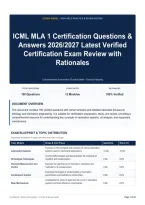
ICML MLA 1 Certification Questions &
Answers 2026/2027 Latest Verified
Certification Exam Review with
Rationales
Comprehensive Examination Question Bank • Concept Mapping
TOTAL QUESTIONS EXAM TOPICS RATIONALES
100 Questions 12 Modules 100% Verified
DOCUMENT OVERVIEW
This document contains 100 verified questions with correct answers and detailed rationales focused on
tribology and lubrication engineering. It is suitable for certification preparation, study, and review, providing a
comprehensive resource for understanding key concepts in lubrication systems, oil analysis, and equipment
maintenance.
EXAM BLUEPRINT & TOPIC DISTRIBUTION
Systematic breakdown of subject domains and exam coverage.
Topic Module Scope & Core Focus Questions Share (%)
Focuses on the principles and practices of various lubrication
Lubrication Systems systems used in mechanical applications. 10 Qs 10.0%
Covers methodologies and best practices for analyzing oil
Oil Analysis Techniques condition and contamination. 9 Qs 9.0%
Viscosity Measurement and Explores the significance of viscosity in lubrication and
Control methods for its measurement. 9 Qs 9.0%
Examines the impact of contaminants on lubrication
Contaminant Control performance and methods to control them. 8 Qs 8.0%
Investigates the types of wear that can occur in lubrication
Wear Mechanisms systems and their effects on components. 8 Qs 8.0%
Confidential • Student Study Edition • Practice & Review Guide Page 1 of 44
,STUDENT STUDY & MASTERY EDITION PRACTICE & REVIEW GUIDE
Analyzes the key properties of lubricants and how they affect
Fluid Properties and Behavior performance under different conditions. 8 Qs 8.0%
Discusses the importance of proper oil change practices and
Oil Change Practices the implications of viscosity selection. 8 Qs 8.0%
Emphasizes the techniques and strategies for effective
Sampling Best Practices sampling of lubricants for analysis. 8 Qs 8.0%
Explores the processes of oxidation in oils and their
Oxidation and Degradation consequences on lubricant performance. 8 Qs 8.0%
Environmental Impact on Examines how environmental conditions influence lubrication
Lubrication effectiveness and oil stability. 8 Qs 8.0%
Regreasing and Maintenance Focuses on the proper regreasing techniques and
Practices maintenance practices for lubrication systems. 8 Qs 8.0%
Particle Contamination and Covers the analysis of particulate contamination in lubricants
Analysis and its implications for machinery. 8 Qs 8.0%
Total Exam Coverage 12 Integrated Topic Modules 100 Qs 100.0%
Confidential • Student Study Edition • Practice & Review Guide Page 2 of 44
,STUDENT STUDY & MASTERY EDITION PRACTICE & REVIEW GUIDE
TOPIC 1: LUBRICATION SYSTEMS
10 Questions • 10.0% of Exam • Focuses on the principles and practices of various lubrication systems used in mechanical
applications.
QUESTION 1
A plain-journal bearing has a composite surface roughness of 0.40 µm and a mean
lubricant film thickness estimated at 0.64 µm. Compute the specific film thickness λ and
identify the lubrication regime.
A. λ = 0.25 → Boundary lubrication
B. λ = 1.6 → Mixed-film lubrication
C. λ = 2.5 → Hydrodynamic lubrication
D. λ = 0.8 → Mixed-film lubrication
Answer: Answer: B.
Explanation / arithmetic: λ = mean film thickness ÷ composite roughness. Compute: 0.64 ÷ 0.40 = (64 ÷ 40) ×
0.01/0.01 = 1.6. (step: 64/40 = 1.6). According to KEW, mixed-film is λ between ~1 and 2 (proper film begins
>1.5), so λ=1.6 places the contact in the mixed-film regime.
QUESTION 2
For typical fluid-power hydraulic systems, target cleanliness level (TCL) is closest to
which ISO 4406 code?
A. <18/16/13
B. <17/15/12
C. <16/14/11
D. <15/13/10
Answer: Answer: D.
Explanation: KEW lists target cleanliness levels by application and shows fluid power / hydraulic systems
generally target <15/13/10 (or better depending on sensitivity). Use this as a baseline when setting filtration
and sampling targets.
Confidential • Student Study Edition • Practice & Review Guide Page 3 of 44
, STUDENT STUDY & MASTERY EDITION PRACTICE & REVIEW GUIDE
QUESTION 3
A centrifugal pump uses a single-row deep-groove ball bearing. The plant wants to
reduce regreasing frequency by switching to a higher NLGI grade. According to KEW
guidance, which is the primary risk of using a too-high NLGI grease in a high-speed
bearing?
A. Reduced corrosion protection
B. Additive starvation
C. Bearing churning and overheating
D. Increased water washout
Answer: Answer: C
Explanation: High NLGI greases (e.g., #3) are stiffer. If applied to high-speed bearings not designed for it, the
rolling elements have trouble channeling the grease, leading to churning, heat, and possible premature
failure. KEW emphasizes matching NLGI to dN value and application.
QUESTION 4
Which bearing type relies most heavily on lubricant viscosity for separation, making it
sensitive to viscosity selection?
A. Ball bearing
B. Tapered roller bearing
C. Plain journal bearing
D. Needle bearing
Answer: Answer: C
Explanation: Plain journal bearings rely on hydrodynamic film formation, which is entirely dependent on
viscosity, speed, and load. Rolling bearings rely more on EHL.
Confidential • Student Study Edition • Practice & Review Guide Page 4 of 44
ICML MLA 1 Certification Questions &
Answers 2026/2027 Latest Verified
Certification Exam Review with
Rationales
Comprehensive Examination Question Bank • Concept Mapping
TOTAL QUESTIONS EXAM TOPICS RATIONALES
100 Questions 12 Modules 100% Verified
DOCUMENT OVERVIEW
This document contains 100 verified questions with correct answers and detailed rationales focused on
tribology and lubrication engineering. It is suitable for certification preparation, study, and review, providing a
comprehensive resource for understanding key concepts in lubrication systems, oil analysis, and equipment
maintenance.
EXAM BLUEPRINT & TOPIC DISTRIBUTION
Systematic breakdown of subject domains and exam coverage.
Topic Module Scope & Core Focus Questions Share (%)
Focuses on the principles and practices of various lubrication
Lubrication Systems systems used in mechanical applications. 10 Qs 10.0%
Covers methodologies and best practices for analyzing oil
Oil Analysis Techniques condition and contamination. 9 Qs 9.0%
Viscosity Measurement and Explores the significance of viscosity in lubrication and
Control methods for its measurement. 9 Qs 9.0%
Examines the impact of contaminants on lubrication
Contaminant Control performance and methods to control them. 8 Qs 8.0%
Investigates the types of wear that can occur in lubrication
Wear Mechanisms systems and their effects on components. 8 Qs 8.0%
Confidential • Student Study Edition • Practice & Review Guide Page 1 of 44
,STUDENT STUDY & MASTERY EDITION PRACTICE & REVIEW GUIDE
Analyzes the key properties of lubricants and how they affect
Fluid Properties and Behavior performance under different conditions. 8 Qs 8.0%
Discusses the importance of proper oil change practices and
Oil Change Practices the implications of viscosity selection. 8 Qs 8.0%
Emphasizes the techniques and strategies for effective
Sampling Best Practices sampling of lubricants for analysis. 8 Qs 8.0%
Explores the processes of oxidation in oils and their
Oxidation and Degradation consequences on lubricant performance. 8 Qs 8.0%
Environmental Impact on Examines how environmental conditions influence lubrication
Lubrication effectiveness and oil stability. 8 Qs 8.0%
Regreasing and Maintenance Focuses on the proper regreasing techniques and
Practices maintenance practices for lubrication systems. 8 Qs 8.0%
Particle Contamination and Covers the analysis of particulate contamination in lubricants
Analysis and its implications for machinery. 8 Qs 8.0%
Total Exam Coverage 12 Integrated Topic Modules 100 Qs 100.0%
Confidential • Student Study Edition • Practice & Review Guide Page 2 of 44
,STUDENT STUDY & MASTERY EDITION PRACTICE & REVIEW GUIDE
TOPIC 1: LUBRICATION SYSTEMS
10 Questions • 10.0% of Exam • Focuses on the principles and practices of various lubrication systems used in mechanical
applications.
QUESTION 1
A plain-journal bearing has a composite surface roughness of 0.40 µm and a mean
lubricant film thickness estimated at 0.64 µm. Compute the specific film thickness λ and
identify the lubrication regime.
A. λ = 0.25 → Boundary lubrication
B. λ = 1.6 → Mixed-film lubrication
C. λ = 2.5 → Hydrodynamic lubrication
D. λ = 0.8 → Mixed-film lubrication
Answer: Answer: B.
Explanation / arithmetic: λ = mean film thickness ÷ composite roughness. Compute: 0.64 ÷ 0.40 = (64 ÷ 40) ×
0.01/0.01 = 1.6. (step: 64/40 = 1.6). According to KEW, mixed-film is λ between ~1 and 2 (proper film begins
>1.5), so λ=1.6 places the contact in the mixed-film regime.
QUESTION 2
For typical fluid-power hydraulic systems, target cleanliness level (TCL) is closest to
which ISO 4406 code?
A. <18/16/13
B. <17/15/12
C. <16/14/11
D. <15/13/10
Answer: Answer: D.
Explanation: KEW lists target cleanliness levels by application and shows fluid power / hydraulic systems
generally target <15/13/10 (or better depending on sensitivity). Use this as a baseline when setting filtration
and sampling targets.
Confidential • Student Study Edition • Practice & Review Guide Page 3 of 44
, STUDENT STUDY & MASTERY EDITION PRACTICE & REVIEW GUIDE
QUESTION 3
A centrifugal pump uses a single-row deep-groove ball bearing. The plant wants to
reduce regreasing frequency by switching to a higher NLGI grade. According to KEW
guidance, which is the primary risk of using a too-high NLGI grease in a high-speed
bearing?
A. Reduced corrosion protection
B. Additive starvation
C. Bearing churning and overheating
D. Increased water washout
Answer: Answer: C
Explanation: High NLGI greases (e.g., #3) are stiffer. If applied to high-speed bearings not designed for it, the
rolling elements have trouble channeling the grease, leading to churning, heat, and possible premature
failure. KEW emphasizes matching NLGI to dN value and application.
QUESTION 4
Which bearing type relies most heavily on lubricant viscosity for separation, making it
sensitive to viscosity selection?
A. Ball bearing
B. Tapered roller bearing
C. Plain journal bearing
D. Needle bearing
Answer: Answer: C
Explanation: Plain journal bearings rely on hydrodynamic film formation, which is entirely dependent on
viscosity, speed, and load. Rolling bearings rely more on EHL.
Confidential • Student Study Edition • Practice & Review Guide Page 4 of 44