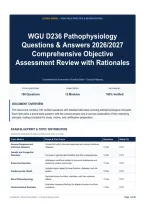
[STUDY GUIDE] • HIGH-YIELD PRACTICE & REVIEW EDITION
WGU D236 Pathophysiology
Questions & Answers 2026/2027
Comprehensive Objective
Assessment Review with Rationales
Comprehensive Examination Question Bank • Concept Mapping
TOTAL QUESTIONS EXAM TOPICS RATIONALES
150 Questions 12 Modules 100% Verified
DOCUMENT OVERVIEW
This document contains 150 verified questions with detailed rationales covering pathophysiological concepts.
Each item pairs a board-style question with the correct answer and a concise explanation of the underlying
principle, making it suitable for study, review, and certification preparation.
EXAM BLUEPRINT & TOPIC DISTRIBUTION
Systematic breakdown of subject domains and exam coverage.
Topic Module Scope & Core Focus Questions Share (%)
Immune Response and Covers the body's immune responses and various infectious
Infectious Diseases diseases. 13 Qs 8.7%
Genetic and Congenital
Disorders Focuses on genetic abnormalities and their consequences. 13 Qs 8.7%
Addresses conditions related to hormonal imbalances and
Endocrine Disorders endocrine system dysfunction. 13 Qs 8.7%
Includes topics related to heart function, diseases, and risk
Cardiovascular Health factors. 13 Qs 8.7%
Explores kidney functions, disorders, and their systemic
Renal Pathophysiology effects. 13 Qs 8.7%
Examines diseases affecting the digestive system and their
Gastrointestinal Disorders symptoms. 13 Qs 8.7%
Confidential • Student Study Edition • Practice & Review Guide Page 1 of 46
,STUDENT STUDY & MASTERY EDITION PRACTICE & REVIEW GUIDE
Cancer and Neoplasms Discusses various types of cancer and their characteristics. 12 Qs 8.0%
Focuses on conditions affecting the nervous system and their
Neurological Disorders consequences. 12 Qs 8.0%
Respiratory Conditions Covers diseases affecting the lungs and respiratory function. 12 Qs 8.0%
Musculoskeletal Disorders Addresses conditions affecting bones and muscles. 12 Qs 8.0%
Examines skin disorders and their underlying
Dermatological Conditions pathophysiology. 12 Qs 8.0%
Focuses on blood disorders and cancers affecting the
Hemato-Oncology hematologic system. 12 Qs 8.0%
Total Exam Coverage 12 Integrated Topic Modules 150 Qs 100.0%
Confidential • Student Study Edition • Practice & Review Guide Page 2 of 46
,STUDENT STUDY & MASTERY EDITION PRACTICE & REVIEW GUIDE
TOPIC 1: IMMUNE RESPONSE AND INFECTIOUS DISEASES
13 Questions • 8.7% of Exam • Covers the body's immune responses and various infectious diseases.
QUESTION 1
Describe how your body responds to an infection.
Answer: T cells produce cytokines, which stimulate B cells. B cells produce antibodies.
Rationale: T helper cells, a type of lymphocyte, release cytokines that activate B lymphocytes, prompting them to
differentiate into plasma cells and produce antigen-specific antibodies for opsonization and neutralization. This adaptive
immune response orchestrated by T and B cells targets specific pathogens.
QUESTION 2
West Nile Virus
Answer: Transmitted through the bite of an infected mosquito. Severe signs and symptoms; high fever,
headache and stiff neck.
Rationale: West Nile virus is a zoonotic arbovirus transmitted to humans via infected *Culex* mosquitoes, with severe
manifestations including encephalitis characterized by high fever, headache, and nuchal rigidity. This highlights the
vector-borne nature of the pathogen and its potential neurological sequelae.
QUESTION 3
Erythema infectiosum
Answer: A febrile upper respiratory illness in a child followed by the sudden appearance of red, flushed
cheeks, "fifth disease".
Rationale: Erythema infectiosum, commonly known as fifth disease, presents with a prodromal febrile upper respiratory
phase followed by the characteristic "slapped cheek" rash. This distinctive presentation differentiates it from other childhood
exanthems.
Confidential • Student Study Edition • Practice & Review Guide Page 3 of 46
, STUDENT STUDY & MASTERY EDITION PRACTICE & REVIEW GUIDE
QUESTION 4
Fungal infections
Answer: Superficial, localized skin conditions or deep tissue infections caused by exposure to spores may
or may not be transmitted.
Rationale: Fungal infections manifest as superficial dermatophytoses or systemic mycoses, arising from inhaled or
inoculated spores, with transmission varying by species. The key concept tested is the diverse presentation and routes of
acquisition for fungal pathogens.
QUESTION 5
Infectious disease
Answer: A disease that is caused by a pathogen and that can be spread from one individual to another.
Rationale: An infectious disease is defined by its etiology as being caused by a transmissible pathogen, distinguishing it
from non-infectious conditions. The ability to spread between individuals is a hallmark characteristic of infectious processes.
QUESTION 6
Differentiate between Innate Immunity and Adaptive Immunity
Answer: Innate immunity is the body's first line of defense against pathogens. It is general and non-specific,
which means it does not differentiate between types of pathogens. Adaptive immunity is a type of immunity
that is built up as we are exposed to diseases or get vaccinated.
Rationale: Innate immunity provides immediate, non-specific defense through physical barriers and phagocytic cells,
whereas adaptive immunity develops slower but offers specific, long-lasting protection via T and B lymphocytes and
immunological memory. This distinction highlights the sequential and specialized nature of the body's immune responses.
QUESTION 7
What are lymph nodes?
Answer: Filter interstitial fluid. Swollen glands mean you are fighting an infection.
Rationale: Lymph nodes act as filters, trapping pathogens and foreign materials in the interstitial fluid, and their
enlargement (swollen glands) indicates an active immune response to infection. This highlights the role of lymph nodes in
both filtration and immune surveillance.
Confidential • Student Study Edition • Practice & Review Guide Page 4 of 46
WGU D236 Pathophysiology
Questions & Answers 2026/2027
Comprehensive Objective
Assessment Review with Rationales
Comprehensive Examination Question Bank • Concept Mapping
TOTAL QUESTIONS EXAM TOPICS RATIONALES
150 Questions 12 Modules 100% Verified
DOCUMENT OVERVIEW
This document contains 150 verified questions with detailed rationales covering pathophysiological concepts.
Each item pairs a board-style question with the correct answer and a concise explanation of the underlying
principle, making it suitable for study, review, and certification preparation.
EXAM BLUEPRINT & TOPIC DISTRIBUTION
Systematic breakdown of subject domains and exam coverage.
Topic Module Scope & Core Focus Questions Share (%)
Immune Response and Covers the body's immune responses and various infectious
Infectious Diseases diseases. 13 Qs 8.7%
Genetic and Congenital
Disorders Focuses on genetic abnormalities and their consequences. 13 Qs 8.7%
Addresses conditions related to hormonal imbalances and
Endocrine Disorders endocrine system dysfunction. 13 Qs 8.7%
Includes topics related to heart function, diseases, and risk
Cardiovascular Health factors. 13 Qs 8.7%
Explores kidney functions, disorders, and their systemic
Renal Pathophysiology effects. 13 Qs 8.7%
Examines diseases affecting the digestive system and their
Gastrointestinal Disorders symptoms. 13 Qs 8.7%
Confidential • Student Study Edition • Practice & Review Guide Page 1 of 46
,STUDENT STUDY & MASTERY EDITION PRACTICE & REVIEW GUIDE
Cancer and Neoplasms Discusses various types of cancer and their characteristics. 12 Qs 8.0%
Focuses on conditions affecting the nervous system and their
Neurological Disorders consequences. 12 Qs 8.0%
Respiratory Conditions Covers diseases affecting the lungs and respiratory function. 12 Qs 8.0%
Musculoskeletal Disorders Addresses conditions affecting bones and muscles. 12 Qs 8.0%
Examines skin disorders and their underlying
Dermatological Conditions pathophysiology. 12 Qs 8.0%
Focuses on blood disorders and cancers affecting the
Hemato-Oncology hematologic system. 12 Qs 8.0%
Total Exam Coverage 12 Integrated Topic Modules 150 Qs 100.0%
Confidential • Student Study Edition • Practice & Review Guide Page 2 of 46
,STUDENT STUDY & MASTERY EDITION PRACTICE & REVIEW GUIDE
TOPIC 1: IMMUNE RESPONSE AND INFECTIOUS DISEASES
13 Questions • 8.7% of Exam • Covers the body's immune responses and various infectious diseases.
QUESTION 1
Describe how your body responds to an infection.
Answer: T cells produce cytokines, which stimulate B cells. B cells produce antibodies.
Rationale: T helper cells, a type of lymphocyte, release cytokines that activate B lymphocytes, prompting them to
differentiate into plasma cells and produce antigen-specific antibodies for opsonization and neutralization. This adaptive
immune response orchestrated by T and B cells targets specific pathogens.
QUESTION 2
West Nile Virus
Answer: Transmitted through the bite of an infected mosquito. Severe signs and symptoms; high fever,
headache and stiff neck.
Rationale: West Nile virus is a zoonotic arbovirus transmitted to humans via infected *Culex* mosquitoes, with severe
manifestations including encephalitis characterized by high fever, headache, and nuchal rigidity. This highlights the
vector-borne nature of the pathogen and its potential neurological sequelae.
QUESTION 3
Erythema infectiosum
Answer: A febrile upper respiratory illness in a child followed by the sudden appearance of red, flushed
cheeks, "fifth disease".
Rationale: Erythema infectiosum, commonly known as fifth disease, presents with a prodromal febrile upper respiratory
phase followed by the characteristic "slapped cheek" rash. This distinctive presentation differentiates it from other childhood
exanthems.
Confidential • Student Study Edition • Practice & Review Guide Page 3 of 46
, STUDENT STUDY & MASTERY EDITION PRACTICE & REVIEW GUIDE
QUESTION 4
Fungal infections
Answer: Superficial, localized skin conditions or deep tissue infections caused by exposure to spores may
or may not be transmitted.
Rationale: Fungal infections manifest as superficial dermatophytoses or systemic mycoses, arising from inhaled or
inoculated spores, with transmission varying by species. The key concept tested is the diverse presentation and routes of
acquisition for fungal pathogens.
QUESTION 5
Infectious disease
Answer: A disease that is caused by a pathogen and that can be spread from one individual to another.
Rationale: An infectious disease is defined by its etiology as being caused by a transmissible pathogen, distinguishing it
from non-infectious conditions. The ability to spread between individuals is a hallmark characteristic of infectious processes.
QUESTION 6
Differentiate between Innate Immunity and Adaptive Immunity
Answer: Innate immunity is the body's first line of defense against pathogens. It is general and non-specific,
which means it does not differentiate between types of pathogens. Adaptive immunity is a type of immunity
that is built up as we are exposed to diseases or get vaccinated.
Rationale: Innate immunity provides immediate, non-specific defense through physical barriers and phagocytic cells,
whereas adaptive immunity develops slower but offers specific, long-lasting protection via T and B lymphocytes and
immunological memory. This distinction highlights the sequential and specialized nature of the body's immune responses.
QUESTION 7
What are lymph nodes?
Answer: Filter interstitial fluid. Swollen glands mean you are fighting an infection.
Rationale: Lymph nodes act as filters, trapping pathogens and foreign materials in the interstitial fluid, and their
enlargement (swollen glands) indicates an active immune response to infection. This highlights the role of lymph nodes in
both filtration and immune surveillance.
Confidential • Student Study Edition • Practice & Review Guide Page 4 of 46