[STUDY GUIDE] • HIGH-YIELD PRACTICE & REVIEW EDITION
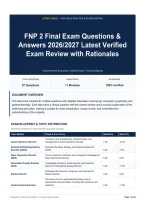
FNP 2 Final Exam Questions &
Answers 2026/2027 Latest Verified
Exam Review with Rationales
Comprehensive Examination Question Bank • Concept Mapping
TOTAL QUESTIONS EXAM TOPICS RATIONALES
67 Questions 11 Modules 100% Verified
DOCUMENT OVERVIEW
This document contains 67 verified questions with detailed rationales covering key concepts in psychiatry and
gastroenterology. Each item pairs a clinical question with the correct answer and a concise explanation of the
underlying principles, making it suitable for exam preparation, course review, and comprehensive
understanding of the subjects.
EXAM BLUEPRINT & TOPIC DISTRIBUTION
Systematic breakdown of subject domains and exam coverage.
Topic Module Scope & Core Focus Questions Share (%)
Focuses on the characteristics, clinical findings, and
Autism Spectrum Disorder management of Autism Spectrum Disorder. 7 Qs 10.4%
Attention-Deficit/Hyperactivity Examines the types, findings, and treatment options for
Disorder (ADHD) ADHD. 5 Qs 7.5%
Major Depressive Disorder Covers screening, treatment, and management strategies for
(MDD) Major Depressive Disorder. 6 Qs 9.0%
Generalized Anxiety Disorder Investigates symptoms, screening tools, and treatment
(GAD) options for Generalized Anxiety Disorder. 8 Qs 11.9%
Addresses the symptoms, diagnosis, and treatment for
Bipolar Disorder Bipolar Disorder. 4 Qs 6.0%
Discusses common gastrointestinal issues such as
appendicitis and pancreatitis, including their symptoms and
Gastrointestinal Disorders treatment. 8 Qs 11.9%
Confidential • Student Study Edition • Practice & Review Guide Page 1 of 26
,STUDENT STUDY & MASTERY EDITION PRACTICE & REVIEW GUIDE
Explores the symptoms, diagnostics, and treatment for
Cholecystitis cholecystitis. 4 Qs 6.0%
Examines causes, symptoms, and treatment protocols for
Intestinal Obstruction intestinal obstruction. 4 Qs 6.0%
Focuses on the causes, symptoms, diagnostics, and
Peptic Ulcer Disease (PUD) treatment of Peptic Ulcer Disease. 11 Qs 16.4%
Covers the risk factors, symptoms, diagnostics, and treatment
Mesenteric Ischemia for mesenteric ischemia. 5 Qs 7.5%
Examines the causes, complications, diagnostics, and clinical
Cirrhosis signs of cirrhosis. 5 Qs 7.5%
Total Exam Coverage 11 Integrated Topic Modules 67 Qs 100.0%
Confidential • Student Study Edition • Practice & Review Guide Page 2 of 26
, STUDENT STUDY & MASTERY EDITION PRACTICE & REVIEW GUIDE
TOPIC 1: AUTISM SPECTRUM DISORDER
7 Questions • 10.4% of Exam • Focuses on the characteristics, clinical findings, and management of Autism Spectrum Disorder.
QUESTION 1
Autism Spectrum Disorder (ASD) is characterized by?
Answer: 1. Deficits in social communication & interaction across multiple contexts
2. restrictive, repetitive patterns of behaviors, interests, and activities.
Rationale: Autism Spectrum Disorder is defined by persistent impairments in social communication and interaction,
alongside restricted and repetitive patterns of behavior, interests, or activities. These core diagnostic criteria distinguish ASD
from other neurodevelopmental conditions.
QUESTION 2
General clinical findings of ASD
Answer: Problems with social interactions, communication, and language skills shown by their unusual
ways of relating to people, objects & events
-abnormal responses to sensory stimuli, usually sound
-restrictive, repetitive, or stereotyped behavior and echolalic speech.
Rationale: Autism Spectrum Disorder (ASD) is characterized by persistent deficits in social communication and interaction
across multiple contexts, alongside restricted, repetitive patterns of behavior, interests, or activities, and abnormal sensory
responses. These core features manifest as challenges in reciprocal social-emotional interaction, nonverbal communicative
behaviors used for social interaction, and developing, maintaining, and understanding relationships, coupled with
stereotyped or repetitive motor movements, speech (like echolalia), or insistence on sameness.
QUESTION 3
Clinical findings of ASD in infants
Answer: Passive, non-engaging, quiet, floppy infant or a difficult, colicky, stiff baby with poor eye contact
-attachment problems, failure to respond to name or gestures.
Rationale: Autism Spectrum Disorder (ASD) in infants presents with a spectrum of social-communicative deficits,
manifesting as either hypo- or hyper-responsiveness to stimuli, leading to challenges in reciprocal interaction and
attachment. These core deficits disrupt typical infant engagement, eye contact, and responsiveness to social cues,
impacting early developmental trajectories.
Confidential • Student Study Edition • Practice & Review Guide Page 3 of 26
FNP 2 Final Exam Questions &
Answers 2026/2027 Latest Verified
Exam Review with Rationales
Comprehensive Examination Question Bank • Concept Mapping
TOTAL QUESTIONS EXAM TOPICS RATIONALES
67 Questions 11 Modules 100% Verified
DOCUMENT OVERVIEW
This document contains 67 verified questions with detailed rationales covering key concepts in psychiatry and
gastroenterology. Each item pairs a clinical question with the correct answer and a concise explanation of the
underlying principles, making it suitable for exam preparation, course review, and comprehensive
understanding of the subjects.
EXAM BLUEPRINT & TOPIC DISTRIBUTION
Systematic breakdown of subject domains and exam coverage.
Topic Module Scope & Core Focus Questions Share (%)
Focuses on the characteristics, clinical findings, and
Autism Spectrum Disorder management of Autism Spectrum Disorder. 7 Qs 10.4%
Attention-Deficit/Hyperactivity Examines the types, findings, and treatment options for
Disorder (ADHD) ADHD. 5 Qs 7.5%
Major Depressive Disorder Covers screening, treatment, and management strategies for
(MDD) Major Depressive Disorder. 6 Qs 9.0%
Generalized Anxiety Disorder Investigates symptoms, screening tools, and treatment
(GAD) options for Generalized Anxiety Disorder. 8 Qs 11.9%
Addresses the symptoms, diagnosis, and treatment for
Bipolar Disorder Bipolar Disorder. 4 Qs 6.0%
Discusses common gastrointestinal issues such as
appendicitis and pancreatitis, including their symptoms and
Gastrointestinal Disorders treatment. 8 Qs 11.9%
Confidential • Student Study Edition • Practice & Review Guide Page 1 of 26
,STUDENT STUDY & MASTERY EDITION PRACTICE & REVIEW GUIDE
Explores the symptoms, diagnostics, and treatment for
Cholecystitis cholecystitis. 4 Qs 6.0%
Examines causes, symptoms, and treatment protocols for
Intestinal Obstruction intestinal obstruction. 4 Qs 6.0%
Focuses on the causes, symptoms, diagnostics, and
Peptic Ulcer Disease (PUD) treatment of Peptic Ulcer Disease. 11 Qs 16.4%
Covers the risk factors, symptoms, diagnostics, and treatment
Mesenteric Ischemia for mesenteric ischemia. 5 Qs 7.5%
Examines the causes, complications, diagnostics, and clinical
Cirrhosis signs of cirrhosis. 5 Qs 7.5%
Total Exam Coverage 11 Integrated Topic Modules 67 Qs 100.0%
Confidential • Student Study Edition • Practice & Review Guide Page 2 of 26
, STUDENT STUDY & MASTERY EDITION PRACTICE & REVIEW GUIDE
TOPIC 1: AUTISM SPECTRUM DISORDER
7 Questions • 10.4% of Exam • Focuses on the characteristics, clinical findings, and management of Autism Spectrum Disorder.
QUESTION 1
Autism Spectrum Disorder (ASD) is characterized by?
Answer: 1. Deficits in social communication & interaction across multiple contexts
2. restrictive, repetitive patterns of behaviors, interests, and activities.
Rationale: Autism Spectrum Disorder is defined by persistent impairments in social communication and interaction,
alongside restricted and repetitive patterns of behavior, interests, or activities. These core diagnostic criteria distinguish ASD
from other neurodevelopmental conditions.
QUESTION 2
General clinical findings of ASD
Answer: Problems with social interactions, communication, and language skills shown by their unusual
ways of relating to people, objects & events
-abnormal responses to sensory stimuli, usually sound
-restrictive, repetitive, or stereotyped behavior and echolalic speech.
Rationale: Autism Spectrum Disorder (ASD) is characterized by persistent deficits in social communication and interaction
across multiple contexts, alongside restricted, repetitive patterns of behavior, interests, or activities, and abnormal sensory
responses. These core features manifest as challenges in reciprocal social-emotional interaction, nonverbal communicative
behaviors used for social interaction, and developing, maintaining, and understanding relationships, coupled with
stereotyped or repetitive motor movements, speech (like echolalia), or insistence on sameness.
QUESTION 3
Clinical findings of ASD in infants
Answer: Passive, non-engaging, quiet, floppy infant or a difficult, colicky, stiff baby with poor eye contact
-attachment problems, failure to respond to name or gestures.
Rationale: Autism Spectrum Disorder (ASD) in infants presents with a spectrum of social-communicative deficits,
manifesting as either hypo- or hyper-responsiveness to stimuli, leading to challenges in reciprocal interaction and
attachment. These core deficits disrupt typical infant engagement, eye contact, and responsiveness to social cues,
impacting early developmental trajectories.
Confidential • Student Study Edition • Practice & Review Guide Page 3 of 26