
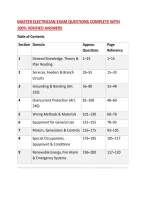
MASTER ELECTRICIAN EXAM QUESTIONS COMPLETE WITH
100% VERIFIED ANSWERS
Table of Contents
Section Domain Approx. Page
Questions Reference
1 General Knowledge, Theory & 1–25 1–15
Plan Reading
2 Services, Feeders & Branch 26–55 15–33
Circuits
3 Grounding & Bonding (Art. 56–80 33–48
250)
4 Overcurrent Protection (Art. 81–100 48–60
240)
5 Wiring Methods & Materials 101–130 60–78
6 Equipment for General Use 131–155 78–93
7 Motors, Generators & Controls 156–175 93–105
8 Special Occupancies, 176–195 105–117
Equipment & Conditions
9 Renewable Energy, Fire Alarm 196–200 117–120
& Emergency Systems
,SECTION 1: GENERAL KNOWLEDGE, THEORY & PLAN READING
(Questions 1–25)
Question 1
Which of the following is the correct formula for calculating electrical
power in a DC circuit?
A. P = I²/R
B. P = V × I
C. P = V² × I
D. P = I/V
Correct Answer: B
Rationale: Power in a DC circuit is calculated using the formula P = V × I,
where P is power in watts, V is voltage in volts, and I is current in
amperes. This is a fundamental relationship in electrical theory derived
from Ohm's Law.
Question 2
The unit of electrical resistance is the:
A. Volt
B. Ampere
C. Ohm
D. Watt
Correct Answer: C
Rationale: Resistance is measured in ohms (Ω). One ohm is defined as
the resistance between two points on a conductor when a potential
difference of one volt produces a current of one ampere.
,Question 3
In a parallel circuit, the total resistance is always:
A. Greater than the largest resistor
B. Equal to the sum of all resistors
C. Less than the smallest resistor
D. Equal to the average of all resistors
Correct Answer: C
Rationale: In a parallel circuit, the total resistance is always less than
the smallest individual resistance. This is because the total current has
multiple paths to flow through, effectively reducing the overall
opposition to current flow.
Question 4
A 240-volt load drawing 15 amperes consumes how many watts?
A. 1,600 W
B. 3,600 W
C. 16 W
D. 36,000 W
Correct Answer: B
Rationale: Power is calculated as P = V × I = 240 V × 15 A = 3,600 W. This
is a fundamental power calculation used throughout electrical work.
, Question 5
What is the impedance of a circuit with a resistance of 8 ohms and an
inductive reactance of 6 ohms?
A. 14 ohms
B. 2 ohms
C. 10 ohms
D. 48 ohms
Correct Answer: C
Rationale: Impedance is calculated using the Pythagorean theorem: Z =
√(R² + XL²) = √(8² + 6²) = √(64 + 36) = √100 = 10 ohms. This formula
accounts for the phase relationship between resistance and reactance
in AC circuits.
Question 6
Power factor is defined as:
A. Voltage divided by current
B. Real power divided by apparent power
C. Resistance divided by impedance
D. Both B and C are correct
Correct Answer: D
Rationale: Power factor is the ratio of real power (watts) to apparent
power (volt-amperes), and it is also mathematically equal to resistance
divided by impedance in a series circuit. Both definitions are correct
expressions of the same concept.
100% VERIFIED ANSWERS
Table of Contents
Section Domain Approx. Page
Questions Reference
1 General Knowledge, Theory & 1–25 1–15
Plan Reading
2 Services, Feeders & Branch 26–55 15–33
Circuits
3 Grounding & Bonding (Art. 56–80 33–48
250)
4 Overcurrent Protection (Art. 81–100 48–60
240)
5 Wiring Methods & Materials 101–130 60–78
6 Equipment for General Use 131–155 78–93
7 Motors, Generators & Controls 156–175 93–105
8 Special Occupancies, 176–195 105–117
Equipment & Conditions
9 Renewable Energy, Fire Alarm 196–200 117–120
& Emergency Systems
,SECTION 1: GENERAL KNOWLEDGE, THEORY & PLAN READING
(Questions 1–25)
Question 1
Which of the following is the correct formula for calculating electrical
power in a DC circuit?
A. P = I²/R
B. P = V × I
C. P = V² × I
D. P = I/V
Correct Answer: B
Rationale: Power in a DC circuit is calculated using the formula P = V × I,
where P is power in watts, V is voltage in volts, and I is current in
amperes. This is a fundamental relationship in electrical theory derived
from Ohm's Law.
Question 2
The unit of electrical resistance is the:
A. Volt
B. Ampere
C. Ohm
D. Watt
Correct Answer: C
Rationale: Resistance is measured in ohms (Ω). One ohm is defined as
the resistance between two points on a conductor when a potential
difference of one volt produces a current of one ampere.
,Question 3
In a parallel circuit, the total resistance is always:
A. Greater than the largest resistor
B. Equal to the sum of all resistors
C. Less than the smallest resistor
D. Equal to the average of all resistors
Correct Answer: C
Rationale: In a parallel circuit, the total resistance is always less than
the smallest individual resistance. This is because the total current has
multiple paths to flow through, effectively reducing the overall
opposition to current flow.
Question 4
A 240-volt load drawing 15 amperes consumes how many watts?
A. 1,600 W
B. 3,600 W
C. 16 W
D. 36,000 W
Correct Answer: B
Rationale: Power is calculated as P = V × I = 240 V × 15 A = 3,600 W. This
is a fundamental power calculation used throughout electrical work.
, Question 5
What is the impedance of a circuit with a resistance of 8 ohms and an
inductive reactance of 6 ohms?
A. 14 ohms
B. 2 ohms
C. 10 ohms
D. 48 ohms
Correct Answer: C
Rationale: Impedance is calculated using the Pythagorean theorem: Z =
√(R² + XL²) = √(8² + 6²) = √(64 + 36) = √100 = 10 ohms. This formula
accounts for the phase relationship between resistance and reactance
in AC circuits.
Question 6
Power factor is defined as:
A. Voltage divided by current
B. Real power divided by apparent power
C. Resistance divided by impedance
D. Both B and C are correct
Correct Answer: D
Rationale: Power factor is the ratio of real power (watts) to apparent
power (volt-amperes), and it is also mathematically equal to resistance
divided by impedance in a series circuit. Both definitions are correct
expressions of the same concept.


