
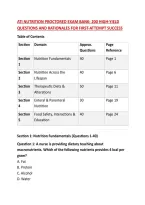
ATI NUTRITION PROCTORED EXAM BANK: 200 HIGH-YIELD
QUESTIONS AND RATIONALES FOR FIRST-ATTEMPT SUCCESS
Table of Contents
Section Domain Approx. Page
Questions Reference
Section Nutrition Fundamentals 40 Page 1
1
Section Nutrition Across the 40 Page 6
2 Lifespan
Section Therapeutic Diets & 50 Page 11
3 Alterations
Section Enteral & Parenteral 30 Page 19
4 Nutrition
Section Food Safety, Interactions & 40 Page 24
5 Education
Section 1: Nutrition Fundamentals (Questions 1-40)
Question 1: A nurse is providing dietary teaching about
macronutrients. Which of the following nutrients provides 4 kcal per
gram?
A. Fat
B. Protein
C. Alcohol
D. Water
,Correct Answer: B
Rationale: Protein and carbohydrates provide 4 kcal/g, fat provides 9
kcal/g, and alcohol provides 7 kcal/g.
Question 2: A nurse is reviewing the function of carbohydrates in the
body. Which of the following is the primary role of carbohydrates?
A. Building muscle tissue
B. Providing the body's main source of energy
C. Insulating vital organs
D. Transporting vitamins
Correct Answer: B
Rationale: Carbohydrates are the body's primary and most efficient
source of energy, broken down into glucose.
Question 3: A client asks the nurse about complete proteins. Which of
the following foods should the nurse identify as a complete protein?
A. Beans
B. Rice
C. Eggs
D. Nuts
Correct Answer: C
Rationale: Eggs are a complete protein because they contain all nine
essential amino acids.
Question 4: A nurse is teaching a client about fat-soluble vitamins.
Which of the following vitamins should the nurse include in the
teaching?
A. Vitamin C
B. Vitamin B12
C. Vitamin D
,D. Folate
Correct Answer: C
Rationale: Vitamins A, D, E, and K are fat-soluble, while the B-complex
vitamins and Vitamin C are water-soluble.
Question 5: A nurse is assessing a client for potential toxicity. Which of
the following vitamins poses a risk for toxicity when taken in excess?
A. Vitamin C
B. Vitamin B6
C. Vitamin A
D. Folate
Correct Answer: C
Rationale: Fat-soluble vitamins (A, D, E, K) are stored in the body and
can accumulate to toxic levels, unlike water-soluble vitamins.
Question 6: A nurse is discussing dietary fiber with a client. Which of
the following statements by the client indicates an understanding of
soluble fiber?
A. "It helps lower blood cholesterol levels."
B. "It adds bulk to the stool to prevent constipation."
C. "It is found primarily in wheat bran."
D. "It slows down glucose absorption."
Correct Answer: A
Rationale: Soluble fiber dissolves in water, forms a gel, and helps lower
blood cholesterol and glucose levels.
Question 7: A nurse is explaining the role of iron in the body. Which of
the following functions should the nurse include?
A. Blood clotting
B. Oxygen transport
, C. Bone formation
D. Fluid balance
Correct Answer: B
Rationale: Iron is a critical component of hemoglobin, which carries
oxygen from the lungs to the tissues.
Question 8: A client is prescribed a potassium-restricted diet. Which of
the following foods should the nurse instruct the client to avoid?
A. Apples
B. Bananas
C. White bread
D. Green beans
Correct Answer: B
Rationale: Bananas are high in potassium, whereas apples, white bread,
and green beans are low-potassium options.
Question 9: A nurse is teaching a client about calcium sources. Which
of the following foods should the nurse recommend as the best source
of calcium?
A. Spinach
B. Yogurt
C. Chicken breast
D. Brown rice
Correct Answer: B
Rationale: Dairy products like yogurt are excellent sources of
bioavailable calcium, whereas spinach contains oxalates that inhibit
calcium absorption.
Question 10: A nurse is reviewing the digestive process with a client.
Where does the majority of nutrient absorption occur?
QUESTIONS AND RATIONALES FOR FIRST-ATTEMPT SUCCESS
Table of Contents
Section Domain Approx. Page
Questions Reference
Section Nutrition Fundamentals 40 Page 1
1
Section Nutrition Across the 40 Page 6
2 Lifespan
Section Therapeutic Diets & 50 Page 11
3 Alterations
Section Enteral & Parenteral 30 Page 19
4 Nutrition
Section Food Safety, Interactions & 40 Page 24
5 Education
Section 1: Nutrition Fundamentals (Questions 1-40)
Question 1: A nurse is providing dietary teaching about
macronutrients. Which of the following nutrients provides 4 kcal per
gram?
A. Fat
B. Protein
C. Alcohol
D. Water
,Correct Answer: B
Rationale: Protein and carbohydrates provide 4 kcal/g, fat provides 9
kcal/g, and alcohol provides 7 kcal/g.
Question 2: A nurse is reviewing the function of carbohydrates in the
body. Which of the following is the primary role of carbohydrates?
A. Building muscle tissue
B. Providing the body's main source of energy
C. Insulating vital organs
D. Transporting vitamins
Correct Answer: B
Rationale: Carbohydrates are the body's primary and most efficient
source of energy, broken down into glucose.
Question 3: A client asks the nurse about complete proteins. Which of
the following foods should the nurse identify as a complete protein?
A. Beans
B. Rice
C. Eggs
D. Nuts
Correct Answer: C
Rationale: Eggs are a complete protein because they contain all nine
essential amino acids.
Question 4: A nurse is teaching a client about fat-soluble vitamins.
Which of the following vitamins should the nurse include in the
teaching?
A. Vitamin C
B. Vitamin B12
C. Vitamin D
,D. Folate
Correct Answer: C
Rationale: Vitamins A, D, E, and K are fat-soluble, while the B-complex
vitamins and Vitamin C are water-soluble.
Question 5: A nurse is assessing a client for potential toxicity. Which of
the following vitamins poses a risk for toxicity when taken in excess?
A. Vitamin C
B. Vitamin B6
C. Vitamin A
D. Folate
Correct Answer: C
Rationale: Fat-soluble vitamins (A, D, E, K) are stored in the body and
can accumulate to toxic levels, unlike water-soluble vitamins.
Question 6: A nurse is discussing dietary fiber with a client. Which of
the following statements by the client indicates an understanding of
soluble fiber?
A. "It helps lower blood cholesterol levels."
B. "It adds bulk to the stool to prevent constipation."
C. "It is found primarily in wheat bran."
D. "It slows down glucose absorption."
Correct Answer: A
Rationale: Soluble fiber dissolves in water, forms a gel, and helps lower
blood cholesterol and glucose levels.
Question 7: A nurse is explaining the role of iron in the body. Which of
the following functions should the nurse include?
A. Blood clotting
B. Oxygen transport
, C. Bone formation
D. Fluid balance
Correct Answer: B
Rationale: Iron is a critical component of hemoglobin, which carries
oxygen from the lungs to the tissues.
Question 8: A client is prescribed a potassium-restricted diet. Which of
the following foods should the nurse instruct the client to avoid?
A. Apples
B. Bananas
C. White bread
D. Green beans
Correct Answer: B
Rationale: Bananas are high in potassium, whereas apples, white bread,
and green beans are low-potassium options.
Question 9: A nurse is teaching a client about calcium sources. Which
of the following foods should the nurse recommend as the best source
of calcium?
A. Spinach
B. Yogurt
C. Chicken breast
D. Brown rice
Correct Answer: B
Rationale: Dairy products like yogurt are excellent sources of
bioavailable calcium, whereas spinach contains oxalates that inhibit
calcium absorption.
Question 10: A nurse is reviewing the digestive process with a client.
Where does the majority of nutrient absorption occur?


