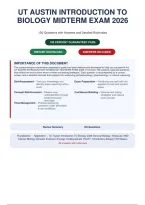
UT AUSTIN INTRODUCTION TO
BIOLOGY MIDTERM EXAM 2026
150 Questions with Answers and Detailed Rationales
100 PERCENT GUARANTEED PASS
INSTANT DOWNLOAD ANSWERS INCLUDED
IMPORTANCE OF THIS DOCUMENT
This comprehensive examination preparation guide has been meticulously developed to help you succeed in the
UT AUSTIN INTRODUCTION TO BIOLOGY MIDTERM EXAM 2026. It contains 150 carefully selected questions
that reflect the most current exam content and testing strategies. Each question is accompanied by a correct
answer and a detailed rationale that explains the underlying pathophysiology, pharmacology, or clinical reasoning.
Self-Assessment – Test your knowledge and Exam Preparation – Familiarize yourself with the
identify areas requiring further question format and content
study areas
Concept Reinforcement – Deepen your Confidence Building – Develop test-taking
understanding through strategies and reduce
evidence-based exam anxiety
rationales
Time Management – Practice answering
questions under simulated
exam conditions
Review Summary 150 Questions
Foundations - Application - UT Austin Introduction TO Biology 2026 General Biology / Molecular AND
Cellular Biology Genetics Evolution Ecology Undergraduate YEAR 1 Introductory Biology FOR Majors
All answers with rationales
,Table of Contents
Content Area Questions Key Topics
Chemistry OF LIFE 1-25 Likely, Cells, Polypeptide, Enzyme, Plant
CELL Structure AND 26-50 Expected, Population, Solution, Recessive, Heterozygous
Function
Cellular Respiration AND 51-75 Solution, Researcher, Population, Placed, Heterozygous
Metabolism
Photosynthesis 76-100 Cells, Likely, Receptor, Mutation, Changes
CELL Communication AND 101-125 Solution, Heterozygous, Describes, Protein, Placed
THE CELL Cycle
Mendelian Genetics AND 126-150 Recessive, Explains, Frequency, Heterozygous, Individuals
Inheritance
TOTAL 150 All questions include answers and detailed rationales
,Section A - Chemistry OF LIFE
Q1.
A newly synthesized polypeptide contains a stretch of hydrophobic amino acids near its
N-terminus. Where is this polypeptide most likely to be localized during its initial
synthesis in a eukaryotic cell?
A. Cytosol B. Rough endoplasmic reticulum lumen
C. Mitochondrial matrix D. Nucleus
Correct: B - Rough endoplasmic reticulum lumen
Rationale:A hydrophobic N-terminal signal sequence directs the ribosome to the rough ER,
where the polypeptide is co-translationally translocated into the ER lumen. Cytosolic proteins
typically lack such signal sequences, and nuclear and mitochondrial targeting use different
import mechanisms.
Why the other answers are wrong:
A. Cytosolic proteins generally lack an N-terminal hydrophobic signal sequence and are
synthesized on free ribosomes.
C. Mitochondrial matrix proteins use amphipathic N-terminal presequences and are imported
post-translationally, not co-translationally into the ER.
D. Nuclear proteins are imported post-translationally through nuclear pore complexes using
nuclear localization signals, not an ER signal sequence.
Reference: Alberts et al. (2022). Molecular Biology of the Cell, 7th Ed., Ch. 12.
Q2.
In a classic experiment, a plant cell is placed in a hypertonic solution. Which of the
following best describes the immediate effect on the cell?
A. The cell will swell and potentially lyse due B. The cell will shrivel as water exits, but the
to water influx. cell wall prevents lysis.
C. The cell will remain unchanged because D. The cell will actively pump water out to
the cell wall is impermeable to water. maintain turgor pressure.
Correct: B - The cell will shrivel as water exits, but the cell wall prevents lysis.
Rationale:In a hypertonic solution, water exits the cell by osmosis, causing the protoplast to
shrink (plasmolysis). The rigid cell wall prevents the cell from lysing, unlike animal cells.
Why the other answers are wrong:
A. Swelling and lysis occur in hypotonic solutions, not hypertonic ones.
C. The cell wall is permeable to water; the cell will lose water and shrivel.
D. Plants do not actively pump water; water movement is passive via osmosis.
Page 3
, Section A - Chemistry OF LIFE
Reference: Campbell Biology, 12th Ed., Ch. 7.
Q3.
A researcher treats cells with a drug that inhibits the enzyme enolase in glycolysis. Which
of the following metabolic intermediates would you expect to accumulate?
A. Glucose-6-phosphate B. Fructose-1,6-bisphosphate
C. 2-phosphoglycerate D. Pyruvate
Correct: C - 2-phosphoglycerate
Rationale:Enolase converts 2-phosphoglycerate to phosphoenolpyruvate (PEP). Inhibiting
enolase would cause accumulation of its substrate, 2-phosphoglycerate.
Glucose-6-phosphate and fructose-1,6-bisphosphate are upstream intermediates and would
not accumulate if the pathway is blocked downstream.
Why the other answers are wrong:
A. Glucose-6-phosphate is an upstream intermediate; its levels would not necessarily increase
if enolase is inhibited.
B. Fructose-1,6-bisphosphate is upstream of enolase and would not accumulate due to a
downstream block.
D. Pyruvate is downstream of enolase; its production would decrease, not increase.
Reference: Lehninger Principles of Biochemistry, 8th Ed., Ch. 14.
Q4.
A cell is treated with a drug that prevents the phosphorylation of GDP to GTP on the Ras
protein. What is the most likely consequence for a growth factor signaling pathway?
A. Ras remains active, leading to continuous B. Ras remains inactive, blocking
cell proliferation. downstream MAP kinase signaling.
C. Ras is degraded, causing apoptosis. D. Ras directly activates adenylyl cyclase,
increasing cAMP.
Correct: B - Ras remains inactive, blocking downstream MAP kinase signaling.
Rationale:Ras is active when bound to GTP. Preventing GTP loading keeps Ras in its
inactive GDP-bound state, halting downstream signaling including the MAP kinase cascade.
Continuous activation would occur if GTP hydrolysis were blocked, not GTP binding.
Why the other answers are wrong:
A. Continuous activation results from impaired GTP hydrolysis, not from preventing GTP
binding.
C. Ras is not typically degraded upon inactivation; it remains in the GDP-bound state.
D. Ras does not directly activate adenylyl cyclase; that is typically a G-protein coupled receptor
pathway.
Page 4
BIOLOGY MIDTERM EXAM 2026
150 Questions with Answers and Detailed Rationales
100 PERCENT GUARANTEED PASS
INSTANT DOWNLOAD ANSWERS INCLUDED
IMPORTANCE OF THIS DOCUMENT
This comprehensive examination preparation guide has been meticulously developed to help you succeed in the
UT AUSTIN INTRODUCTION TO BIOLOGY MIDTERM EXAM 2026. It contains 150 carefully selected questions
that reflect the most current exam content and testing strategies. Each question is accompanied by a correct
answer and a detailed rationale that explains the underlying pathophysiology, pharmacology, or clinical reasoning.
Self-Assessment – Test your knowledge and Exam Preparation – Familiarize yourself with the
identify areas requiring further question format and content
study areas
Concept Reinforcement – Deepen your Confidence Building – Develop test-taking
understanding through strategies and reduce
evidence-based exam anxiety
rationales
Time Management – Practice answering
questions under simulated
exam conditions
Review Summary 150 Questions
Foundations - Application - UT Austin Introduction TO Biology 2026 General Biology / Molecular AND
Cellular Biology Genetics Evolution Ecology Undergraduate YEAR 1 Introductory Biology FOR Majors
All answers with rationales
,Table of Contents
Content Area Questions Key Topics
Chemistry OF LIFE 1-25 Likely, Cells, Polypeptide, Enzyme, Plant
CELL Structure AND 26-50 Expected, Population, Solution, Recessive, Heterozygous
Function
Cellular Respiration AND 51-75 Solution, Researcher, Population, Placed, Heterozygous
Metabolism
Photosynthesis 76-100 Cells, Likely, Receptor, Mutation, Changes
CELL Communication AND 101-125 Solution, Heterozygous, Describes, Protein, Placed
THE CELL Cycle
Mendelian Genetics AND 126-150 Recessive, Explains, Frequency, Heterozygous, Individuals
Inheritance
TOTAL 150 All questions include answers and detailed rationales
,Section A - Chemistry OF LIFE
Q1.
A newly synthesized polypeptide contains a stretch of hydrophobic amino acids near its
N-terminus. Where is this polypeptide most likely to be localized during its initial
synthesis in a eukaryotic cell?
A. Cytosol B. Rough endoplasmic reticulum lumen
C. Mitochondrial matrix D. Nucleus
Correct: B - Rough endoplasmic reticulum lumen
Rationale:A hydrophobic N-terminal signal sequence directs the ribosome to the rough ER,
where the polypeptide is co-translationally translocated into the ER lumen. Cytosolic proteins
typically lack such signal sequences, and nuclear and mitochondrial targeting use different
import mechanisms.
Why the other answers are wrong:
A. Cytosolic proteins generally lack an N-terminal hydrophobic signal sequence and are
synthesized on free ribosomes.
C. Mitochondrial matrix proteins use amphipathic N-terminal presequences and are imported
post-translationally, not co-translationally into the ER.
D. Nuclear proteins are imported post-translationally through nuclear pore complexes using
nuclear localization signals, not an ER signal sequence.
Reference: Alberts et al. (2022). Molecular Biology of the Cell, 7th Ed., Ch. 12.
Q2.
In a classic experiment, a plant cell is placed in a hypertonic solution. Which of the
following best describes the immediate effect on the cell?
A. The cell will swell and potentially lyse due B. The cell will shrivel as water exits, but the
to water influx. cell wall prevents lysis.
C. The cell will remain unchanged because D. The cell will actively pump water out to
the cell wall is impermeable to water. maintain turgor pressure.
Correct: B - The cell will shrivel as water exits, but the cell wall prevents lysis.
Rationale:In a hypertonic solution, water exits the cell by osmosis, causing the protoplast to
shrink (plasmolysis). The rigid cell wall prevents the cell from lysing, unlike animal cells.
Why the other answers are wrong:
A. Swelling and lysis occur in hypotonic solutions, not hypertonic ones.
C. The cell wall is permeable to water; the cell will lose water and shrivel.
D. Plants do not actively pump water; water movement is passive via osmosis.
Page 3
, Section A - Chemistry OF LIFE
Reference: Campbell Biology, 12th Ed., Ch. 7.
Q3.
A researcher treats cells with a drug that inhibits the enzyme enolase in glycolysis. Which
of the following metabolic intermediates would you expect to accumulate?
A. Glucose-6-phosphate B. Fructose-1,6-bisphosphate
C. 2-phosphoglycerate D. Pyruvate
Correct: C - 2-phosphoglycerate
Rationale:Enolase converts 2-phosphoglycerate to phosphoenolpyruvate (PEP). Inhibiting
enolase would cause accumulation of its substrate, 2-phosphoglycerate.
Glucose-6-phosphate and fructose-1,6-bisphosphate are upstream intermediates and would
not accumulate if the pathway is blocked downstream.
Why the other answers are wrong:
A. Glucose-6-phosphate is an upstream intermediate; its levels would not necessarily increase
if enolase is inhibited.
B. Fructose-1,6-bisphosphate is upstream of enolase and would not accumulate due to a
downstream block.
D. Pyruvate is downstream of enolase; its production would decrease, not increase.
Reference: Lehninger Principles of Biochemistry, 8th Ed., Ch. 14.
Q4.
A cell is treated with a drug that prevents the phosphorylation of GDP to GTP on the Ras
protein. What is the most likely consequence for a growth factor signaling pathway?
A. Ras remains active, leading to continuous B. Ras remains inactive, blocking
cell proliferation. downstream MAP kinase signaling.
C. Ras is degraded, causing apoptosis. D. Ras directly activates adenylyl cyclase,
increasing cAMP.
Correct: B - Ras remains inactive, blocking downstream MAP kinase signaling.
Rationale:Ras is active when bound to GTP. Preventing GTP loading keeps Ras in its
inactive GDP-bound state, halting downstream signaling including the MAP kinase cascade.
Continuous activation would occur if GTP hydrolysis were blocked, not GTP binding.
Why the other answers are wrong:
A. Continuous activation results from impaired GTP hydrolysis, not from preventing GTP
binding.
C. Ras is not typically degraded upon inactivation; it remains in the GDP-bound state.
D. Ras does not directly activate adenylyl cyclase; that is typically a G-protein coupled receptor
pathway.
Page 4