
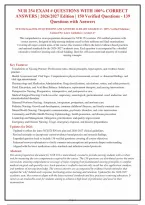
,Keywords:
NUR 254, nursing exam prep, NCLEX-style questions, medical-surgical nursing, pharmacology, health
assessment, maternal-newborn, pediatric nursing, mental health, evidence-based practice
Answer Format:
Each question is presented in a multiple-choice format with four options. The correct answer is clearly indicated,
followed by a detailed rationale explaining why it is correct and why the other options are incorrect. This format
promotes critical thinking and helps students understand the underlying concepts.
Compliance Checklist:
All questions aligned with NUR 254 course objectives and AACN essentials.
Answers verified against current nursing textbooks and evidence-based guidelines.
Rationales provided for every correct and incorrect option.
Content reflects the latest NCLEX-RN test plan and 2026-2027 standards.
Questions are free from bias and culturally sensitive.
Document is formatted for easy navigation and study.
Content Area Overview:
Content Area Questions Key Topics Weight
Foundations of Nursing 1-15 Professional roles, ethics, legal issues, 10%
evidence-based practice
Health Assessment 16-30 Physical assessment, vital signs, normal vs. 10%
abnormal findings
Pharmacology 31-45 Drug classifications, calculations, 10%
administration, safety
Fluid & Electrolytes 46-55 Imbalances, replacement therapy, acid-base 7%
balance
Perioperative Nursing 56-65 Preoperative, intraoperative, postoperative 7%
care
Medical-Surgical Nursing 66-100 Cardiovascular, respiratory, neurological, 23%
GI, renal, endocrine, musculoskeletal
Maternal-Newborn Nursing 101-115 Antepartum, intrapartum, postpartum, 10%
newborn care
Pediatric Nursing 116-125 Growth & development, common illnesses, 7%
family-centered care
Mental Health Nursing 126-135 Therapeutic communication, psychiatric 7%
disorders, crisis intervention
Community & Public Health 136-142 Epidemiology, health promotion, disease 5%
prevention
Leadership & Management 143-147 Delegation, prioritization, quality 3%
improvement
Emergency & Disaster Nursing 148-150 Triage, emergency response, disaster 1%
preparedness
Page 2
,Q1. A patient with septic shock is on a norepinephrine infusion titrated to a mean
arterial pressure (MAP) of 65 mm Hg. The nurse notes the cardiac output is 3.2
L/min, systemic vascular resistance (SVR) is 1800 dynes/sec/cm-5, and central venous
oxygen saturation (ScvO2) is 58%. Which intervention is most appropriate?
A. Increase norepinephrine to achieve MAP >70 mm Hg.
B. Initiate dobutamine infusion to improve cardiac output.
C. Administer a fluid bolus of 500 mL crystalloid.
D. Decrease norepinephrine to reduce excessive afterload.
Correct Answer: B. Initiate dobutamine infusion to improve cardiac output.
Rationale: The patient has high SVR and low cardiac output with low ScvO2, indicating
inadequate tissue perfusion despite adequate MAP. Dobutamine increases cardiac
contractility and improves oxygen delivery. Increasing norepinephrine would worsen
vasoconstriction and further reduce cardiac output. Fluid bolus may be considered if
preload is inadequate, but the high SVR suggests vasoconstriction, not hypovolemia.
Decreasing norepinephrine would lower MAP and worsen perfusion.
Why Wrong:
A - Increasing norepinephrine would exacerbate the already high SVR and further
impair cardiac output.
C - The high SVR and low cardiac output suggest a cardiogenic component rather
than hypovolemia, so additional fluids are less likely to be the primary intervention.
D - Decreasing norepinephrine would drop MAP below the goal, compromising
perfusion pressure.
Reference: Urden, L.D., Stacy, K.M., & Lough, M.E. (2024). Critical Care Nursing:
Diagnosis and Management, 9th ed., Ch. 16.
Q2. A nurse is caring for a patient with diabetic ketoacidosis (DKA) who has an
initial serum potassium of 5.2 mEq/L. After initiating insulin infusion and IV fluids,
the nurse reviews the next potassium level. Which finding necessitates immediate
intervention?
A. Serum potassium of 4.5 mEq/L
B. Serum potassium of 3.8 mEq/L
C. Serum potassium of 3.0 mEq/L
D. Serum potassium of 5.0 mEq/L
Correct Answer: C. Serum potassium of 3.0 mEq/L
Rationale: In DKA, total body potassium is depleted despite an initially elevated serum
level. As insulin drives potassium into cells and fluids dilute the serum, potassium levels
can fall rapidly. A level of 3.0 mEq/L indicates hypokalemia, which can precipitate
life-threatening dysrhythmias and must be corrected before or concurrently with insulin
administration. Levels of 4.5 and 3.8 are within acceptable ranges, and 5.0 is slightly
elevated but not the most urgent.
Page 3
, Why Wrong:
A - 4.5 mEq/L is within normal limits and does not require immediate intervention.
B - 3.8 mEq/L is slightly low but not critical; however, it is not the most urgent
finding.
D - 5.0 mEq/L is mildly elevated but expected initially in DKA and does not require
emergent action.
Reference: American Diabetes Association. (2024). Standards of Care in Diabetes-2024.
Diabetes Care, 47(Suppl 1).
Q3. A patient with acute respiratory distress syndrome (ARDS) is on
volume-controlled ventilation with a tidal volume of 6 mL/kg ideal body weight. The
plateau pressure is 32 cm H2O, and the PaO2/FiO2 ratio is 120. The provider orders
an increase in positive end-expiratory pressure (PEEP). The nurse understands that
this intervention may improve oxygenation by which mechanism?
A. Decreasing alveolar dead space
B. Recruiting collapsed alveoli and improving ventilation-perfusion matching
C. Increasing cardiac output and oxygen delivery
D. Reducing pulmonary vascular resistance
Correct Answer: B. Recruiting collapsed alveoli and improving ventilation-perfusion
matching
Rationale: In ARDS, alveoli collapse and fill with fluid, causing shunt and hypoxemia.
Increasing PEEP recruits collapsed alveoli, improves functional residual capacity, and
enhances ventilation-perfusion matching, thereby increasing PaO2. PEEP does not
primarily decrease dead space (that is achieved by reducing overdistension). PEEP can
decrease cardiac output due to increased intrathoracic pressure, and its effect on
pulmonary vascular resistance is variable, not the primary mechanism.
Why Wrong:
A - PEEP may actually increase alveolar dead space by overdistending normal alveoli.
C - PEEP often decreases cardiac output due to reduced venous return.
D - PEEP may increase pulmonary vascular resistance, not reduce it.
Reference: Acute Respiratory Distress Syndrome Network. (2000). Ventilation with lower
tidal volumes. NEJM, 342(18), 1301-1308.
Q4. A nurse is preparing to administer a continuous infusion of heparin for a patient
with a pulmonary embolism. The activated partial thromboplastin time (aPTT) result
is 45 seconds (control 30 seconds). According to the weight-based nomogram, the
infusion rate should be adjusted. Which action is most appropriate?
A. Increase the infusion rate by 2 units/kg/hr
B. Decrease the infusion rate by 2 units/kg/hr
Page 4


