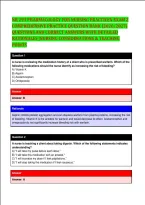
NR 293 PHARMACOLOGY FOR NURSING PRACTICEN EXAM 2
COMPREHENSIVE PRACTICE QUESTION BANK (2026/2027)
QUESTIONS AND CORRECT ANSWERS WITH DETAILED
RATIONALES |NURSING CONSIDERATIONS & TEACHING
POINTS
Question 1
A nurse is reviewing the medication history of a client who is prescribed warfarin. Which of the
following medications should the nurse identify as increasing the risk of bleeding?
A) Vitamin K
B) Aspirin
C) Acetaminophen
D) Omeprazole
Answer
Answer: B
Rationale
Aspirin inhibits platelet aggregation and can displace warfarin from plasma proteins, increasing the risk
of bleeding. Vitamin K is the antidote for warfarin and would decrease its effect. Acetaminophen and
omeprazole do not significantly increase bleeding risk with warfarin.
Question 2
A nurse is teaching a client about taking digoxin. Which of the following statements indicates
understanding?
A) "I will take my pulse before each dose."
B) "I will take this medication with an antacid."
C) "I will increase my dose if I feel palpitations."
D) "I will stop taking the medication if I feel nauseous."
Answer
Answer: A
,Rationale
Clients taking digoxin should monitor their pulse and hold the medication if the heart rate is below 60
beats per minute in adults. Antacids decrease digoxin absorption. Dose changes require provider
guidance. Nausea is a sign of toxicity and should be reported, not a reason to stop the medication
independently.
Question 3
A nurse is caring for a client who is receiving heparin. Which of the following laboratory values
should the nurse monitor?
A) PT/INR
B) aPTT
C) Platelet count
D) Bleeding time
Answer
Answer: B
Rationale
The activated partial thromboplastin time (aPTT) is used to monitor heparin therapy. Therapeutic
levels are typically 1.5 to 2.5 times the control. PT/INR monitors warfarin. Platelet count monitors for
heparin-induced thrombocytopenia but is not the primary efficacy parameter.
Question 4
A nurse is administering insulin glargine. Which of the following actions should the nurse
take?
A) Administer intravenously
B) Administer subcutaneously once daily
C) Administer with meals
D) Administer only when blood glucose is elevated
Answer
Answer: B
Rationale
2
,Insulin glargine is a long-acting basal insulin administered subcutaneously once daily at the same time
each day. It should not be mixed with other insulins or given intravenously.
Question 5
A client is prescribed metformin. Which of the following laboratory values should the nurse
monitor?
A) Serum potassium
B) Serum creatinine
C) Serum calcium
D) Serum sodium
Answer
Answer: B
Rationale
Metformin is excreted by the kidneys and can accumulate in renal impairment, increasing the risk of
lactic acidosis. Serum creatinine and BUN should be monitored. Potassium, calcium, and sodium are
not primary concerns.
Question 6
A nurse is teaching a client about levothyroxine. Which of the following instructions should the
nurse include?
A) "Take this medication at bedtime."
B) "Take this medication with food."
C) "Take this medication in the morning on an empty stomach."
D) "Take this medication with calcium supplements."
Answer
Answer: C
Rationale
Levothyroxine should be taken in the morning on an empty stomach, 30 to 60 minutes before
breakfast, to enhance absorption. Food, calcium, and iron decrease absorption.
3
, Question 7
A nurse is caring for a client receiving furosemide. Which of the following findings indicates a
therapeutic response?
A) Weight loss
B) Increased blood pressure
C) Decreased urine output
D) Peripheral edema
Answer
Answer: A
Rationale
Furosemide is a loop diuretic used to reduce fluid retention. Weight loss indicates effective diuresis.
Increased blood pressure, decreased urine output, and peripheral edema indicate worsening fluid
status.
Question 8
A nurse is administering morphine to a client. Which of the following findings requires
immediate intervention?
A) Respiratory rate of 10/min
B) Blood pressure 110/70
C) Pain relief
D) Drowsiness
Answer
Answer: A
Rationale
Morphine can cause respiratory depression. A respiratory rate below 12/min requires immediate
intervention. Pain relief and drowsiness are expected effects. Blood pressure 110/70 is acceptable.
Question 9
A client is prescribed prednisone. Which of the following findings should the nurse report to
the provider?
4